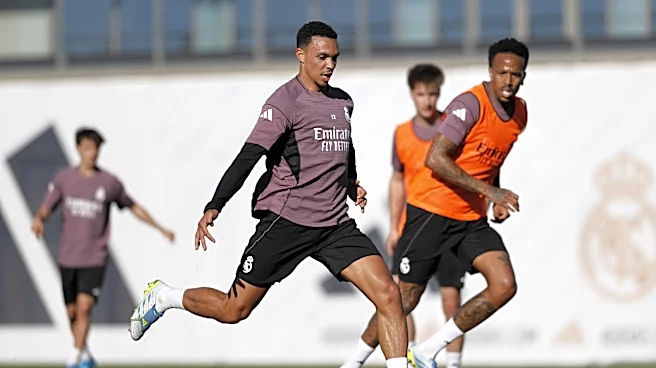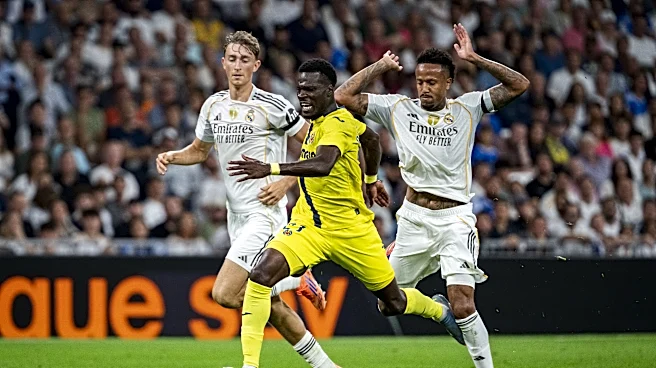

Éder Militão’s possible return from a four-month hamstring absence this weekend is, on the surface, a welcome boost to Real Madrid’s depth ahead of the Champions League quarter-finals. The more interesting question is what his return means beyond the immediate fixture list, and what it tells us about the defensive architecture Arbeloa is trying to build through the final months of the season and into next year.
The short answer: the plan internally is for Militão to establish himself alongside Dean
Huijsen as the first-choice pairing as soon as he can play consistent minutes. It’s what is emerging from the club, and when you look at the profiles of the players available, the squad decisions already made, and the contract situations in the back line, the data points in exactly the same direction.
Suiting Arbeloa’s system
Before ranking the options, it helps to understand what Arbeloa’s structure actually asks of centre-backs. His system operates from a 4-3-3 that shifts into a 4-2-3-1 in possession, with an emphasis on vertical progression, controlled pressing triggers, and rapid recovery of possession through proximity between lines. Compared to Xabi Alonso’s Madrid, Arbeloa’s defensive line sits at 43.2% of the defensive height, marginally deeper, but both coaches run what Mehedi Hassan’s data analysis described as mid-to-low block systems.
What Arbeloa’s version does ask for, though, is ball-playing ability under pressure and intelligent positional reading. That sounds like Dean Huijsen, a composed ball-playing centre-back who is equally as comfortable distributing the ball or progressing it himself.
In Arbeloa’s rotational structure, centre-backs are regularly used as distribution anchors. Güler’s switch to Rüdiger in the derby was a designed move to exploit Atlético’s slow lateral shifting. The centre-back in question needs to be capable of receiving under pressure and progressing quickly. That matters because it already starts to narrow the field.
Huijsen’s bounce back to form
In La Liga this season, Huijsen has played 1,589 minutes across 21 appearances, contributing two goals and two assists. Across all competitions, he’s racked up 32 appearances and 2,528 minutes, making him by some distance the most-used centre-back at the club this season.
The form across the back end of the season has been notably consistent. He played 90 minutes in both Manchester City legs, 90 minutes in the derby against Atlético, and produced one of his best performances against Benfica in the second leg. He has not missed a significant fixture when fit.
At 20 years old and under contract until 2030, he arrived from Bournemouth for approximately €58 million. His current Transfermarkt valuation sits at €65 million, a figure that has risen steadily since the season began. Real Madrid signed him knowing that he and Militão represented the intended long-term answer in central defence, with everything else a short-term arrangement around them.
The yellow card accumulation is one genuine concern. Five bookings and one red card in La Liga this season suggest a player still calibrating the line between aggression and discipline in a high-stakes environment. Earlier this season he struggled in certain big games, individual aerial duel losses against Atlético, a red card at the Club World Cup, moments of overconfidence, though the more recent run has been considerably cleaner.
Analytically, Mehedi Hassan’s pre-season profile of Huijsen drew close parallels between Huijsen’s distribution data from his Bournemouth season and David Alaba’s 2021/22 campaign at Real Madrid. His progressive pass distance and passes into the final third matched Alaba’s closely, with a notably higher volume of long passes, nearly double Alaba’s total, speaking to an instinct to play vertically and exploit space behind the press. That maps directly to the left-sided ball-player role Arbeloa’s system needs filled.
Former Real Madrid defender Manolo Sanchís praised Huijsen’s distribution and intuition while identifying aggressiveness in duels as the area most in need of development. “He has had some weaker matches against big teams, in which he struggled physically,” Sanchís said, “but his foundation is magnificent and I am convinced that he will become a very important player for Madrid in the coming years.”

A partnership we’re yet to see much of
Before making the case for Militão and Huijsen as Madrid’s long-term answer, it is worth being precise about one thing: the data on how they function together is thin. Their shared time on the pitch has been more limited than most coverage suggests.
Militão returned from his second ACL tear at the start of the season and was established as the intended first-choice partner alongside Huijsen from the opening weeks. He scored in the 2-0 win over Espanyol in September, one of the early matches the two started together. But the partnership was interrupted almost immediately. Militão picked up a groin strain during Brazil’s international break in late October and missed the Girona fixture, then returned briefly before suffering the more serious hamstring rupture against Celta in early December. Huijsen also dealt with his own injury issues through November, a knee problem that emerged after the Rayo Vallecano draw kept him out for several weeks, meaning Madrid were simultaneously without both intended starters for a significant stretch.
The upshot is that the Militão-Huijsen pairing has started only eight competitive games together. That makes any sample too small and too interrupted to draw firm tactical conclusions. But the stats do look positive. Of those, the Clásico win in October, highlighted as the peak of Xabi Alonso’s time at the club, and a 4-0 win over Valencia, and a 3-1 win over Villarreal, among the best performances of the season. They were Alonso’s clear first-choice pairing, starting against the likes of Atlético Madrid, Barcelona, Juventus and Liverpool, while both fit.
What does exist is qualitative assessment. Huijsen’s form was noticeably better with Militão beside him, and that Militão’s leadership gave the younger player the freedom to take risks and develop. When Militão went down in December, that stabilising dynamic disappeared, and Huijsen’s individual performances dipped in the weeks that followed. The former Bournemouth defender’s most difficult period this season, the spell against Liverpool, Sevilla, and others where he struggled in aerial duels and under physical pressure, coincided directly with having to carry defensive responsibility without that experienced presence beside him.
The design of the partnership was explicit before the season started: Militão’s aerial strength, pace, and duelling toughness were identified as the natural complement to Huijsen’s composure in possession. The theory is sound. The practice, so far, has been repeatedly deferred by injury on both sides.
What the next few weeks represent is less a reassertion of an established partnership and more the first genuine extended run the two will have together. Mallorca gives Militão competitive minutes to rebuild sharpness. If Madrid progress past Bayern, the semi-finals offer the first high-stakes test of whether these two actually function the way the profiles suggest they should. Until that sample exists, the Ramos-Varane comparison that has been floated in some corners of the Madrid press remains aspirational rather than evidenced. The data to test it has barely started accumulating.
Militão as the missing piece
Militão has suffered cruciate ligament injuries in consecutive seasons, in 2023 and 2024, before making his comeback at the start of this campaign. He returned strongly under Alonso and became a regular starter before the biceps femoris rupture in December against Celta ended a promising run.
The profile he brings is not easy to replicate: pace to cover large spaces behind the line, aerial dominance in both boxes, strength in duels, and the ability to defend at high tempo against technically sharp attackers. Those attributes complement Huijsen’s ball-playing composure directly, one reads the game and distributes, the other wins the physical contest.
Arbeloa has confirmed Militão will be eased in carefully and is unlikely to start either leg against Bayern Munich, but could be ready for the semi-finals if Madrid progress. That timeline is both cautious and logical. A player returning from a significant muscle injury needs competitive minutes to rebuild rhythm and confidence, and against Bayern’s pace and movement on the counterpress, a Militão who has played 20 minutes across four weeks carries genuine risk.
The smart use of this period is Mallorca, Girona, the Alavés fixture on April 22, lower-stakes matches where he gets 60 minutes, then 75, then 90. By the time the semi-finals arrive, if Real Madrid make it past Bayern Munich, he has a month of competitive preparation behind him.
The Rüdiger transition
Antonio Rüdiger has done more for Real Madrid since arriving on a free transfer from Chelsea in 2022 than many perhaps give him credit for. He won La Liga and the Champions League, provided reliable cover through two consecutive Militão absences, and has been a significant presence in the dressing room. MARCA described him as having built a “big brother” relationship with Huijsen specifically, helping the young Spaniard understand the demands of playing for Real Madrid.
At 33, with his contract expiring in the summer of 2026, Real Madrid are not planning to extend it according to multiple reports, with Rüdiger set to leave as a free agent. The club has already begun exploring defensive alternatives for the future, and the decision reportedly follows a series of physical setbacks that have limited his influence this season. Alonso before his departure showed faith in Militão and Huijsen as the preferred pairing, with Rüdiger increasingly on the margins, and Arbeloa looks likely to follow that same approach
Rüdiger has managed only 906 minutes in La Liga this season across 12 starts. Those are the numbers of a player performing adequately in a reduced role, not a player making a case for a contract extension. His value to Arbeloa now is as cover for the run-in and the experience he brings to a still-developing back line. Beyond June, the expectation is that he leaves.

Asencio and the third option
Raúl Asencio has held the line when both Militão and Rüdiger were unavailable, and done so without embarrassing himself. He was listed as a minor doubt for Mallorca after a muscular problem but is expected back in the squad, and has featured regularly enough this season to be considered a genuine third option going forward.
He is seen internally as a long-term piece, which suggests the club views him as Militão and Huijsen’s backup once Rüdiger departs. Whether Arbeloa has enough confidence in him to start him in a Champions League tie against elite opposition is a different question, his minutes in the biggest games have been limited, and the Bayern fixtures are not where that question gets answered.
There are growing concerns about his attitude off the field, famously being the last one to leave a recent team meal at almost 3am, and his form this season has shown that he lacks the elite level of quality that Real Madrid demands. But he fills a role, much like Nacho has in the past, of a homegrown and versatile player who his coach can count on, and who his team can rely on to get the job done.
Long-term vision
Reports earlier this season linked Real Madrid with Liverpool centre-back Ibrahima Konaté, described as a primary transfer target, as well as Borussia Dortmund’s Nico Schlotterbeck. Schlotterbeck has been highlighted as a realistic option: 26 years old, left-footed, which would make him a natural partner for Militão, and valued at around €50 million by Borussia Dortmund. While those reports have quietened in recent months, it seems that more depth is needed. An injury to Huijsen, Militão, which seems likely given his recent record, or Asencio could leave the squad looking thin after David Alaba and Antonio Rüdiger depart in the summer. The question lies in what the club are looking for: a proven starter, or a squad filler.
That context frames the remaining months of the season as something beyond just a title race and Champions League run. Militão coming back fit and forming a genuine partnership with Huijsen before the summer gives Arbeloa, or his successor, hard data on whether the long-term plan holds, or whether the club needs to accelerate a possible Schlotterbeck or Konaté pursuit.
The Militão-Huijsen pairing is the answer to the question of who plays centre-back for Real Madrid going forward. Getting both of them through the next eight weeks without a further injury setback, playing consistently and together, is the central defensive challenge of the season’s end, and one the squad structure has been trying to resolve since August.