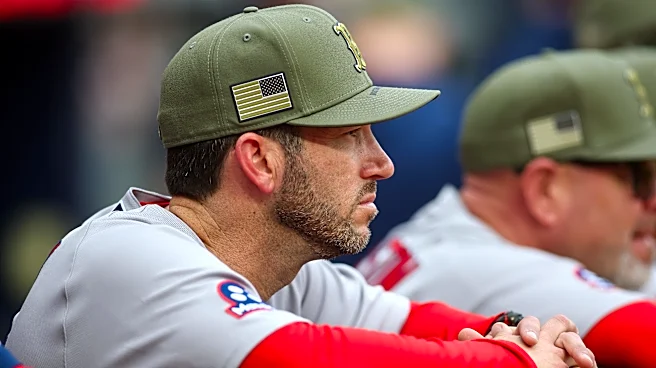





Chad Tracy stepped into this role with an interesting résumé. Years developing hitters in the Red Sox minor league system, building lineups with pieces that weren’t quite ready for prime time. Now he’s doing it in the majors, where the margin for error is different and the stakes are real. The early returns: 23 games, a 12-11 record so far.
That record doesn’t tell the whole story, though. The offense hasn’t improved. Not even close. Boston is only averaging 3.14 runs per game under Tracy vs. 4.15
under Alex Cora in the 2026 season. The team hasn’t gotten better at scoring. It’s gotten better at not giving games away, and the pitching deserves most of that credit.
But lineup construction is more of a story here than it might look at first. A lot of what Tracy has done looks similar to what Cora was doing—but the things that are actually different have fundamentally changed how this team operates on a nightly basis.
To understand the difference, I scraped every Red Sox game from Baseball Reference and ran the data through some pretty intense Python. A little caveat; the following analysis covers 49 games through May 21st, just before the start of the Twins series last night.
The clearest finding isn’t about who Tracy puts in the lineup. It’s about what they do once they’re in there.
Both managers shuffle the lineup constantly. Tracy has written 21 different lineups in 22 games. Cora wrote 26 in 27. Neither of them was the stability guy: something changed almost every night.
What’s different is how they shuffle. Under Cora, the same group of players appeared in wildly different spots in the order from game to game. A guy who hit fifth on Tuesday might hit second on Wednesday and seventh on Friday. Under Tracy—when a player is in the lineup, he tends to know where he’s hitting. Tracy changes who’s in the lineup more than he changes where his regulars hit. For some players, that consistency has made a real difference. For others, the consistency is the problem.
Re-Establishing The Top Of The Lineup
No player’s deployment tells the Tracy story more clearly than Jarren Duran’s.
Under Cora, Duran bounced around—second, third, fourth, fifth, and only four games in the lead-off slot. To measure how scattered that was, we calculated a consistency score for each player: a number that captures how all-over-the-place a player’s lineup spot has been across the season. A score of zero means they’ve batted in the exact same spot every single game. The higher the number, the more random their placement has been. Duran’s score under Cora was 2.4. That’s high. Cora never really made up his mind about where Duran fit.
Tracy made up his mind on day one. Duran has batted leadoff in virtually every game since Tracy took over, and his consistency score has dropped to 0.27—basically as close to zero as you’ll see from any player on any team mid-season. Genuinely—with the exception of one game in late April where Duran was put seventh in the order and a sporadic off day here and there—Tracy has looked at Duran, put him first, and hasn’t blinked.

Duran’s overall OPS is .562 on the year. That’s not great for a leadoff hitter. Tracy isn’t rewarding performance here; he’s making a bet. Get your most disruptive presence on base first, let him cause problems at the top, and build from there. Lately, that bet is looking smarter. Duran has started to find his groove over the recent stretch of games, looking more like the hitter who earned this role in the first place. Whether you agree with Tracy’s reasoning or not, it’s a real, committed decision. Cora never quite got there.
Pushing The Problems Down
Under Cora, Durbin averaged the six-hole in the lineup and was a regular presence across 24 starts. Under Tracy, he’s been sliding steadily toward the bottom of the order. He’s now averaging closer to the 8-hole, and the movement has been consistent enough over several weeks that it’s clearly not random. His OPS is .372. That number tells you everything about why. I wrote earlier this season about Durbin’s bat speed being akin to rolling up a newspaper to swat a fly. That hasn’t exactly changed and Tracy is putting him in a position that feels a lot more comfortable for the shape of this team and hopefully for Durbin’s development.

Trevor Story is a different kind of story. Under Cora he was a middle-of-the-order fixture around the cleanup spot. Story was clearly relied upon under Cora to be a leader and was depended on for his slot in the order—regardless of what ownership seems to think. Under Tracy, he’s floated between fourth and eighth: still in the lineup when healthy, but clearly no longer trusted with the big RBI spot he occupied earlier in the season. Story’s Win Probability Added has been the worst on the roster by a significant margin. He’s cost this team more in high-stakes moments than any other hitter. Story last started on May 14 and is now on the injured list until at least July. How much of his previous poor form is due to this sports hernia? Who’s to say.
The bottom of the order under Tracy is where problems go to do the least possible damage. That’s not an insult — it’s just how you manage a roster when you don’t have the depth to hide anything. Durbin gets buried. Story floated downward. And the guys who can actually hit get pushed up.
He Actually Thinks About Matchups

Here’s something that doesn’t show up in the box score: Tracy has written a noticeably different lineup depending on who’s starting on the mound for the other team.
The sample is small, just five games against left-handed starters under Tracy versus seventeen against righties; treat these as trends to watch rather than definitive patterns. Still, the direction is clear enough to be worth discussing.
The biggest mover is Andruw Monasterio. Against RHPs, Monasterio has averaged the sixth or seventh spot in the lineup. Against lefties, he jumps up more than two full spots, closer to the cleanup area. Tracy is using him more as a lefty specialist, recognizing that a right-handed hitter with that kind of flexibility is most valuable when the matchup actually calls for it. See his start on Friday night as DH against southpaw Connor Prielipp as some good evidence there.
The flip side is Isiah Kiner-Falefa. Against righties, he bats around sixth. Against lefties, Tracy buries him ninth. If you know the splits, the reason is obvious. Tracy clearly knows his splits.
Ceddanne Rafaela also bumps up in the order against left-handed starters on average, though the signal is softer than Monasterio’s. Tracy is thinking about the opposing arm when he writes the card.
The One He Still Hasn’t Figured Out
Rafaela’s overall deployment is the honest counterpoint to all of this.
He’s starting almost every game—19 of 22 starts under Tracy—which tells you Tracy values what he brings. But the lineup keeps moving him around without a clear pattern beyond the broad lefty-righty adjustment above. He’s batted fifth, seventh, sixth, eighth, and third. There’s no real home. His consistency score is the second-highest on the roster, meaning he’s more unpredictably placed than almost anyone else in the lineup. He started in the two-hole on Friday in Boston, the first time under Tracy and the fourth time this season. His chaos read in the lineup is all over the place. If Tracy is starting to think of him as a top-of-the-order option against lefties, that’s something to keep an eye on.
Some of that is the nature of who Rafaela is — his defense in center field is good enough that he earns his spot regardless, and Tracy probably has more freedom to move him around because of it. But you get the sense Tracy hasn’t fully decided what offensive role he wants Rafaela in. A consistency score that high doesn’t lie. It means no one knows where he’s batting tomorrow, including the manager.
Mickey Gasper is a footnote worth mentioning in all of this. He didn’t exist in Cora’s lineup—every one of his eight starts has come under Tracy, and he’s been one of the more interesting stories of this stretch. He’s slotting mainly into the 2-hole and posting over a 1.000 OPS. If that holds, Tracy’s going to have to account for him when the roster gets more crowded. Again, is this a product of Tracy coming from Worcester, knowing these AAA regulars better, and having faith about their usage in Boston? Still not enough sample size there to know for sure.
The Lineup Is About To Get A Lot More Complicated
The lineup Chad Tracy will write in July is going to look almost nothing like the one he’s been writing in May. And the decisions waiting for him are legitimately hard ones.
Roman Anthony is the most pressing. He hasn’t started since May 4—14 straight Tracy games missed with his wrist injury—but he’s expected to be the first of the big injured pieces to return. Before this, in the eight starts Anthony made under the new skipper, he batted third seven times and first once. That’s a clear answer about how Tracy sees him. Under Cora, Anthony was essentially the leadoff hitter. That role belongs to Duran now, and it’s not changing when Anthony comes back. The realistic lineup when Anthony is healthy: Duran leading off, maybe Rafaela or a platoon hitting second (we’ll see if Micky Gasper isn’t the first send down back to Worcester at that point in time), Anthony third, Abreu fourth. That’s a real top of the order — and it could come together before the end of June.
Trevor Story is more of a July problem. He’s out until at least then, and honestly, the lineup has been fine enough in his absence given where his numbers were. Whoever fills that spot in the meantime isn’t going to match Story’s name value. They might match his actual production without too much trouble. The more interesting question is what Tracy does with Story when he comes back healthy. Does he reclaim a middle-of-the-order spot on reputation? Or does the data — and Tracy — say otherwise?
And then there’s Triston Casas, who hasn’t appeared in a single game this season. More setbacks in his recovery but he is still contractually obligated to this team. If and when Casas comes back, Tracy has a real decision at first base. Contreras has been the team’s best run-producer this season—10 home runs, solid OPS, 1,000th career RBI, and he’s been doing it at first. You can’t just bench Contreras. But you also can’t ignore what Casas is when healthy. Of the three injured pieces, Casas likely comes back last, which at least gives Tracy some runway before he has to make that call. Even for Conteras, the return of Anthony puts him in a pickle. Is he the five hole man, does he get starts at the two spot, does he shuffle everyone else and stay as the cleanup hitter he’s been in the past week? These are good problems to have, but still hard ones to make.
Chad Tracy has spent 23 games making real decisions and mostly making smart ones. He committed to Duran at the top, buried his problems at the bottom, and genuinely understands his roster enough to make the right tweaks facing lefty vs. righty starters. He responds to what’s in front of him. That’s a coherent approach and the record reflects it.
But the roster he’ll manage in July won’t be exactly the roster he has today. And the decisions he makes when the pieces come back will tell us a lot more about what kind of manager he actually is.