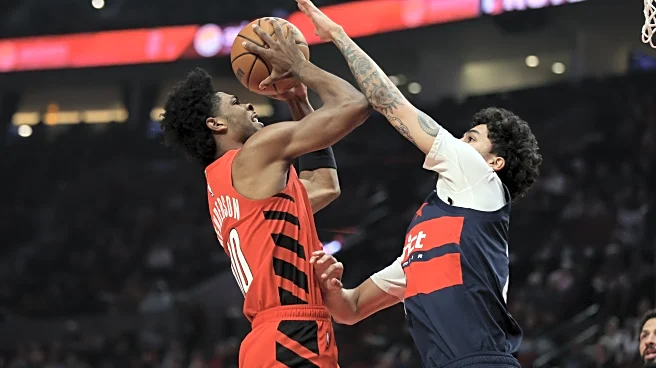




The Wizards got utterly blasted by the Portland Trail Blazers, trailing by as much as 39 before finally losing by 34. While the score was close into the second quarter, there was no point where the game felt truly competitive. Once again, it felt like when Portland started making the abundant open looks they were getting, the margin would expand. And it did. Like a mushroom cloud.
At one point in the second quarter, the Wizards were 1-9 from three-point range, and Portland was 0-10. Washington shot
4-13 (30.7%) the rest of the way. The Trail Blazers: 12-26 — 46.2%.

This kind of outcome was mostly to be expected. They started the “Tank Towers” of 6-9 JuJu Reese in the middle with Tristan Vukcevic alongside. Despite pairing two “centers,” the lineup was thoroughly incapable of contending with Portland’s size and athleticism.
That deficit was matched on the perimeter where the Wizards were unable to stay in front of opposing ball handlers or even direct penetration to a spot where they’d at least theoretically have help. Oh yeah, they also missed lots of rotations, over-helped, and ball-watched. All stuff they’re working on, of course, but there are serious talent deficits, even when the roster is at full strength. And they’re not at full strength.
It was one of those “almost no one played well” kind of butt-kickings. The closest guy to “good” was probably Will Riley, and I thought he was only okay.
Leaky Black had what was probably his best game as a pro (8 rebounds, 4 on each end) in 22 minutes, though I was once again appalled by his defense.
Bright side: the Wizards get the Los Angeles Lakers Monday night and then get to go home to take on the Philadelphia 76ers later in the week.
Brighter side: Only eight games left in the season.
Thoughts & Observations
- It was an absolute treat to watch the Portland broadcast. Kevin Calabro is excellent on play-by-play, and Lamar Hurd is one of the best analysts around. Tom Haberstroh is a fully integrated provider of meaningful and interesting stats and analysis. Brooke Olzendam is good in the courtside reporter role. They also do some fun things with graphics — putting up numbers and then having them “sticky” on the stands so that they pan to the side as the camera follows the action. The Wizards could do worse than copy the format with good people.
- Recurring entry in last night’s notebook: Clingan overpowers JuJu. It happened on the boards and inside. On several possessions in the third quarter, Reese sought to attack inside. Clingan erased the shots repeatedly while barely leaping. He was just that much bigger and stronger.
- Yes, that preceding bullet is something of a subtweet who thinks Reese is any kind of roster solution for next season. I like that he’s competitive and plays hard, but he’s not big enough, strong enough, athletic enough, or skilled enough to play in the middle.
- One more on Reese: I had some notes in the first half about Bilal Coulibaly having a brutal game. One of the big reasons — Portland bigs didn’t have to defend Reese away from the basket. They ignored him, let him set screens and then waited in the lane for Coulibaly (or whoever) to drive. I think Reese could be an interesting high-post passing hub, but he has to be able to shoot well enough to bring the big out from under the basket. Otherwise, the lane is clogged, and he’s just dishing to teammates for contested midrangers and worse.
- Any regular reader knows I’m not a fan of midrange field goal attempts, except when necessary. Bub Carrington is getting close to “exception” range. For the season, he’s inching closer to 50% on two-point attempts outside 10 feet, which is pretty dang good. He’s also around 40% from three this season. I have some issues with his game, but his shooting has become a strength.
- At the 6:20 mark of the first quarter, Deni Avdija just trucked Vukcevic on a drive. On the court, the refs called it an offensive foul, which was the correct call. Portland challenged and the officials reversed the call upon review. I think they more or less applied the rule properly, but the rule itself is bad. Vukcevic beat Avdija to the spot, Avdija veered into him and blasted him into the stanchion. Calling what Vukcevic was doing “still in motion” is an absurdity that gives way too much advantage to the offensive player.
- Riley was okay overall, but had a lot of trouble attacking when Toumani Camara was defending.
- The Wizards needed a three on the final possession to get to 15 points in the 1st quarter. According to Haberstroh, that was the fewest scored in a quarter against Portland this season.
- Another cool stat from Haberstroh — he reported on a Damian Lillard workout the previous day in which Lillard shot 1,000-1,090 from three-point range. That’s 91.7%. From three-point range.
- One more from Haberstroh — he said Camara leads the NBA in defensive miles covered. Camara is approaching 100 miles for the season, a feat he achieved last season, as well.
- The game ended weird. Yang Hansen and Reese got double technicals with 28 seconds remaining and Portland up by 34. The Portland big boxed out Reese, Reese apparently didn’t like it much. He put Hansen in a kind of half nelson, at which point Hansen went limp, at which point Reese dropped him to the floor.
- A few seconds later, Sharife Cooper decided he absolutely had to get a steal while Portland was trying to run out the clock and committed a foul instead. And then complained (a lot) to ref Bill Kennedy, whose body language said he just wanted the game to end.
- This was Washington’s worst offensive game of the season, by the way.
Four Factors
Below are the four factors that decide wins and losses in basketball — shooting (efg), rebounding (offensive rebounds), ball handling (turnovers), fouling (free throws made).
The four factors are measured by:
- eFG% (effective field goal percentage, which accounts for the three-point shot)
- OREB% (offensive rebound percentage)
- TOV% (turnover percentage — turnovers divided by possessions)
- FTM/FGA (free throws made divided by field goal attempts)
Stats & Metrics
PPA is my overall production metric, which credits players for things they do that help a team win (scoring, rebounding, playmaking, defending) and dings them for things that hurt (missed shots, turnovers, bad defense, fouls).
PPA is a per possession metric designed for larger data sets. In small sample sizes, the numbers can get weird. In PPA, 100 is average, higher is better and replacement level is 45. For a single game, replacement level isn’t much use, and I reiterate the caution about small samples sometimes producing weird results.
POSS is the number of possessions each player was on the floor in this game.
ORTG = offensive rating, which is points produced per individual possessions x 100. League average so far this season is listed in the Four Factors table above. Points produced is not the same as points scored. It includes the value of assists and offensive rebounds, as well as sharing credit when receiving an assist.
USG = offensive usage rate. Average is 20%. Median so far this season is 17.7%.
ORTG and USG are versions of stats created by former Wizards assistant coach Dean Oliver and modified by me. ORTG is an efficiency measure that accounts for the value of shooting, offensive rebounds, assists and turnovers. USG includes shooting from the floor and free throw line, offensive rebounds, assists and turnovers.
+PTS = “Plus Points” is a measure of the points gained or lost by each player based on their efficiency in this game compared to league average efficiency on the same number of possessions. A player with an offensive rating (points produced per possession x 100) of 100 who uses 20 possessions would produce 20 points. If the league average efficiency is 115, the league — on average — would produced 23.0 points in the same 20 possessions. So, the player in this hypothetical would have a +PTS score of -3.0.
Players are sorted by total production in the game.