



#1 – Ball-movement vs. Iso-ball
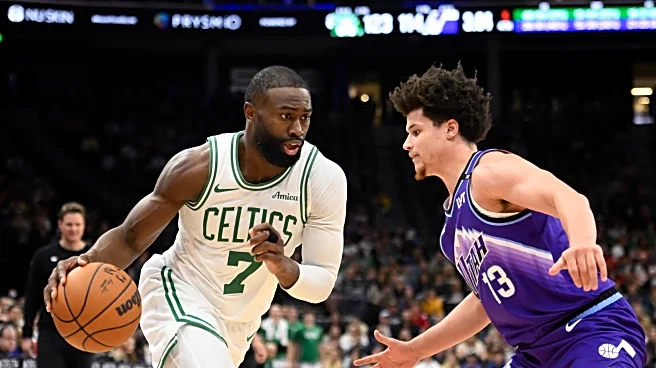
Entering the game, the Boston Celtics and the Utah Jazz were perfect opposites when it came to ball movement. While Joe Mazzulla’s offense generates the lowest volume of assists in the league, with a 55.6% assist rate, Will Hardy’s team sits at the very top.
Over the last month, they have been two of the hottest teams on offense. The Celtics are the best offense in the league in December, with 126 points per 100 possessions, while the Jazz are not far behind at 120 points per 100 possessions (6th
in the league).
Nonetheless, over the course of the season, the Jazz have struggled to remain consistent on offense and do not yet belong among the league’s elite attacks… despite a very impressive level of ball movement. It is interesting to notice how, across the league, the teams with the highest assist rates are not necessarily the ones posting the best offensive performances.

#2 – Attacking Jusuf Nurkic lack of mobility
One of the Celtics’ offensive strategies in this game was to attack Nurkic’s positioning and lack of mobility. As he is the biggest body on the floor for the Jazz, and given his age, the Celtics wanted to keep him close to the rim and force him to move as little as possible.
The first way they took advantage of that was through Payton Pritchard’s pull-up game. In the play below, Pritchard uses Neemias Queta’s screen twice to generate separation. Nurkic is matched up with Queta, which naturally creates a gap in the defense as he stays low.
And when Pritchard chooses the drive instead of the pull-up, it creates even more problems for the Jazz defense. The big man is stuck between PP and Queta and can only try to disrupt the play, but the verticality and the pass are too good to be stopped.
White and Garza were also able to take advantage of Nurkic using the same approach, and watching this game, it makes sense why the Jazz are one of the worst defenses in the NBA.
Yet, the Jazz actually won the minutes with Nurkic on the floor — how? Because while the Celtics were exposing his lack of mobility, he was simultaneously taking advantage of the Celtics’ defensive lapses.
#3 – Nurkic displaying Boston defensive limitations
The Bosnian big man scored 26 points on just 11 shot attempts, while adding 8 assists in 34 minutes. Despite being one of the slower players on the court, he repeatedly found space at the rim in the middle of the Celtics’ defense.
The screen navigation from the guards and wings, combined with Queta’s questionable positioning on some of these plays, was just enough for the veteran big man to attack the rim whenever he wanted.
The lack of off-ball awareness from Jaylen Brown also remains an issue on defense. This play shows it clearly, as he fails to recognize that he is the low man and supposed to be the safety at the rim. The Celtics are conceding +7.7 points per 100 possessions when JB is on the court, one of the worst defensive impacts in the NBA.
Overall, this game against Nurkic was a good reminder that the Celtics need both a center and Jayson Tatum back to perform at a high level defensively. As JT is often tasked with defending big men while the center roams the paint, his return is much needed to turn the defense around.
Nurkic may have exposed a collective issue, but this game also highlighted an individual defensive limitation, despite strong physical tools: Jordan Walsh.
#4 – Utah Jazz exposing Walsh defensive problems
The young Celtic impressed many observers early in the season with his on-ball defense and stamina. However, on-ball defense is only one part of the job. More often than not, your matchup does not have the ball, and you must stay connected, read the game, and navigate screens — all areas where Walsh still struggles.
With Keyonte George being quick, loving give-and-go actions, and frequently using screens, it was a nightmare matchup for Walsh, who could not keep up with the young guard. He was often late on his reads and got stuck on screens, creating gaps in the Celtics’ defense.
The Jazz quickly identified this and kept him in motion, asking George to move constantly off-ball to beat his defender and create open looks. Overall, when Walsh was on the court, the Jazz posted a 142 offensive rating and generated the shots they wanted. That explains why Walsh played only 13 minutes despite starting the game.
#5 – Derrick White rim protection
While most Celtics struggled defensively, one player stood above the rest: Derrick White, the Celtics’ best rim protector.
With seven blocks, he helped Boston create separation against the Jazz. But beyond the blocks, D-White has been among the best rim protectors in the NBA all season. Based on NBA.com tracking data, he has a similar impact to Anthony Davis or Luke Kornet on shots defended at the rim.
On more than five shots defended at the rim per game, opponents see their field-goal percentage drop by 10%. That is better than Jaren Jackson Jr. or Neemias Queta.
#6 – Jaylen Brown passing
Another 10-assist game for JB this season. Three of them stood out in particular.
The first came out of a pick-and-roll where he did everything right: using the screen, putting the defender on his back, attracting a second defender, and delivering a beautiful pass at the rim. Sheesh.
The second might look basic, but it shows a smart off-ball read and a willingness to pass as a connector. Great positioning in the dunker spot to find Queta at the rim when he flashes.
The last one, which gave the Celtics an 11-point lead, came from a great read in the post. He got the mismatch he wanted, attracted three defenders, stayed patient, and found Anfernee Simons open in the corner.
#7 – Ram and replace to open the 3rd
After halftime, the Celtics found a way to expose the Jazz defense by running the same play twice in two minutes.
The action starts with White setting a ram screen for Queta, before Queta flips into a ball screen. As the play develops, White replaces himself to the perimeter, and his defender gets caught staying low. When D-White receives the ball, he has enough space to attack and find his shot.
They ran it again two minutes later and generated a finish at the rim for D-White.
#8 – Payton keeps finding his spots
Offensively, Payton was outstanding at getting to his spots. From around the free-throw line, he is deadly, shooting 58% from that zone.

And it felt like he could reach that area on demand. Against the Jazz, he did it against smaller defenders like Isaiah Collier and bigger bodies like Tyler Hendricks.
The speed, the strong and controlled dribbles, the footwork — it feels like he keeps getting better. His ability to find solutions against all types of defenders is impressive.
The only issue with this offense is how much it relies on shot-making. Even at 58.5%, that zone only generates 1.17 points per shot, which is far less efficient than attempts at the rim.
#9 – Derrick White last 12 minutes
At times, D-White looks like the best player on the team. Last night’s fourth quarter was another example. In a tight game, he delivered on both ends with two blocks, 13 points, and an assist. Even late in the game, the hustle was still there, as he kept fighting for offensive rebounds.
#10 – Anfernee Simons offensive impact
BOOM. Twenty points in 27 minutes, a +27 on the floor, and four assists — hard to ask for more from a guard off the bench. His shooting remains the biggest strength of his skill set, perfectly suited to create space for ball-handlers and punish defensive collapses.
He does not bring much collective creation, but this pindown action clearly exploits his offensive strengths and can get him going on an empty side.
Still, it remains fair to wonder whether this role and impact will translate when the playoffs start.