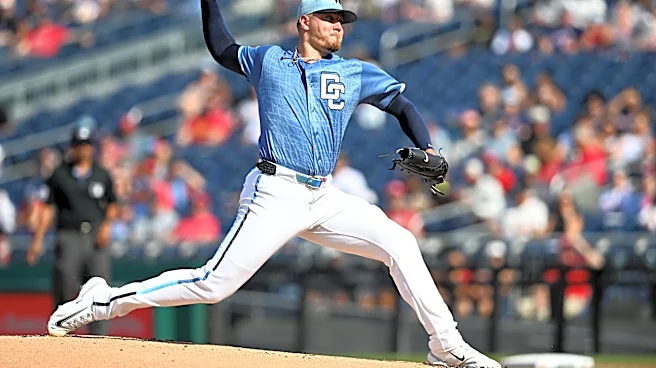

Ever since Max Scherzer left the team at the trade deadline in 2021, Nationals fans have been waiting for an ace to emerge. For years, we were holding out hope that MacKenzie Gore would be that guy. He showed great things early in seasons but would inevitably fall apart. Once he was traded, it was on to the next guy in the hunt for an ace.
Heading into this season, our hopes hinged on Cade Cavalli, a 27 year old who had only made 11 career starts. Despite his inexperience, Cavalli was named the Opening
Day starter due to his high potential. This season, Cavalli rewarded the team’s faith and emerged as a true front of the rotation arm.
Talent has never been the issue for Cavalli. He was drafted in the first round in 2020 out of Oklahoma due to his electric arm talent. Cavalli established himself as a top prospect and made his debut at the end of the 2022 season. However, that is where the trouble began.
During Spring Training of 2023, Cavalli had to undergo Tommy John Surgery. He missed all of that season and only threw 8.1 innings in 2024 due to a litany of setbacks. After struggling in AAA to begin 2025, Cavalli looked like damaged goods.
However, he ended his season on a positive note, making 10 solid starts in the big leagues. His 4.25 ERA and 1.48 WHIP was not anything special, but he was averaging 97 MPH with a nasty curveball. Even if the results were not there, you could see the vision.
During Spring Training, it became very clear that the new regime was tantalized by Cavalli’s potential. Blake Butera talked about how special he could be and he quickly was named the Opening Day starter.
It is easy to forget now, but for the first three months of the season, Cavalli was fine but not elite. After his June 25th start, Cavalli had a 4.00 ERA and was averaging under 5 innings per start. He was not having a bad season by any means, but he was far from elite.
The turning point came during his June 30th start against the Red Sox. Of course, that was the infamous ‘sit down boy’ game. In that contest, Cavalli struck out 13 hitters, allowed just 1 hit and got 25 whiffs. He looked like a dominant force at Fenway Park that night.
His role in starting that brawl put him in hot water, but the way Cavalli handled that was impressive. He seemed genuinely remorseful and handled the aftermath of that situation as well as he could have. It also did not stop him from going forward with his season.
In his last 15 starts of the season, Cavalli went 9-1 with a 2.08 ERA, striking out 111 hitters in 86.1 innings. He made the leap from solid big league starter to staff ace. As the season went on, you could just see that confidence growing each time he took the ball. Cavalli performed like an ace on the field, but also carried himself like one.
His nasty stuff and leadership were rewarded with an extension at the end of the season. The Nats and Cavalli agreed to a 4-year deal which has a club option for a 5th season. After all the injury set-backs Cavalli has faced, that had to be an awesome moment for him. It was also great to see the team lock up a rising star.
We have talked a lot about his story and rise to prominence, but now I want to dive into the data. For the season, Cavalli finished with a 3.02 ERA and an even 200 strikeouts in 169.2 innings of work.
His underlying numbers were also stellar, with a 3.25 FIP, a 3.67 xERA and a 3.13 xFIP. From a value perspective, Cavalli had 3.9 fWAR and 3.7 bWAR. The strikeout and walk numbers were also phenomenal. Cavalli struck out 28.3% of hitters while only walking batters at a 6.8% clip.
When you look at his pitch mix, Cavalli made a couple big changes. The first one was adding a sweeper to go with his already fantastic curveball. His sweeper gave Cavalli a new weapon, particularly against right handed hitters, who he struggled with in 2025. Cavalli’s sweeper is a hard one, averaging over 86 MPH. It also had much more drop than your average sweeper because he throws it similarly to his curve.
The hard sweeper is a pitch that has been really successful for big name starters this year, and Cavalli is part of that trend. Gavin Williams and Jesus Luzardo are a couple other high end arms with high velocity sweepers. Batters hit just .115 with a 37% whiff rate against the Cavalli sweeper.
One change that coincided with Cavalli’s quantum leap was an increase in cutter usage. The cutter was a pitch Cavalli had thrown in the past, but he did not use it much in the beginning of the season. However, he started throwing it more starting in that Red Sox start. He threw it about 12% of the time from July onwards.
The cutter on its own is nothing special, but it mixed well with his other pitches. It also gave him an offering he could consistently throw in the zone. With these new weapons, Cavalli had all the answers.
Those new weapons are cool to talk about, but another big part of his rise was an improvement in command. In the second half of the season, Cavalli walked less than 6% of hitters and was executing at an extremely high level. It felt like he could put pitches wherever he wanted.
When I watch the playoffs this year, I am confident that Cavalli can thrive in that environment. He has the stuff, command and moxy to succeed against the best hitters. We saw that in his biggest matchups this year. When the lights got bright, Cavalli was at his best.
With that extension, we now know that Cavalli will be a National long term. That is great news because he pitched like an ace down the stretch. If that is what he looks like moving forward, Cade Cavalli could challenge for Cy Young’s. It is so great to finally have a horse at the front of the rotation.
Season Grade: A+