







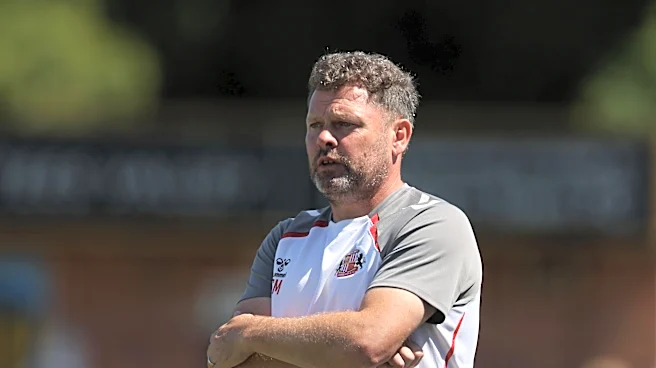



It’s always a bitter pill to swallow when one of our own leaves the Academy of Light, but Harrison Jones’ permanent move to League One side Peterborough United is a classic case of the right move at the right time.
The 21-year-old midfielder, a boyhood Sunderland fan who joined the club at the age of six, has put pen to paper on a three-year contract with Posh. Sunderland smartly triggered a 12-month extension to his contract earlier this summer, ensuring the club secured an undisclosed fee and a crucial
sell-on clause rather than losing him for nothing.
But what does this departure say about his chances of ever truly breaking through on Wearside, and how does it impact Régis Le Bris’ squad?

If we are being completely honest, the writing has been on the wall for a little while, despite Jones’ undeniable talent.
Jones leaves having made seven senior appearances for the Black Cats, including captaining the Under-21s to the Premier League Cup final. He got his taste of first-team football with a debut against Preston in 2024, an FA Cup start against Stoke, and a memorable league debut in a 2-1 win over Sheffield Wednesday.
However, Sunderland’s rapid trajectory has fundamentally changed the landscape for academy prospects. With the club preparing for a demanding season, balancing the Premier League and Europa League, the bar for central midfield minutes has risen exponentially. When you have the likes of Chris Rigg breaking through as a generational talent and the club actively recruiting senior European-level quality, the bottleneck for a 21-year-old needing regular football has become almost impassable.
Jones is a highly gifted technical footballer, but he has reached an age where standard Premier League 2 football is no longer serving his development. To truly kickstart his career, he needed to leave the nest. Peterborough United, renowned for developing young talent and playing expansive football, is an absolutely perfect landing spot for him.

In terms of on-pitch depth, Le Bris won’t be scrambling to replace Jones’ minutes, as those were already heavily restricted. However, the biggest impact of his departure will be felt in the dressing room and on the training pitch.
Nothing encapsulates his impact on the club’s daily culture better than the glowing tribute paid to him by Luke O’Nien just days before the transfer was finalised:
“The parts about Harrison Jones that no one will see, that fella’s obviously incredible. The last two years he’s been one of the most consistent trainers in the first team every single day. When you don’t play, the culture goes to those sorts of people.
“His level that he’s set, he’ll never get the plaudits at this football club, but I know inside how important he is to this club. All the boys know it. I can’t wait to see his career kick on. He’s an unbelievable player, incredible. He’s been one of the most proudest things… seeing Jonesy, the way he’s just matured over the last two, three, four years, the person he’s become, plus the footballer, that means more.”

Looking ahead to Sunderland’s European adventure, Jones’ departure introduces a complex administrative headache regarding UEFA’s stringent squad registration rules.
At 21 years old, Jones was reaching the threshold where he would soon occupy a definitive senior spot. By letting him go, Sunderland risks running short of the required four club-trained senior players. If a club cannot fulfil this specific quota, UEFA does not allow them to substitute those spaces with other players. Instead, the maximum squad size is reduced. Losing Jones means Régis Le Bris might be forced to name a shortened 24 or 23-man squad for the Europa League group stage.
This raises a tough philosophical question: should Sunderland have kept Jones around simply to act as a “homegrown barcode” on a UEFA spreadsheet?
The short answer is no. Retaining a young player’s registration purely to satisfy administrative criteria, with no genuine intention of giving him meaningful minutes on the pitch, is counterproductive to the club’s cultural ethos. As Luke O’Nien highlighted, Jones’ greatest value was his outstanding professionalism and training standards. Forcing a player of his character to stagnate as an emergency backup just to fill a bureaucratic quota would have been unfair to his career development.
While a shortened Europa League squad poses a logistical challenge for Le Bris in managing fatigue across domestic and continental campaigns, allowing Jones to kickstart his career at Peterborough remains the ethically and sportingly correct decision.
All the best, Harrison!