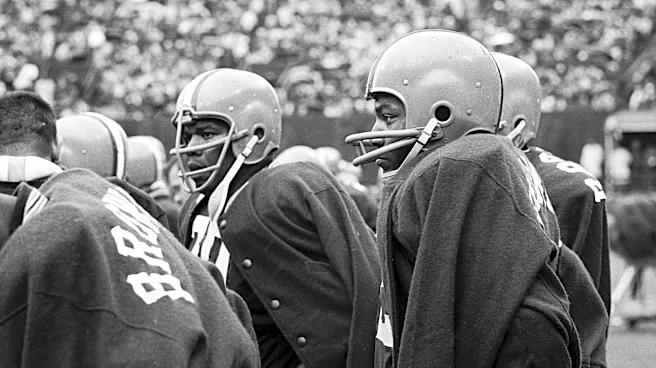





The Cleveland Browns captured the 1964 NFL Championship by defeating the #1-ranked Baltimore Colts 27-0. The game was standing room only at Cleveland Municipal Stadium, which has 78,000 seats. The attendance was announced at 79,544. Fans were standing along the end zone lines and in every crevice of the venue.
The Colts came into the game as 17-point favorites. The score at halftime was 0-0, which means the Browns erupted in the second half for all of the game’s points. WR Gary Collins hauled in three
touchdown passes and was voted the game’s MVP.
RELATED: 1964 BROWNS OT ROGER SHOALS INTERVIEW
John Brown was a right tackle for the Browns in the 1964 NFL Championship Game.
The Browns have eight pro football championships, tied for the third most with the New York Football Giants. The Green Bay Packers have 13 titles while the Chicago Bears have won nine. The 1964 club was the last championship team in Cleveland.

In that 1964 season, Cleveland had gone 10-3-1 in the Eastern Conference, one game ahead of the St. Louis Cardinals, who finished 9-3-2. Meanwhile, the Colts crushed everyone en route to a 12-2-0 record in the Western Conference. Back then, the league was devoid of a playoff system, so the winners of each division, labeled “conferences,” were placed in the NFL Championship Game, with the winner named “World Champions.”
Offensive tackle John Brown came to the Browns as a fourth-round draft pick after a good career at Syracuse University. He played with Ernie Davis, with whom he became great friends and was later roommates.
At the time, the Washington Redskins were the only NFL club to have zero black players on their roster. The United States government came down on them and was about to ban them from using the brand-new 56,000-seat state-of-the-art D.C. Stadium (later renamed JFK Stadium), which was paid for by taxpayer money.
The Redskins’ owner, George Preston Marshall, had a fresh 30-year lease and was given an ultimatum by U.S. Interior Secretary Stewart Udall to hire black players beginning the 1962 season, or forfeit the lease. This would mean the Redskins would have to go back to antiquated Griffin Stadium, which held 27,000 and was built in 1937. It featured wooden bleachers and was built for baseball. Fitting a football field was problematic from Day 1.
Marshall was a well-known racist and never denied this. Of course, this was the time period when black Americans, although no longer enslaved, had a boatload of restrictions and minimal actual rights. Few restaurants accepted black patrons. In grocery stores, the white clientele was served first. Black folk had to sit in the balcony in theaters. They weren’t allowed in most stores at all. The only black doctors were employed in black medical facilities. No black judges, police, lawyers, or few teachers and athletes in college and the professional ranks.

Marshall refused to draft a black college athlete, so instead, he handed over the draft to his GM/head coach, Bill McPeak, who selected Davis with the first overall pick in the 1962 NFL draft. Davis had just won the Heisman Trophy, the first black player to do so.
Brown and Davis were really good friends while playing for Syracuse. And rightly so, not only did an offensive lineman with a running back make a lot of sense, but there were only four black players on the roster. Back then, coaches did not match black players with white players with housing. It just wasn’t done, so most schools recruited black players in pairs.
Davis refused to go to Washington after the draft. Paul Brown then made a trade with Marshall that sent Davis to Cleveland for RB Bobby Mitchell (a very good player on his own and a favorite teammate of Jim Brown) and the Browns first round draft pick that year, Leroy Watson. Coach Brown envisioned Jim Brown with Ernie Davis as a monster backfield. Think: Barry Sanders and Emmitt Smith suddenly in the same backfield.
John Brown was in negotiations with the AFL Chargers and the NFL Browns. When he heard that Davis was now with Cleveland, Brown signed with the Browns, and suddenly, he and Davis were once again teammates.
Davis never played a down with Cleveland after being diagnosed with leukemia. His story was well-chronicled in the movie, “The Express.” Brown’s character in the movie was called “JB” throughout the film. In the summer of 1962, Brown shared an apartment with Davis while he went through treatment in the hospital, and then Davis passed away in May of 1963 at the age of 23-years old.

Brown grew up in Camden, New Jersey, and played high school football at Camden High School. He lettered three years at Syracuse and played 10 seasons in the NFL: five with the Browns and the final five with the Pittsburgh Steelers after he was traded in 1967.
Back then, the Browns-Steelers rivalry wasn’t a thing. Pittsburgh was annually one of the worst teams until it hired Chuck Noll in 1969. Although the two teams were in the same division, Cleveland’s main rivalry during this time frame was the Giants.
Dawgs by Nature staff writer Barry Shuck interviewed John Brown, one of the surviving members of that 1964 NFL Cleveland Browns title team, the franchise’s last championship team. A lot of Shuck’s questions center on racial unfairness, because back in the 1950s and into the early 1960s, it was a tradition in every American city to shove black people to the bottom and keep them there. Including athletes. There are also a fair number of questions centered around Davis, because you can’t tell the story of Ernie Davis without discussing John Brown. And vice versa.
Get this: Brown blocked for Ernie Davis and Jim Brown at different levels. Both running backs passed away exactly 60 years apart, and Brown moved defenders out of the way for both.
Brown’s journey is full of oppression, and so some of these questions have to address what happened. For goodness’ sake, Brown was banned from using the elevators in a hotel in Dallas just because he was black. Race was part of Brown’s trek to and in the NFL. To know what America was like in the 1950s-1960s gives the reader an idea of just how remarkable Brown’s trail towards becoming an NFL player actually is.
Brown, now age 87, became a bank executive after his NFL career concluded. He has remained in the Pittsburgh area after that retirement. He was baptized in 1947. His wife passed away years ago, but he has three sons, four granddaughters, and one great-granddaughter.
Shuck: Besides football, what other sports did you play at Camden High School?
Brown: I ran track. I ran the 100 and 200. Then I put on weight, and I stopped running and did the shot put, discus, and the high jump. Back then, my best time in the 100 was 11.5. But the guy who won was like 10.1. We had a guy who was fast at my high school who later played for Rutgers.

Shuck: Back in those days, black athletes did not have the opportunities they have today. How did you end up at Syracuse? And did you get any offers from predominantly black colleges?
Brown: We did not have those opportunities. We had a referee who refereed some of our high school games. He gave my name to (Syracuse head coach) Coach Schwartzwalder. I was on my way to a college that I loved, called Colby College in Waterville, Maine. They had only one or two black students at the time, but I liked the college. They had a lake in the middle of the campus. I then went to Rutgers for a visit, and all they talked about was Paul Roberson. I was an admirer of his, but they put me off because I thought they could talk to me instead of just about Paul Roberson. Talk to me about me. I came to understand, as I got older, why they just talked about Paul Robeson.
After that trip, I got a call from the University of Idaho. I knew nothing about Moscow, Idaho, then went to the library to find out about it. I was polite and told them thank you, but no way. I found out later that they were trying to recruit blacks. Then I went to Syracuse, and Jim Brown was told to be my sponsor for that weekend. How can I not be impressed with Jim Brown showing me around? My principal and minister had gotten calls about me from Syracuse. They did not call me until about April to tell me I had a scholarship. And because Jim Brown had taken me around, I agreed to go to Syracuse.
You name a black college, and they offered me a scholarship. I know my mom wanted me to go to Florida A&M because that was her alma mater. My YMCA director became a real good friend of mine, and he ended up coaching at Maryland State and wanted me.
Editor’s note: Paul Roberson had broken many color barriers at the time and was considered a pioneer, and played football at Rutgers. He later played for the Akron Pros and Milwaukee Badgers of the NFL.
Shuck: Were you the only black athlete or student at Syracuse?
Brown: There was a kid from Erie, Pennsylvania named Art Baker who was a fullback. I guess we were recruited to be roommates because whites and blacks did not room together. I got hurt in my first year playing. At no time in my four or five years at Syracuse was there more than 30-35 blacks in the university. In the whole school. And 20-25 were black athletes. There was a sociologist who had married interracially and was the only professor who would talk to the black athletes, other than talk about sports. He talked to us about becoming something other than football players. This was in 1957, and pro football wasn’t paying a lot of money like the $10, $20, $30 million guys are getting today. What he was trying to say was that you can’t play football all your life, so prepare yourself for after football to become a regular citizen of the United States.

Shuck: Your playing size was 6’-2” and 248 pounds while playing offensive tackle, and you played both ways at defensive tackle. Today, that body size is either a fullback or a linebacker. You must have used leverage or been extremely strong to pull that off. What was your strategy?
Brown: In the NFL today, take eight pounds off my weight, and there are some defensive backs that size. I was quick. And because of that, I could come off the corner and use leverage as the defender was just coming off the line. I was also really strong and could get low. But I had good quickness.
Shuck: You were a three-year starter for Syracuse. Teams back then ran the ball more than a passing attack. Why are teams today more pass-oriented?
Brown: It is a lot easier to get a receiver 40 yards downfield than to get a running back through five or six 250-to-350-pound linemen. It’s a lot quicker. I watch the game now. We had to come off the line to block. A lot of games are like Sumo wrestling. Everybody’s holding. We had to keep our arms within our chest, we had to come off the ball, and we had to have closed fists. We couldn’t open our hands and grab like they do today. And now, man, as soon as the ball is snapped, they stand up, and they’re like Sumo wrestling. Immediately, the offensive lineman will grab the bottom chest plate of the shoulder pads of the defensive player on each side. That’s the first thing they do. I don’t think they hit the machines anymore. The sleds. There was the seven-man machine and the two-man. That taught how to come off the ball.
Shuck: You began college in 1957, right after Jim Brown graduated. When did you first meet Ernie Davis, and at the time were the two of you the only black players?
Brown: My freshman year, we could only play four games and not play varsity ball. And during a freshman game, as I was running down the field on the kickoff, I got hit from the side and tore my ligaments, and I had to have an operation that year. My sophomore year is when I met Ernie. Nice kid, very polite. His mom and dad were very nice. As a matter of fact, Ernie’s mom was my middle son’s grandmother.
Shuck: We know the stories of black athletes in the Deep South. What was the attitude among other students towards the two of you? Were there any other black players in other sports at Syracuse?
Brown: Well, at Syracuse, we were heroes. But we were not absorbed into the total community. There were some white people who didn’t like us. A lot of them wanted to be our friends because we played football. Before Jim Brown, there was a black player called Avatus Stone. There was a band called “100 Men and a Girl.” Stone was a rich kid from DC. His father was a doctor. He became enamored with this girl, and soon they became an item. He would parade around campus with her. When we got to Syracuse, we were told we were there to play football and not to date interracially. So, we knew where we stood. There were no black basketball players, but in football, track, and gymnastics.
After a game that we had played very well and won, we went up to the girls’ dormitory that was called Mount Olympus, and this alumnus guy and his daughter approached Art and me and told us what a wonderful game we played. He said he was very proud. And Art, who was kind of a flip kind of guy, he was supposed to be the Jim Brown before Ernie came there. Art looked at the guy and said, “If you think so much of us, let me take out your daughter.” He got red as a beet and walked away. It tells you about the mindset back then.
Shuck: What was Ernie Davis like?
Brown: Jim Brown was perhaps the greatest running back, even to this day. I think Ernie was comparable. If Ernie had lived and been able to play, he would have been equally as great. Because he was big and powerful. He would have been greater than Jim because people would have been accepted him more than Jim because people liked Ernie. A lot of people didn’t like Jim.
At Syracuse, Ernie and I became close. Ernie and John Mackey became roommates while Art and I became roommates. Ernie and I were similar in our demeanor and so forth. Art and Mackey were similar. You could befriend Ernie a lot easier than you could befriend Art. I became like another son to Ernie’s mother. Ernie didn’t have to be with me, and I could ride up to Elmira (New York) and have Sunday dinner.

Shuck: The 1959 Syracuse team went undefeated, had five shutouts, led the nation in total offense with a 451.5 yards per game average, averaged 39.0 points per game, and won the National Championship. Yet, when folks talk about some of the greatest college football teams, the subject always comes back to recent history with Alabama, Notre Dame, Georgia, USC, Clemson, and Ohio State. What made that team so great?
Brown: We were all unknowns. Still are. I figured that we may have been all All-State athletes, but we weren’t the principal All-Staters. And we just had the idea that once we started rolling, we just thought that we were better than anybody. Because I think from that team, you had All-American guard Roger Davis and Maury Youmans, who both went to the Bears. We had a punter named Tom Gilburg who went to Baltimore along with Ger Schwedes, a running back. Another halfback, Art Baker, was drafted by the Eagles. We had Ernie. A lot of teammates went up to Canada to play. We were an unknown team that aspired to be a known team. We never had the greatest quarterbacks if you go back to the record. (Dave) Sarette and (Dick) Easterly went to Canada. We weren’t individually great except for Ernie. But collectively, we really knew how to spell teams. Except for Ernie, most of us were the fastest guys but made up for it with wonderful technique. We had position coaches who really knew technique. I don’t know if they do that today – they may have a ton of coaches, but I don’t think they teach a lot of technique today.
Shuck: What were some unusual things that happened in Dallas, Texas, during your Cotton Bowl week?
Brown: At the hotel, we black players were told to stay off the elevators. Which we did. The room we all stayed in was a suite set aside for entertainers who would play in their ballroom. It had its own door to the outside. When they brought black entertainers in, they stayed in this large room. Although it was called a suite and was a pretty good-sized room, it was a pigsty. We stayed in this wonderful hotel. They had a banquet for the winning team, and Ernie got an award for being named the game’s MVP. After the banquet, the NAACP had arranged to have a big event for us in the black part of town. As soon as the dinner was over, we left. In this world, there are good black people, and there are bad black people, and there are good white people, and there are bad white people. So, you have to accept those people that you meet and have to develop your own opinion.

Shuck: You were selected in the 1962 draft in the fourth round by the Cleveland Browns and in the 22nd round by the San Diego Chargers. Plus, Montreal of the CFL wanted you. What did each team offer?
Brown: I had five knee operations in college, so today, nobody would have wanted me. I was actually headed to San Diego to see about joining their team when I heard that the Browns had traded for Ernie. Chuck Noll was one of the coaches for the Chargers, and he was pretty persuasive in our first meeting. They offered me a two-year $11,000 contract, and the Browns offered me $11,500. But when I found out that Bobby Mitchell was going to Washington and now Ernie was going to Cleveland, I changed my mind and signed with Cleveland, and when we signed to play pro ball, we became roommates. Ernie found us a place to live. The Chargers had sent me a watch that was comparable to a Rolex to sign with them, and I sent that back.
Shuck: What do you remember about the beginning stages of Ernie getting sick?
Brown: We were already roommates when he got sick. He played in an All-Star game in Buffalo. It was very, very warm. And after the game, Ernie called me and said, “JB, man, I’m really tired.” I told him I was tired, too.
He was also selected for the Chicago Charities game, where selected rookies played against the NFL champion Packers. I was already in Browns camp. Before the game, he was hospitalized with a swollen neck. (Art) Modell permitted Jim Brown, John Wooten, and me to go to the hospital to see him. He had gotten really sick. Eventually, we flew him back. When we broke camp, Ernie was living at our apartment. I would wake up in the morning and go into the bathroom, and there would be blood all over the place. He bled profusely, and then he would go into the hospital.

A lot of Browns fans hate Modell for moving the Browns, but when Ernie got sick and was diagnosed with leukemia, Modell took Ernie all over the country trying to find a cure for it. He really liked Ernie as a person, not because he was a great ball player. I respected the fact that Modell took this kid, this black kid, all over the country and saw a lot of doctors who would say that they weren’t far from finding a result for leukemia. Not a cure, but a result. And talking to Ernie, it was when they started using bone marrow transplants (also called stem cell transplants). Modell took him all over the country trying to find a cure for leukemia.
Shuck: What made Ernie Davis a great running back?
Brown: He had speed. In the Cotton Bowl, he had a muscle cramp or maybe a torn muscle, and he scored like a 60-yard TD. And nobody could catch him. He also had good strength. Ernie could run down to the right, stop on a dime, and reverse all the way across the field. That takes a lot of energy and strength. Especially the deceleration skills.

Shuck: Did you like the movie about Ernie’s life in “The Express”?
Brown: With that movie, his mom hated it. Parts of the movie weren’t truthful. It was Hollywood. I had about four writers from Hollywood that come that came to us. I remember one writer saying, “This is going to be tough because there’s no controversy about this guy.” So, he had to create controversy in the movie. That’s why you always have a villain in the story. You know it has a good guy, you have the girl, and you have the villain. There was no villain in Ernie’s life. That’s why his mom really didn’t like the movie. But we were glad that they made the movie because you were beginning to forget that he was the first black Heisman winner ever. Nowadays, so many black athletes have won it. In the movie, it showed us taking a bus and seeing black people in the cotton field. That didn’t happen. We flew everywhere we went. And once we got on a bus from the airport, we went directly to the hotel. Which meant we didn’t pass by any cotton fields.
Shuck: How was Blanton Collier different from Paul Brown?
Brown: I’ll put it this way: I never saw Jim Brown turn his back on Paul Brown while he was speaking. Coach Brown was strict, very strict. But the way he coached, he wanted it done exactly like he coached. He used tough love, but he made us all better ballplayers. Now, Blanton Collier, he had all the acronyms that a coach should have. That’s why he was the offensive coordinator before. He was a tactician. But he wasn’t Paul.
Shuck: The 1962 Browns under Coach Brown went 7-6-1. The 1963 Browns, under new head coach Collier, almost went to the championship game, going 10-4-0. Why the flip?
Brown: I said that Paul was very tough. The people who played for him understood football. But I think they were glad to have the Sergeant leave and relax a little bit. In 1964, we just thought our emperor had left, and we got our king. Then we could win that year. And we almost won the second year. In that final game, it was raining and really slippery, and the ball went straight to Jim on a pass that he usually caught. And because the ball was wet, it had snowed the day before, and it slipped out of his hand, and we lost the game. In 1963, we were one game out of first place, so we were just one game from going to the championship game. So, that was three years with Blanton right off.
Shuck: What was it like playing against the All-World defensive end Gino Marchetti?
Brown: Their offense was their trademark with Johnny Unitas, Lenny Moore, and Raymond Berry. But their defense was one of the best in the league. It just didn’t get the coverage because of the offense being so well-known. Gino Marchetti had been in the league for a while, and he wasn’t as fast as he used to be. But he was still a great man and a great player. Shifty and hard to stop.

Shuck: You were the right tackle for the Browns’ offense. What was it like watching WR Gary Collins when he caught those three touchdown passes in the second half?
Brown: Elated. In the second half, we scored 27 points to win. Gary’s first touchdown catches just started us going. Gary was a tricky receiver. I remember him from Maryland. I don’t think he had all that much speed, but he had technique. He was lanky, and he could catch the ball. So, seeing him catch a pass and then another, then another made it so we knew our offense could score against that great Colts defense. Frank (Ryan) had to settle us down in the huddle when we went back out there, especially after that second touchdown catch in the third quarter.
Shuck: Tell me things that happened as the clock was winding down, you knew that Cleveland had won the game, and in the locker room afterwards.
Brown: It was a happy place along the sidelines. Early in the second half, when we started to score, we just hoped we could keep the lead. We were playing (Johnny) Unitas and Lenny Moore, and they had scored big points on every team all year. So, we knew they were capable. Then the locker room was nothing but yelling and shouting, and everyone knew we had beaten a very good team. The winner’s share was $7,500. I didn’t get a Corvette like Gary got.
Shuck: In 1967, Art Modell traded you to the Pittsburgh Steelers for a third-round draft pick plus a 10th-round pick. Did this become a good thing for you as a player, or did you think it would end your career?

Brown: Modell got rid of me after the 1966 season because I wanted a dollar and a half more. But I liked Modell. I thought I had played well and deserved to make more. Instead, he traded me. In my first year in Pittsburgh, Modell had to speak at a banquet, and I met him, and he said to me, “John, I liked you, but you put me in a bad position.” At the time, Carl Stokes was running for Mayor of Cleveland and would become the first black Mayor in a majority-white city. Stokes was also a lawyer. There were five or six of us black players who gathered together to get more money from Modell, and Stokes was our lawyer. But he was also amicable about supporting him for his mayoral run. So, when I met Modell in Pittsburgh the year after I was traded, he said to me that you were one of my favorite people, but I had put him in an awkward position. I understood that because I guess I was beginning to grow and understand business.
Editor’s note: After being traded to Pittsburgh, Brown became a fixture on the Steelers’ offensive line, playing five seasons in black and gold from 1967 to 1971. During his tenure in Pittsburgh, he started 67 games.
Shuck: Very few fathers who played in the NFL have had the opportunity to see their sons also play pro football. Your son, Ernie Brown, played nine years of pro football. What was the experience of being in the stands watching him play in his first professional game?
Brown: He was with Detroit as a rookie. He injured his ankle, and it did not heal, but he got paid. Then he went and played in the Canadian League. My wife and I traveled all over Canada to watch him play. Up in Canada on one weekend, that’s the first time I stopped for gas, and I saw it was a liter instead of a gallon.
Editor’s note: Ernie Brown was signed by the Detroit Lions in 1994, then played for the Saskatchewan Roughriders for three years, two seasons with the Calgary Stampeders, the Pittsburgh Steelers for two years, and finished out in NFL Europe when he was optioned out to the Rhein Fire
Shuck: What CFL rule would you like to see the NFL adopt?
Brown: Motion. They allow two guys to go in motion, and they can move forward before the snap.
Shuck: After you hung up your cleats, you became an executive in the banking industry. How did you get into that line of work?
Brown: After the Browns traded me to Pittsburgh, I worked for a social service agency in the offseason. Everybody back then had an offseason job. The head of a retail bank was a football fan. He would go to a lot of banquets to promote the bank, and I would talk at these banquets. At that time, the banking industry was trying to collect blacks or higher blacks. That’s when the civil rights movement was started. He took me down to the chairman’s office to speak to him, and the chairman said to me that they were thinking about putting me in public relations or something like that. I came home, and I told my wife what the guy said, and I wasn’t happy about it because athletes can get kind of arrogant. She said that he was only trying to tell you to get some more education. Then they hired me, and I became an analyst for Pittsburgh National Bank, which is now PNC.

They were making loans around the world, but to make the loans, they had to analyze the companies that had asked for those loans to see whether there was solvent or not. I became very adept at doing that. About a year or two ago, I got tired of sitting down at the desk analyzing these companies. I went to the vice president who originally brought me into the bank. So, they put me in retail banking, and I’m glad that they did. That’s when I rose up the bank chain and became the district manager and vice president, which means I had a district. I had about 150 people and about eight different branches. The bank had a bonus program. My wife and I went on five trips. We took two trips to Bermuda, two trips to the Bahamas, and one trip to Hawai’i. At the end of the year, I was rewarded for keeping the numbers at a certain level.
Shuck: Other than money, what has changed in the NFL today?
Brown: The league today wants to protect its assets so that everyone won’t get hurt very badly. It’s easy to turn an ankle or break a bone. They protect quarterbacks a lot better now. It used to be that a quarterback was beaten up pretty badly in a game. Players today are much bigger and much faster. And now at the beginner level, everything is organized. We started playing football with two-hand touch in the middle of the street, a graveyard, or an empty schoolyard. And coming up, we played as many sports as we possibly could all the time. Now, most of them just play one sport, and they focus on it. So, that’s a change.

In the NFL, what’s changed is the quickness of the receivers and how many on each team they have. When I was coming up, we would have one guy who caught everything, and that was it. And the quarterbacks used to be stationary. If you’re stationary today, you’re dead. And the rookies never played the first couple of years, and now they play Week 1. Also, when I came into the league, blacks could not be centers, middle linebackers, or quarterbacks because those were considered the intellectual positions. They didn’t think blacks had any brains.
Shuck: What is your fondest moment of being a Cleveland Brown?
Brown: Winning a championship, but first was making the Browns roster. Winning the championship, it was one of those feel-good moments, but you feel kind of bad because Ernie wasn’t there. If that makes sense to you.