





The calendar has flipped to July, with a long weekend on the horizon, for many that will help pass the two weeks and a day until rookies of the Seattle Seahawks report for training camp on July 17, with veterans slated to do the same exactly one week later.
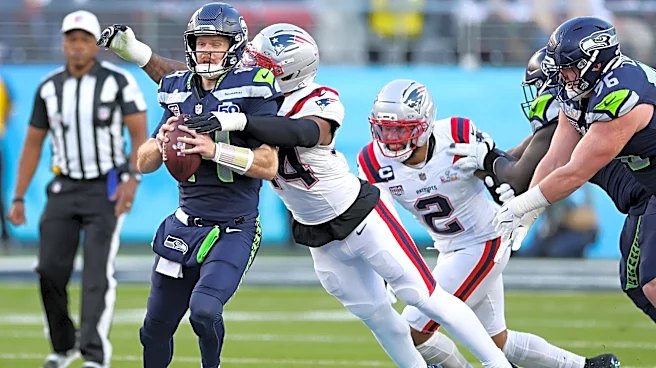
That will mark the end of the summer slow season and the beginning of the Super Bowl title defense for the Seahawks, after dismantling the New England Patriots 29-13 in Super Bowl LX back in February. With that the case, the 90-man roster the team
will bring to camp is filled out, though just as every year there will undoubtedly be competition at the fringes of the roster that brings significant movement.
With attention now turning to training camp, it’s as good a time as any to review the salary cap situation of the team, as there are unlikely to be any major changes in the immediate weeks. Certainly a Devon Witherspoon extension could be in the works, but that is a development that seems more likely to take place in mid- to late August for other reasons.
All of that in mind, the starting point for the cap situation for this analysis is the $25.49M as listed for the team at OverTheCap.com, a nearly identical number to the $25.71M of space the NFLPA lists in its Public Salary Cap Report.
Fans, of course, see that number and starting dreaming of adding an impact player who could help the Seahawks on the field in 2026. However, what the team is likely to do with that space is far more mundane, and the most immediate uses will likely be to build out the practice squad and setting some space aside for injury replacements.
For the 2026 season practice squad players will be paid $13,750 each week, which means that a full squad of 16 members on the roster for all 18 weeks will require $3.96M of cap space. Long time Field Gulls readers will be more than aware of the way in which the Seahawks tend to manage their practice squad, which results in more than 16 practice squad players earning practice squad pay each week.
In addition, when players are elevated from the practice squad to the active roster, that player earns league minimum for a member of the 53-man roster for their level of experience that week. That increase will almost always be in the $35k-$55k range, and even just a single elevation each week results in additional cap charges in the neighborhood of $600k. Thus, between the ghost roster and weekly elevations, an additional $1M of cap charges is not out of the question, which allows for the cost of the practice squad for the season to be estimated at a nice, round $5M of cap space.
As for the injury pool, the assumptions for when and how many players land on injured reserve can vary based on different methods for generating the estimates. The Seahawks were relatively healthy during the 2025 campaign, with 14 players landing on injured reserve during the course of the season. Using that as a baseline, and the fact that the minimum salary for a player added to the roster as an injury replacement in 2025 is $885,000, fourteen replacements for the full season would be $12.39M.
Of course, not all players will miss the entire season, and some players who land on injured reserve will have split contracts that see their base salary lowered while not on the 53 man roster. To account for these factors, the $12.39M amount can be reduced by sixty percent, yielding $4.956, which rounds nicely to $5M. The team could need more or it could need less than this, so this doesn’t become an untouchable cap space reserve, it’s just an amount to keep in mind, and the team has the roster flexibility to create more cap space if needed.
Combining the $5M or so needed for an injury replacement pool with the $5M from the practice squad, and the team will need to keep somewhere around $10M of its current $25.5M of available cap space for use during the season. That leaves roughly $15M of deployable cap space that the front office could put to use on signings, whether in the form of extensions or free agent signings.
A piece of that space seems likely to be used on a Devon Witherspoon extension sometime between now and 4pm Saturday January 9, but the exact timing, of course, remains up in the air until the two sides actually reach agreement on an extension. Others, such as Anthony Bradford or Jalen Sundell, could also see an extension, but it’s also entirely possible the Seahawks could simply keep that space and let it roll over at the end of the year.
The reason to allow their cap space to roll over is the simple fact that while they have more than enough cap space for the 2026 season, looking ahead to the 2027 season Seattle is already under $30M of available space with just 48 players under contract. That means once the team fills out the roster, pays signing bonuses to the 2027 draft class and builds out the practice squad, at the current time there is probably roughly as much 2027 effective cap space as there is 2026 effective cap space.
So, while fans will most certainly clamor for the Hawks to add a big name or to make a veteran addition to the roster in the coming weeks, it’s very possible the front office could opt to simply let the space roll into 2027 and give themselves some extra breathing room next spring.