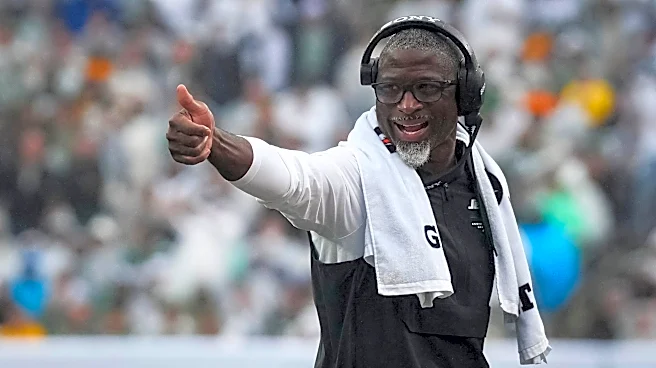



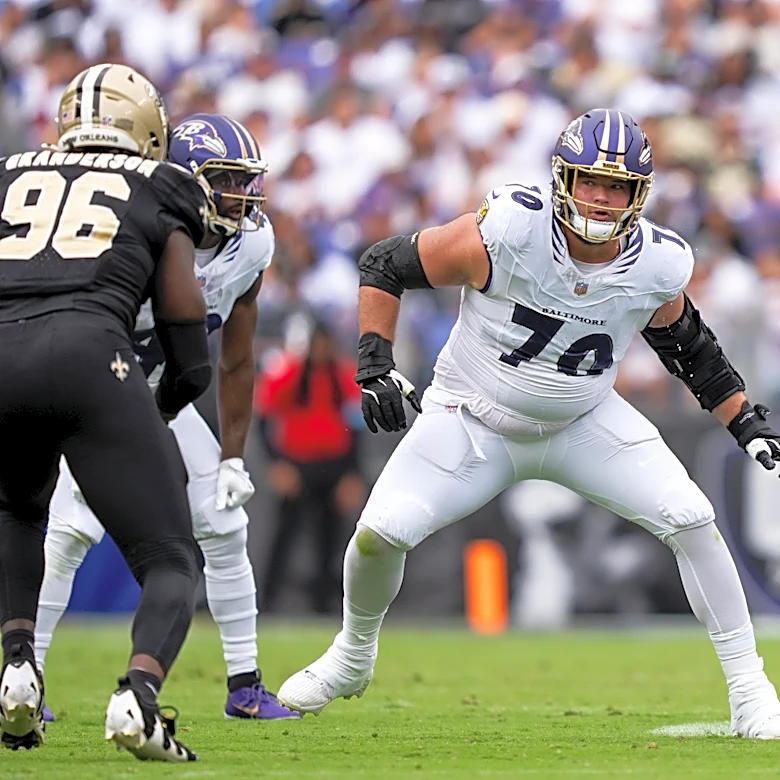

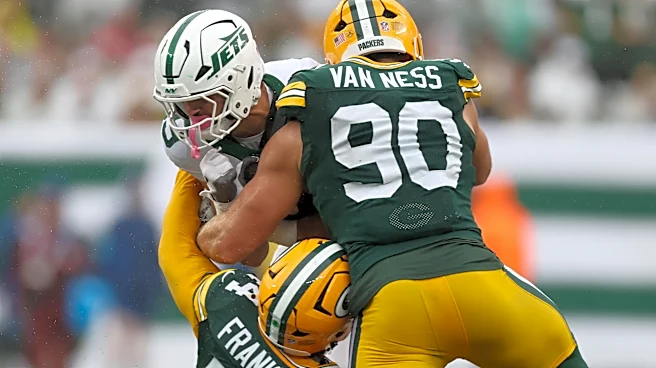
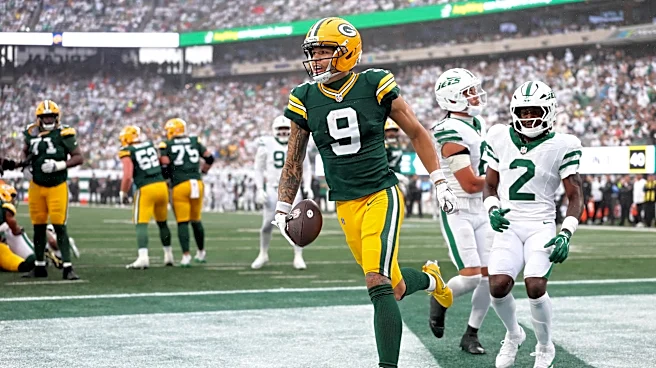
In order to prepare for Week 3’s game between the New York Jets and Detroit Lions, I watched the Jets’ Week 2 loss to the Green Bay Packers to get a better sense of how Aaron Glenn’s team is playing amidst their 1-1 start.
Here are six things I learned.
The Jets offensive line looks improved
Now, this could very well be the result of an extremely questionable Packers pass rush without Micah Parsons, but Geno Smith had all day to pass against the Packers defense. The Jets’ offensive line averaged 2.71 second to pressure, the seventh-highest
mark of Week 2 (they ranked 10th in Week 1).
New York currently has PFF’s highest pass blocking grade (77.4) and seventh-highest run blocking grade (70.0).
Where they’re particularly strong is on the left side, where third-year left tackle Olu Fashanu is having a great start and veteran left guard Dylan Parham (PFF’s #1 graded guard) has been outstanding. It’s no surprise the Jets’ most successful runs are to the offense’s left.
While Aidan Hutchinson moves around quite a bit, DJ Wonnum spends the majority of the time opposite the left tackle, so it’s a big game for him.
Run game has had mixed results
The Jets ran for 152 yards and 3.9 yards per carry in Week 1 vs. the Titans, but they managed just 67 rushing yards and 2.5 yards per carry against the Packers. There were far too many negative plays for New York running the football, with 29.6% of their rushes gaining zero or fewer yards—the third-highest mark of Week 2. Even in Week 1, they managed just 0.82 yards before contact (25th), so there should be plenty of opportunities for the Lions defense to get the Jets behind the sticks.
The Packers were able to be disruptive by being aggressive with their linebacking corps. I got the sense the Jets were being a little predictable in the run game. Through two weeks, the Jets have the second-highest early-down run rate in the NFL.
Tough to beat in passing game in perimeters, but inside may be available
On defense, I was impressed by the Jets’ ability to defend the perimeter in the passing game. That meant slowing down the Packers’ wide receiver screens, but also erasing the sidelines on deeper throws. As you can see, most of Jordan Love’s work came over the middle of the field.

Love completed a lot of passes near the line of scrimmage, but those plays were largely ineffective. It was the intermediate stuff over the middle that finally got Green Bay’s offense going.
Of course, that could play into Detroit’s strengths. Guys like Sam LaPorta and Amon-Ra St. Brown thrive over the middle of the field.
But I would stay away from No. 1 cornerback Azareye’h Thomas. The second-year corner was excellent against the Packers, and PFF credited him with a 75.9 coverage grade this season, and he was also outstanding against the run vs. Green Bay.
Run defense has some hidden leaks
On the surface, it looks like the Jets have an awesome run defense. They rank:
- Second in rushing yards allowed (66.5 YPG)
- 18th in YPC (4.1)
- Third in rush EPA (-0.378)
- Ninth in rush success rate (32.3%)
But when the Packers were at their best against the Jets, they were able to get the run game going pretty well, particularly in the first half. Green Bay rushed eight times for 35 yards (4.4 YPC)—all of which came on their first touchdown drive.
If Green Bay could’ve stuck with the running game and not gotten behind the sticks with 15 penalties, I believe the game would have worked out differently.
Through two weeks, the Jets have produced just a 9.4% stuffed rate (27th), and have given up 3.30 yards after contact per attempt (23rd).
In short, I think some of their early run defense success may be a result of playing a Packers team down several offensive linemen and a Titans team that spent the entire second half down two scores. They’ve faced an NFL-low 32 rushing attempts, so they’ve yet to be really tested, but the cracks in the foundation are there.
But one thing to keep an eye on: fumbles. The Jets forced five (!) fumbles against the Packers, but only recovered one.
Coaching decisions, conservative play could be a big issue
The Jets should have beaten the Packers. They were the better team for approximately 55 minutes of that game and on a success rate basis, they were dominant. However, there were several very questionable coaching decisions that Aaron Glenn is rightfully under fire for.
At the end of the first half, the Jets got the ball back with four minutes left and no timeouts (another coaching issue). New York seemed more concerned about ensuring the Packers didn’t get the ball back, and they essentially erased all four minutes without getting in field goal range (to be fair, the drive did start at their own 9-yard line). Still, that level of conservative play likely cost them at least a field goal attempt.
The fourth quarter was far worse. First, the Jets faced a fourth-and-1 from the Packers’ 9-yard line up a touchdown. Rather than go for the kill, they kicked a field goal to go up 10. Then, they had an opportunity to get one more possession before overtime. When Green Bay failed to convert a third-and-10 from midfield, the Jets could’ve called a timeout with over a minute left. Instead, Glenn said he was worried about being backed up in his own zone and wanted to play for overtime.
Then, in overtime, Glenn made the controversial decision to take the ball first. Typically teams want to go second in overtime, to know what sense of urgency they need on offense (i.e. do they need a FG? A TD?) plus it gives the second-team’s chance to go for a two-point conversion for the win. Glenn believed they could run a bunch of overtime clock and put the pressure on Green Bay’s offense. Instead, they went three-and-out and lost.
The Jets did get aggressive on one occasion against the Packers. With 1:20 left in a tie game, New York faced a fourth-and-1 at midfield. The Jets went for it, but a predictable run up the middle was stuffed.
In a close game, Detroit’s more aggressive mindset could give them the edge.
Special teams were a disaster
Here are all the of the mistakes I saw the Jets make on special teams in one game:
- (Former Lions) punt returner Isaiah Williams muffed two punts, but the Jets recovered each
- Allowed a 43-yard kick return to the Packers’ own 46-yard line
- Allowed a 63-yard punt return that set up Packers’ game-tying field goal
- Four penalties on the return teams
Overall, the Jets rank 26th in special teams DVOA, 23rd in punt return average, 22nd in kick return average, 31st in punt return average allowed, and 13th in kick return average allowed.
If the issues continue, this is the kind of thing that could swing the result of a close game on Sunday.