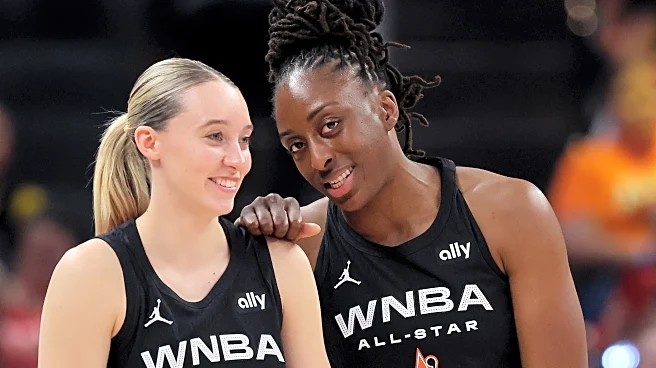



On Friday afternoon, the WNBA and WNPBA completed and signed the term sheet for the new collective bargaining agreement (CBA). The next step is ratification by the players and board of governors.
As reported by Annie Costabile at Front Office Sports, the union held meetings on Friday where they educated players on all the dynamics of the new deal. The player voting process is expected to commence
“soon” and will take a “couple of days.”
The official announcement provided additional deals about the new deal (which is for seven years with a six-year opt out), filling in the gaps about previously-reported provisions while also clarifying other elements.
Here’s a look at the headlining features:
First-comprehensive revenue sharing model in women’s pro sports history
The new system will result in significant increases in player compensation, with the league projecting more than $1 billion in player salaries and benefits over the seven-year agreement. The salary cap for the 2026 season will be set at $7.0 million and will adjust annually based on league and team revenue growth.
Costabile’s reporting has confirmed that the average revenue share for the term of the agreement is 20 percent.
Million-dollar contracts and increasing salaries for all players
The league’s top players will gain the ability to sign the first multi-million-dollar contracts in WNBA history. Maximum-contract players will earn a salary of $1.4 million in 2026 that is expected to grow to more than $2.4 million by 2032, based on current financial projections. The league’s average salary is expected to be $583,000 in 2026 and increase to over $1 million by 2032. Minimum salaries will range from $270,000 to $300,000 in 2026 (based on years of service) and will range from $340,000 to $380,000 by 2032.
In addition, starting in 2027, players with seven or more years of service cannot be designated as Core Players.
At FOS, Costabile provided additional details about a new salary cap exception.
The minimum contract for veterans with 10 or more years of service will be $300,000; however, their salary will count only $277,500 against a team’s cap sheet, which is the value of a minimum contract for players with one to three years of service. This exception thus encourages teams to sign and retain experienced, veteran players, while still ensuring these players are paid at a rate commensurate with their service time in the league.
An EPIC (Exceptional Performance on Initial Contract) new rule
The agreement also establishes a new rookie contract scale that significantly increases salaries for top draft picks, including the No. 1 overall pick in 2026 projected to earn $500,000.
All existing rookie-scale contracts will also be adjusted upward, delivering meaningful pay increases for players at every stage of their careers. The agreement also creates an expedited pathway to maximum-level contracts for players on rookie deals who earn MVP or All-WNBA First or Second Team honors.
Three players—the past three No. 1 picks in the Indiana Fever’s Aliyah Boston and Caitlin Clark and Dallas Wings’ Paige Bueckers—currently qualify for the EPIC provision. Having earned an All-WNBA selection in their first three seasons, they will be eligible to sign a three-year max contract extension with their current team entering their fourth season. Boston is eligible now, Clark will have the opportunity in 2027 and Bueckers in 2028.
If a player wins MVP within her first three years, she would be eligible for the supermax entering her fourth season.
Using Clark as an example, ESPN’s Alexa Philippou explains:
For example, 2024 Rookie of the Year Caitlin Clark—who made $78,066 in 2025—is poised to see her salary jump to $530,000 in 2026, a source said. She could earn the projected max of $1.3 million in 2027 as a previous All-WNBA player and the projected supermax of $1.7 million in 2028, the first year of her extended term.
Player quality-of-life benefits, including increased award bonuses
The deal includes significant investments in the overall player experience, including enhanced standards for team facilities, expanded team staffing requirements, fully codified league-wide charter air travel, first-class travel accommodations, and significantly increased performance bonuses for individual award winners and playoff and Finals participants. It also includes substantial enhancements for retirees and retirement planning, with expanded team contributions to player 401(k) accounts, enhanced benefits for players with children or who are family planning, and recognition payments for WNBA veterans and retired players based on years of service.
Reporting from ESPN and FOS confirmed that teams will be required to provide housing support for all players for the first three years of the deal. In 2029 and 2030, housing support will be given to all players making less than $500,000. Starting in 2031, only developmental players will receive housing support from their teams.
The league’s increased award bonuses, which will continue to increase in line with the salary cap, are headlined by $60,000 in extra compensation for winning a championship or MVP.
Bigger rosters and more basketball
The deal also includes an increased minimum roster size of 12 players plus two more roster spots for developmental players, and salary cap exceptions for injured or pregnant players. Fans will also experience more WNBA basketball through an increase of up to 50 games in 2027 and 2028, and up to 52 games in 2029 through 2032.