
No coach has dominated March like Geno Auriemma. Not only does he own a record-setting 12 national titles, he’s also made it to 24 Final Fours — including 14 straight from 2008-22 — and been a 1-seed in 22 of 36 NCAA Tournament appearances. Overall, Auriemma owns a 142-24 record in March Madness, claiming a victory in 85.5 percent of contests. To put that in perspective, only three other women’s basketball coaches have a better all-time winning percentage.
But before all that, the coach struggled
to win his first game in the big dance. Auriemma began his NCAA Tournament career 0-2 and eked out a victory in his third try.
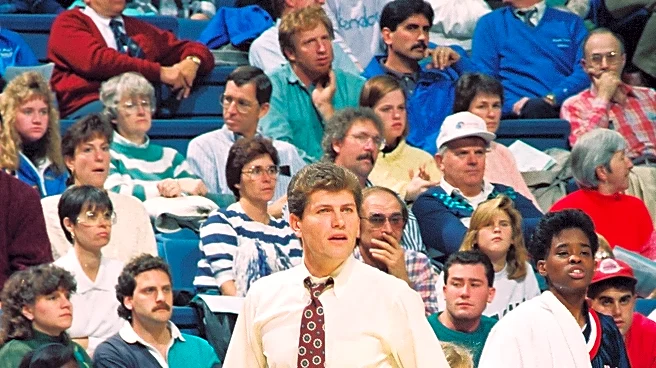
When he took over at UConn in 1985, the program had only put together a single winning season and never even sniffed the tournament. Auriemma’s first few years were lean — a 12-15 record in his first year, followed by steady progress to 14-13 in 1986-87 and 17-11 in 1987-88.
The breakout came in 1988-89. The Huskies marched to the Big East regular season title with a 13-2 record then dominated the conference tournament, winning all three games by an average margin of 15.7 despite being without their head coach, who was suspended for a scheduling error.
With the Big East’s automatic bid in hand, UConn landed as an 8-seed in the East Regional, where it hosted 9-seed La Salle at Hugh Greer Field House in Storrs — the predecessor to Gampel Pavilion. Going into the contest, Auriemma wasn’t sure how to handle the moment.
“I didn’t know what to do to get them ready,” he admitted back in 2019. “I wasn’t gonna panic and overdo it and start coaching like John Wooden or something. So one day we played wiffle ball. I was just trying to get their minds off of that.”
The trick didn’t work. UConn went up by as many as 16 in the first half, only to let the Explorers come back and pull off a 72-63 victory. It didn’t help that Kerry Bascom, the Huskies’ star, dealt with an injury during the contest, according to Auriemma.
The moment wasn’t too big for the upstart program, though. If anything, it wasn’t big enough.
“This doesn’t even feel like a tournament game,” he remembered thinking. “It almost felt like we just lost a regular season game.”
The next season, the Huskies returned to the big dance by earning their first at-large bid. As a 4-seed, they received a first-round bye into the 48-team field and hosted 5-seed Clemson in the second round, this time at the newly-opened Gampel Pavilion. Trailing by two on the final possession, Bascom attempted a potential game-winning 3-pointer that went halfway down the cylinder and came out.
“I think it even touched the next and came out,” Auriemma said in 2023 about the miss.
That second NCAA Tournament loss weighed heavily on the coach.
“That shot (by Bascom) was devastating that it didn’t go in because it made me feel like we’re never going beyond the first or second round of the NCAA Tournament,” Auriemma said in 2020. “It actually felt like that. It felt like one opportunity to make this work and that one opportunity has gone away. I thought we had one more chance.”
The Huskies made that last chance count. In 1990-91, UConn had a veteran team with two key seniors — an All-American in Bascom and point guard in Laura Lishness — along with a deep junior class that featured Debbie Baer, Wendy Davis, Orly Grossman, Meghan Pattyson, Shannon Saunders, Pamela Rothfuss and Stacey Wetzel. That group claimed both the Big East regular season and tournament titles, then got a bye into the second round of the NCAA Tournament as a 3-seed.
In their opening game, the Huskies took on 11-seed Toledo, which knocked off Rutgers in the first round. Despite the significant difference in seeding, UConn found itself in a dogfight. Bascom needed to drop a then-school record 39 points, capped off by a three-point play with 19 seconds left, to put the Huskies ahead by one. On the final possession, UConn sent Toledo to the foul line with the chance to re-take the lead, but the visitors missed both shots. The Rockets then rebounded their own miss and drew another foul.
Or so it appeared. After a long discussion, the officials ruled that time expired before the foul. The game was over and the Huskies finally had their first NCAA Tournament victory.
From there, UConn traveled to the Palestra in Philadelphia for the regionals. There, it beat NC State in the Sweet Sixteen and then got revenge on Clemson in the Elite Eight. Just like that, the Huskies were on to the Final Four for the first time in program history.
The dream season eventually came to an end with a loss to Virginia in the national semifinal. Still, just getting that far proved to be a watershed moment for the program.
“If that [Final Four] didn’t happen, none of this would’ve happened. Zero. Not even close to happening,” Auriemma said in 2020. “Because nobody would’ve seen us play, we never would’ve been on television, never been to the Final Four, nothing. We would’ve just been a bunch of kids who played basketball and moved on with the rest of their lives.”
UConn didn’t actually take off from there. The following season, it beat St. Peter’s in the first round of the NCAA Tournament before getting smoked by Vanderbilt, 75-47, in the second round. In 1993, they fell to Louisville at home in the opening round.
”Right after we go to the Final Four in ’91, the next two years, we suck,“ Auriemma laughed.
In 1994, UConn began its ascent. It earned a 1-seed for the first time ever and made it back to the Elite Eight, only to lose a winnable game to eventual national champions North Carolina. The Huskies didn’t lose again for a long, long time. The following season, they went a perfect 35-0 en route to the program’s first national title.
Since then, Auriemma has been nearly untouchable in the NCAA Tournament. He’s reached 31 straight Sweet Sixteens, missed the Elite Eight just three times and, of course, has 12 national championships to his name.
But with that success comes sky-high expectations and the pressure to win every season. While Auriemma struggled just to win a single NCAA Tournament game early in his career, he looks back on that time nostalgically.
“Back then, it was so much fun, so exciting, just so invigorating,” he said. “Not like now. Now, it’s torture. Now, it’s work.”