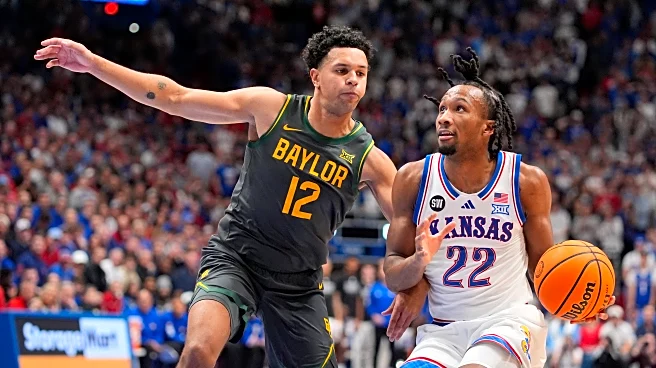
The Portland Trail Blazers added two names to the franchise on NBA Draft Day last June. The first was Yang Hansen, a near-unknown Chinese big man the franchise fetched with the 16th pick. The second was Caleb Love, a five-year college guard who went undrafted before signing a two-way deal with the Blazers in the minutes after the draft.
The mature-aged rookie had garnered a reputation at both North Carolina and Arizona as someone willing to let the ball fly, perhaps almost too liberally. Despite that,
he was largely considered a suitable two-way signing for the Blazers.
Before the season, I wrote that if the 24-year-old could improve his shot selection and subsequently his efficiency, he would earn minutes in specific situations and in the case of injury. Unfortunately, for the Blazers, the case of injury became permanent with Love subsequently serving as more than just an end-of bench name, splitting time between the Blazers and the Rip City Remix.
Unfortunately for Portland’s G League affiliate, Love has been too busy helping the Blazers to suit up for the team located at the Chiles Center.
Through 41 games with the Blazers, Love has averaged 11.2 points on 32.2 percent on 6.4 three-point attempts and 38.8 percent on 10.7 field goal attempts, to go with 2.6 boards, 2.7 assists and 0.6 steals in 22.3 minutes. Nothing to go crazy about but for an undrafted guard on a two-way contract, it’s impressive.
So much so that his omission from the All-Star rookie-sophomore festivities in Los Angeles next month has been noted. Perhaps it’s because he went undrafted but that’s a pretty weak excuse considering he’s currently nineth in points, 12th in assists, 13th in minutes and 20th in steals among rookies.
More than that, Love has arguably been responsible for at least two Blazers wins thanks to his late-game, long-range shooting heroics. While some might argue that players of Love’s ilk get lucky throwing up bricks, it’s not entirely true. Love is unafraid to take high degree of difficulty shots but he’s shown he can make them.
He’s stealthily been a key member of a roster starved of offensive punch, thanks to his ability to keep the scoreboard ticking over when there seemed no other way to the hoop, particularly in the half court. His contribution has been so impressive that it’s made me wonder how Coach Tiago Splitter can keep him on the court when he gets his full complement of guards back.
Defense
The Blazers haven’t been flush with two-way guards over the past 15 years. Damian Lillard, CJ McCollum and Anfernee Simons were and are all important and valued Blazers but the trio were never asked to take the court because of their defensive prowess.
While Love moves a lot like Lillard, he’s already a more reliable defender than the nine-time All Star. He’s no Blake Wesley, but he has the athleticism and lateral movement that allows him to stay in front of opponents at the point of attack while also operating in passing lanes, snaring opportunistic balls.
Love is rarely the weak link on that end, giving Splitter a key piece to boost scoring without sacrificing anything on the other end. The numbers back this up with Love currently averaging 1.0 steals per 36 minutes and 1.1 deflections a game.
Offense
As mentioned, Love’s lack of shyness letting the ball fly has been divisive for many. It’s true he’s not afraid to shoot anywhere within the half court. But that probably comes from the fact that he’s hitting 33.7 percent of shots from more than 25 feet out.
I do like the fact that he’s improved his accuracy from long range since the start of the season. In October and November, Love was hitting the three ball at around 25 percent on 6.2 attempts a game. That rose to 34.7 percent on 5.4 attempts in December, before this month reaching 35.8 percent on 7.6 attempts.
Though the majority of his shots are taken from beyond three, he’s also efficient at the rim hitting 68.5 percent in the paint. On top of that, his field goal percentage has risen from 32.3 percent in November to 42.1 percent in January.
Interestingly, he’s also been efficient taking long midrange shots, hitting 50.0 percent from beyond 16 feet out. Love’s only weak spot appears to be between three and 16 feet where he’s barely topping 35 percent on the 21.3 percent of shots taken from within that range.
As far as facilitations goes, Love is more combo than point guard. Despite his preference to score, he’s served admirably as Deni Avdija’ main respite distributor during the depths of the injury despair. He’s averaging 2.8 pick and roll ball handler possessions a game, which is fine but I’d rather have him serve more in catch and shoot situations, hopefully raising his 4.1 attempts. No doubt that will occur when Henderson returns to the court.
Roster crunch
The obvious issue at the moment is the fact that both Love and Sidy Cissoko’s ability to play more than 50 games and in postseason action relies on them gaining a regular roster deal. Rest assured, my belief is both players find their way onto the roster, but it’ll be interesting to see how, and more importantly, who General Manager Joe Cronin taps to make way for them.
Conclusion
While I suspected Love would be more productive than your average two-way contract, I had no idea he’d be this central to the Blazers bench play. Behind Avdija and alongside Cissoko, Love has been one of this team’s more pleasing stories of the season.
The short-term goal will be to get him a regular-roster spot over the next week. Beyond that, this team would do well to have someone like Love as a third-string scoring guard, someone Splitter can confidently call on for scoring and defense when needed. Don’t get me wrong, when Lillard and Henderson return to the court, Love will see less minutes but I doubt he gets kicked out of the rotation completely.
If there has been a silver lining from the Blazers overworked medical room over the past three months, it’s been the discovery of two two-way contracted players who belong in the league. Love is an NBA player and the Blazers should get a pat on the back for recognizing the talent.