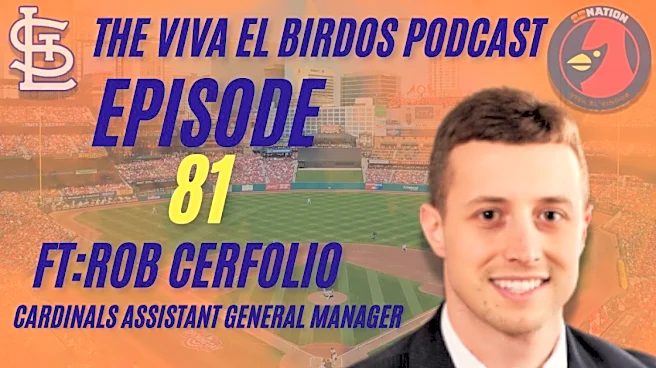




This week, the long-promised episode with Rob Cerfolio is finally here! We were once again delighted to be able to sit down with the Cardinals’ Assistant General Manager and Head of Player Development as we continue down the path of youthful investment. We touched on a lot of great topics this week, and I’m excited for you all to hear/read what Cerf had to say on Friday. Also, later today, I will be releasing a special bonus episode featuring Cardinals 2025 4th-round pick Cade Crossland and special guest
co-host Kyle Reis of Thecardinalnation.com!
00:00 Introduction to Viva El Birdo’s Podcast
00:12 Meet the Hosts: Jake, Gabe, and Scott
00:23 Introduction to the Cardinals’ Development Strategy
03:40 The Role of Media and Fan Engagement
06:31 Evidence-Based Player Development
09:26 Promoting Young Talent to the Big Leagues
12:29 Evaluating Defensive Skills in Players
15:39 Arizona Fall League Participation
18:39 Acquisition Strategies for Players
21:21 Impact of New Training Facilities
24:28 Managing Pitcher Development and Roles
28:10 Exploring Minor League Strategies
29:03 Spotlight on Rising Stars
31:33 Underrated Players to Watch
33:48 The Impact of Player Development
36:02 Pitching Development Insights
41:08 Timing Player Promotions
44:44 Drafting for the Future
48:08 The Evolution of Baseballs and Performance
Here is a list of the topics that were touched on this week and the timestamps if you wish to jump ahead to a certain topic. I will also be posting the full edited transcript of the conversation below to serve as my “article” for this week. Thanks for watching, listening, interacting, and caring about the work we do here at VEB; without readers/followers like you, none of this would matter!
Spotify:
YouTube:
Transcript:
Jake Wood (00:23)
Welcome into the Viva El Birdos Podcast. My name is Jake Wood, and I write for vivaalbertos.com. I am the host of the show, and I am joined by fellow writer Gabe Simons. Please be sure to like and subscribe to our channel. We are available on YouTube, Spotify, Apple Podcasts, and all of your favorite audio streaming platforms. We are so privileged, not only because of the incredible job that those who came before us here at VEB did to establish this brand to be what it is, but also because
Of our incredible connections and the information and insights that are provided as a result of that. After the 2024 season, the Cardinals set out to re-asphalt a path that had once provided a consistent highway to playoff baseball. One of the guiding lights on that project rejoins us today to share with us about the progress, development, and insight into the organization that we all follow so closely.
Please welcome back Cardinals Assistant General Manager and Head of Player Development, Rob Cerfolio.
Rob Cerfolio (01:36)
What’s up, fellas? Guiding guiding light might be the nicest thing anyone’s ever said about me, so I’ll take that to start. I think it’s probably overly kind and an exaggeration of the truth, but no, fired up to chat with you guys. Obviously appreciate you know everything you guys do to cover the big league team, the minor league system. It goes a long way and yeah, let’s have a little bit of fun talking some Cardinals baseball.
Jake Wood (02:01)
You know, we in the media have never been known to be hyperbolic whenever we describe anything, so of course, that
Rob Cerfolio (02:07)
Yeah.
Jake Wood (02:07)
was exactly how you are to be described. But you know, before we get to
Rob Cerfolio (02:10)
Fair enough.
Jake Wood (02:11)
the the informative, hard-hitting journalism that we’re known for, right? we had one of our readers their username is Lovebirds, and they wanted to ask really quick if you were somebody who visits the site, if you read any of what’s being written, and if you have any critiques or notes
for fans that would be helpful for them to understand kind of further what’s going on from the outside and then further what importance these outside fan communities have in progressing the conversation forward.
Rob Cerfolio (02:41)
Yeah, you know, this is a this is a good one. It’s it’s a little bit of yes and no. you know, I think the way we try and approach this is to be aware of things that are happening in the media, whether it’s like internal platforms like you guys that really cover the Cardinals or some of the more global ones, whether it’s baseball America, MLB pipeline, those types of things. And sometimes like we miss stuff and you guys pick up on things that we’re not even like tracking. We’re tracking a lot of things. And when you’re doing that, it’s it’s oftentimes just great to have more people helping you ensure that you’re on top of every little thing that’s out there because every piece of information can matter in some way. So the answer is both yes in that perspective and no in the perspective of you know, we try not to get caught up in some of that stuff. So it’s a little bit of it’s a little bit of both, but
You know, like I said at the jump, really appreciate what you guys and other platforms that cover our team closely do and you know, like I said, it doesn’t go unnoticed.
Gabe (03:50)
It’s okay to say no. We kind of assume nobody reads, and the Cardinals read our stuff. Just joking, though. my question is Right, right.
Rob Cerfolio (03:58)
Yes and no, it’s both. Sometimes
Jake Wood (03:59)
I was gonna say,
Wait a minute, I assume
Rob Cerfolio (04:00)
yes.
Jake Wood (04:01)
That they’re only paying attention to what we’re doing because we’re doing it so well.
Rob Cerfolio (04:04)
Yeah.
That’s exactly right. It’s sometimes
Jake Wood (04:07)
Ha ha.
Rob Cerfolio (04:08)
yes and it’s, and it’s sometimes no, if I’m being perfectly candid.
Jake Wood (04:12)
And we’ll just
assume that the no means you’re just too busy to see it, not that you don’t want to.
Rob Cerfolio (04:17)
That’s exactly right, Jake. You’re spot on right there. (sarcasm)
Gabe (04:20)
So my question is, I know the Cardinals aren’t obviously completely data-driven, but do you, like, is there a way to input what coaches say about players or what coaches think about things and then you kinda, like, integrate that into the data somehow? Like, do you know what I mean by that question?
Rob Cerfolio (04:40)
yeah.
Yeah, you know, I think the words that that I use and we try and use internally is really more like instead of data driven, like evidence based, and evidence based could be
Could be objective data, it could be subjective expertise, it could be experiential wisdom, like it’s just a little bit of a more all-inclusive term. And, you know, Gabe, I think to the to the nature of your question, like that’s exactly why we use that term. because evidence can come in all forms and fashions. You know, it’s like comparing a doctor today versus a doctor 100 years ago. The doctor 100 years ago is still using experience and subjective expertise to make a diagnosis.
And if you gave that doctor 100 years ago an MRI machine in 2026,
Now they just have another piece of information or another data pipeline to factor into well, what do I do with this patient? And it’s really no different. That analogy is the exact same. That’s why we have people from all different like experiences and backgrounds. We have people that never played above high school that can write really good models and build awesome code and tools to help us understand who a player is and what’s happening. And then we have guys that played in the major leagues for the St. Louis Cardinals for a long time.
that know the organization, the ins and outs, like what allows for players to have success at the highest level. And you know, I think the competitive advantage on our end is like how do you build a team and a culture where those people like want to use each other. and it’s not about this one way or that one way. It’s about all of this evidence matters and how do we build the best team to really use all of those pieces of information to our advantage. So like that’s really like to the nature of your question, it’s a great question because
evidence-based in in our world is all of those things and they kind of have to work in harmony.
Jake Wood (06:36)
Rob, this season we’ve seen player after player be promoted to the big leagues from JJ Wetherholt on opening day, you know, all the way to Leo Bernal’s recent promotion and, you know, looking like an unfazed 10-year big league vet, you know, not only to the credit of the players for their roles and their development, as you’ve kind of like say how you’ve kind of like alluded to that, but also this goes a long way in showing proof of concept when it comes to the work you and your group has put in to these guys and to get them to the point they’re in in their careers. So, you know, while we’ve enjoyed watching these young players ascend, you know, there is a looming dark cloud over the sport as a whole. And, you know, I’ve been curious, as one of the main developers of the quote-unquote offseason player plans, you know, how much additional thought is going into player plans this offseason as uncertainty on a potential report date for next season remains, you know, murky at best.
Rob Cerfolio (07:33)
Yeah, I’ll I’ll try to tackle the first part and then I’ll jump into the second part and you know, maybe as a precursor, like that second part is kind of out of our control. There’s only so much that we can even say or talk about. But, you know, the first part I think just speaks to like you know, every time I’ve I’ve done one of these
Like we look at player development as like the major leagues down. it’s not like that is not a minor league concept. That’s why we have Larry Day, who’s our farm director, that like really oversees the day to day of our minor league operations. And that’s why, you know, we have a role like myself that’s St. Louis based that brings all of those same concepts and strategies into the big leagues. And you talk about guys that are coming up for the first time,
We want that to feel like just another affiliate to our players. Like, yes, there’s more media, yes, there’s more
There’s more pressure to quote win the game. but the way in which we train, the way in which we go about our business, the way in which we come up with strategies as a group to like how do we help Josh Baez when he faces Major League pitching adapt to that challenge and environment? It’s the exact same process. Like that’s really speaks to how everybody’s role within the machine kind of works. So it’s been really awesome to have the opportunity to have so
many young guys come up and it’s it’s really put a cool emphasis on just our major league staff and our minor league staff kind of like we talked about earlier working together being on the same page that’s why we write stuff down that’s why we have systems and processes to make that transition as smooth as we possibly can for our players and that’s why we have the structure that we do from from a staffing standpoint. You know I think to the second part, you know the honest answer is it’s no different.
Whether we can work with our players, whether players in in the off season kind of go train on their own, the organization owes them that partnership on the way out of let’s calibrate on what happened, what went really well this year, what did we set out to do, and if you’re doing that at a high level, like you’re involving your players during various points of the season. So it’s not just like one conversation. it’s really just kind of the last of many conversations in season to ensure that the player
Has clarity, the player has a voice in what we’re gonna do and why, and then we kind of come up in partnership as a group with them and our staff on well, what are we gonna do about that? And so you know, there are things that we do to create touch points with our major league players, with our minor league players to ensure that everybody’s on the same page that way. and then you’re right, like for guys that are you know training away from us, whether it’s this upcoming offseason or you know, last off-season, regardless of constraints, you just want to
make sure that we have a roadmap for where people are going to be and what they’re going to be working on and key dates along the way to ensure that they’re ready. So it really like the information doesn’t change. Maybe there’s some things strategy-wise depending on how the next couple months go and the nature of this off-season that we might have to change, but but really like the the core principles are the exact same.
Gabe (10:52)
As somebody who’s fouled the minor leagues for you know the Cardinals and follows minor leagues, follows the public outlets and what they say about the defense specifically, I’m always surprised how often like a Cardinals player will come up and just be way better defensively than anybody saying. Paul DeJong, Harrison Bader, more recently JJ Wetherholt. Do the Cardinals are you guys ever surprised when somebody comes up and you’re like, wow, they’re our scouting didn’t say that they would be this good defensively or or maybe they’re worse defensively than you expect.
It’s it’s
a hard thing to grade, basically. Defense is so hard.
Rob Cerfolio (11:26)
Yeah. You know, to the to the c you know, question we talked about earlier of like in the space of pitching or hitting, like there’s just more things that
you can quantify that people have been quantifying objectively for five, ten years. In the defensive space, you know, I would say that while the information has gotten better on the objectivity of it, you know, the pr the percent of that pie chart is probably a little bit more on like subjective expertise.
So I think it’s a l it’s it’s maybe yes, but the information has gotten pretty good on that side of the ball. And you know, I think that speaks to like our hiring efforts of trying to have really great staff that know the space of defense really well. And then ensuring that like again, our major league staff, our minor league staff are all on the same page of what do we value, what are we teaching, how do we teach it. so in some ways it’s it’s a little bit of yes, but but also no.
we have good information. This is a space that we spend a lot of time on. you know, just the our organizational philosophy is we wanna on the position player side, like impact the game in all three phases of play. And that’s offense, defense, and on the bases. Those are the types of players and athletes that we want.
in the organization and our staff does a great job of really valuing and pushing those things each and every day, whether it’s our work in the big leagues or in the minor leagues pregame. So we have good information that helps us just guess wrong more times than not. And then we have awesome experts within the spaces of defense that are able to use that information and their experience to their advantage. So in JJ’s case, you know, last year we really tried to we thought that by him playing multiple positions
One would give him optionality to get into a major league lineup. We just didn’t know what that first positional need was gonna be. So if we could have JJ ready to play three different spots on the dirt, we knew that would just give his bat more options to get into Ali’s lineup card.
That was something we talked about with Ollie and Scals and the Major League staff the previous year. And you know, Ryan Barba and Larry Day and our group in the minor leagues like put a great plan in place to ensure that he was comfortable at all three. And I think the other advantage of that is he then got better as an infielder by way of playing multiple positions. You know, there’s a lot of cool research out there in the space of like skill acquisition theory. And like the analogy I like to make is if you want to become a better free throw shooter in basketball, you don’t just shoot
free throws, you shoot all over the court. And by developing the skill of different angles, different distance,
In baseball it’s different pace of ball on the dirt, different types of spin, different look off the bat. You actually just acquire the skill of being a better infielder more than you would if you were just playing one position. So that’s why you see a lot of our guys up and down the minor leagues playing multiple positions. It’s part A of we owe it to them to have positional versatility as like a thing, like a feather in their cap. it gives them options and more pathways to get to the big leagues. And then we also just believe
that it helps them become a better defender, regardless if that’s outfield or infield.
Jake Wood (14:49)
Now, before the baseball industry goes to its little shutdown period, there is one more league that is set to open. You know, that of course is the Arizona Fall League. we haven’t been graced with a public list of participants yet. I was wondering if you could maybe share a name or two under the consideration and a little bit about how that process of selecting players to the league has evolved over time.
Rob Cerfolio (15:13)
No, I appreciate the question. Unfortunately I cannot. you know, MLB really likes to really likes to be the quote dropper of news on that one. So I think that’ll be out soon enough. I know LD and the crew have been working hard on both the list of players and the actual announcement itself. So that’s probably not that far in the future. And you know, to the to the last part of that question,
You know, that league has has changed both in terms of like when it happens in the calendar year, the age of the players that play and it’s become like younger and younger. I think ten years ago it was, you know, maybe a little bit more parallel to like a double A ish type level. And, you know, now the the league has gotten a little bit younger, which which is both good and bad. so for us, you know
Every year is different. We’re trying to find the right players that they either one need more reps because they miss time during the course of the year. Or two, they’re working on something new and more gameplay is advantageous for helping them develop that skill. or three, just could benefit from the environment of being challenged by good pitching or good hitting. So most of our decisions kind of fall into one of those three buckets and
And then it’s a little bit of well, what is MLB asking the organization to provide in terms of certain positions and frequency at which they can play. So, you know, ultimately you’re just trying to use those three things as a little bit of like a mental model to help you select which players are good candidates or not. And then some of it’s out of your control. And how does how do those pieces fit into the four or five other organizations that you’re paired with? so anyway, that’s kind of a little bit into how we think about it, but you know.
Yeah, I wish I wish I could drop the first part of that answer, but there’s only so much we can do, a little bit of our hands tied behind our back that way. Yeah, correct.
Jake Wood (17:10)
Eventually we’ll get some news break on this show. I’m I
promise our listeners, you know, I was kinda you hope for yeah, by the way, Brandon Clark is gonna be in the fall league. yeah, Ty
Gabe (17:20)
Ha ha.
Jake Wood (17:21)
Pete, he missed a little bit of time this year, he’s gonna be in the Fall League. Like that I I bring those names up specifically because they missed a great amount of time this season, and we’ve seen in the past that guys who have missed, you know, chunks of the season, that’s a good way to make up some of those innings from in season as they continue on their their ramp up and their progression.
Rob Cerfolio (17:40)
Yep. Yep. I think you’re thinking about that the right way. As you know, as I noted, th that’s certainly something that we factor in quite a bit with trying to finalize those names.
Gabe (17:50)
When you’re looking to acquire, whether through the draft or waivers, a pla a position player or a pitcher, there’s certain traits or skills that like you hyper focus on and maybe if they don’t have something, you’re you’re like, I we don’t need to buy get this player because he doesn’t fit what we’re looking for.
Rob Cerfolio (18:10)
Yeah, no another good question, Gabe. I think yeah, this has been over the last eighteen, nineteen months, I’m losing track of what the actual number is at this point. I guess it’s getting closer to twenty-four months for me. this is something that I’m I’m pretty proud of just in terms of how we have really integrated our acquisitions teams with our you know, quote, player development personnel.
I think there’s some things behind the scenes in terms of how we built our team and our structure. You know, the example I would give is our director of pitching, Matt Pierpont, our director of hitting, Dalton Hurd. Like a lot of their jobs, yes, is overseeing kind of what we’re doing in the minor leagues and partnering with our major league staff on like what do we believe in, what do we teach, etc. But like a huge part of those guys’ jobs is integrating into our acquisition team. So that’s
Everything from interviewing players at the draft in the combine to doing a whole bunch of assessments during different parts of the year, whether it’s around the trade deadline or the draft itself, or to your example, a player pops up, excuse me, on waivers, if it’s a pitcher or a hitter. you know, our senior leadership team, myself included, and those guys are digging into who are these players, what makes them great, where do they have opportunities for continued growth, and how likely do we think we can
achieve that. And then there’s also other things about well, what do we know about the person from a makeup standpoint, from a work quality perspective? So and then there’s the other part of it of like, well, what are the roster constraints or the fit in terms of what you already have and like profiles in your organization already? How does that new piece then fit into
the players you already have in terms of opportunity availability, but also just depth and roster fit. So things that matter in those perspectives is like options and service time and all these all these things that have to factor into a decision beyond just how good is this player. It affects like the kind of the whole ecosystem of players you already have. But it always does start with
Who is this player in terms of what we can learn from afar? What do they do well? the same way that we would build a player plan for a new player in the draft, we start that process in March and April as part of draft assessments. And then when guys come in, we hit the ground running. It’s the same thing when a player pops up on the waivers. You’re just trying to understand who is this player to the best of our ability. If we were to get him, what do we think we could do and how feasible is that? and then you have to factor in those other pieces of the puzzle of
How does that impact our ecosystem? What type of optionality and roster flexibility does the player actually have? And you just try and weigh all those pieces of information and all the opinions across the group to the best of your ability. But that’s kind of like a lot of what goes into it, I guess, from our end.
Jake Wood (21:21)
This past spring the Cardinals new spring training renovations and development labs were finally functional after years of hard work to complete that project. You know, how have the new facilities facilitated player development this year specifically? And additionally, players who are able to take advantage of the development list in the minor leagues, you know, how does that impact your guys’ ability to get more instant feedback and adjust quicker to help players advance their careers?
Rob Cerfolio (21:48)
Yeah, it’s huge. and it’s not just in season. Like it’s gonna allow us to do some some things a little bit differently than than what the organization’s done historically in the off season. I think dominating the off-season is oftentimes a forgotten piece of just how do you excel at consistent long-term development of a player. a lot of what these especially young players are working on.
It starts in the months of October, November, December, January. And so having a facility in in one of the best locations in Florida and Jupiter is a competitive advantage for us and we’re gonna leverage the fact that ownership has given us such tremendous resources down there, and that’s obviously where the majority of like our minor league leadership team lives as well. Because you know our plan and strategy is developments 365 and it never stops. so it’s gonna allow us to do some things in the office.
Off season that the organization has not traditionally been able to do by way of strategy and facilities. So we’re really fired up about that. And Jake, you know, kind of to your question, it allows us to do some things in season as well. You know, thinking about like a lead better example or a Trey Richardson, like guys that spent some time on a dev list, had a very specific intervention that the group wanted to target. And sometimes we do that locally at the affiliates, sometimes we
send guys down to Florida for multiple weeks because we do have you know some some toys down there that it is fun to leverage with our players. So we’re we’re blessed that ownership has just you know kind of trusted us and put so much by way of backing with with finances and resources to ensure that we can offer the very best thing
in the training environment, in the cafeteria, in the weight room, in the training room. It’s been really cool to see those things kind of blossom over the last year or so and you know we plan to leverage it even further here in the coming months.
Gabe (23:57)
I know you guys wait more or less to the last minute to move somebody off of starting. and I’m wondering like what some of the starters in the minor leagues are you guys like pretty sure they’re gonna be in the bullpen? Like is there a percentage of certainty that they will stay at starting where you decide we wanna keep giving them opportunities and when they drop below that percentage, like maybe it’s like five percent chance they could stick a starter, you’re like, We gotta move in the bullpen. And do you think that will change if the Cardinals are in like a win now mode?
More of a win now mode than right now.
Rob Cerfolio (24:28)
Good question. You know, I don’t know if I’ve ever looked at it as black and white as that Gabe. the way that you kind of talked about the percent chance. that’s that’s probably a little bit more in in terms of how like we try and just have a hypothesis on, you know, I guess if I was to zoom all the way out, like one of the biggest competitive advantages in our sport is being able to consistently churn out like internally developed Major League starting pitching. I think as you guys can see like you can never have enough pitching just with one how volatile
It is year to year, and two, just you know, the injury risk of our sport. And so the more you know, quote, lottery tickets you have in that space, and the more consistently your staff can have real major league starting pitcher options that come up through the system. I think that’s a huge competitive advantage. So it’s something we prioritize, and by way of prioritizing it, we want to ensure that everybody that is
On a starter like track or role in the minor leagues, that we don’t take any shortcuts with those guys. We’re smart or as smart as we can about their workloads, their pitch counts. Like we’re working backwards for multiple years ahead of us in terms of how many innings do we think this guy should throw two years from now in the big leagues if he’s a starter? And what does that mean for what he needs to do today based on what he’s done the last couple years? And so
you’re really just always trying to ask yourself those questions, put players in opportunities where they can kind of make that decision a little bit for you. How well can they consistently throw strikes? How well can they beat both right-handed and left-handed hitters? Like the best starters in the major leagues have deep arsenals and weapons to be able to get opposite-handed hitters out, especially as left-handed pitchers. I think generally they face closer to about 75%.
Right-handed hitters, and obviously you’ve seen like just more and more teams really have used their 26-man roster to be able to combat a righty or a lefty and just try and stack the odds in the offense’s favor. So it’s about consistent strikes, it’s about having the arsenal characteristics to be able to get major league hitters out, especially like platoon disadvantage major league hitters. and then you let guys just kind of respond to that environment, and oftentimes they’re
ability to handle workload based on how their velocity trends in game, based on how well they can adapt to a full season starting pitcher workload, a lot of that kind of tells you the answer on its own. And on our end, we want as many of our players as we possibly can to have the opportunity to start. And then to your point, as they get closer to the big leagues, then you kind of have to ask yourself some of those hard questions, like what is most needed on the Major League roster tomorrow? And who’s the best candidate for that?
And if we go this path with a player, what does that mean for what we can and can’t do with him next year? and so you’re really just always trying to give yourself optionality and balance the long-term development of the player, but what is most advantageous to win a baseball game in Busch Stadium tomorrow? And sometimes those answers are not the same. And then that’s where you kind of have to pick a lane to swim down. And so that though again, those are the types of things that we consider. There’s no crystal ball or like math equations.
into that but that’s why we try and extend a lot of guys in the lower levels of the minor leagues and see like how they do and let kind of the game be our feedback that way.
Gabe (28:21)
Do you
think that the Cardinals will explore like a one inning or one time to the order approach, where a reliever will throw two to three innings more consistently, like what Grossofo’s done lately and JoJo Romero and his first appearance?
Rob Cerfolio (28:33)
Yeah, I mean as you guys can see by some of those names right there, those are conversations that are talked about a lot. we do that in the minor leagues too, where especially in the lower levels when you kind of guys don’t have the 130 inning seasons yet, so you want to see like who are our best candidates for that in the future. You’ll see guys in piggyback roles and sometimes they’ll start, sometimes they’ll come in on the backside of that, so that they’re getting challenged in different environments. So certainly things that we talk about.
Jake Wood (29:03)
I think one player specifically that every Cardinals fan kinda has their eye on right now this year is Rainiel Rodriguez. You know, from a measurability standpoint and a development standpoint, you know, how much fun has it been to watch, you know, Hulk, as he’s affectionately referred to, grow into his superpowers further this year?
Rob Cerfolio (29:22)
Yeah.
Yeah, well you know, sometimes you just have to with this kid stop yourself and r and remind yourself that he’s nineteen years old.
Some of the things he’s doing at 19 years old in double A is pretty special. And you know, I was I hadn’t been able to see the Springfield guys in a couple of months. I just spent a couple days with them earlier this week and it was it was good to see Rainiel and just kind of chat with him about where he is right now, what he’s thinking about, like plans for the off season, all that good stuff. And it’s it’s
It’s pretty special in the batter’s box, guys. I mean what this guy is doing against guys that are five, four, five, six years older than him at double A, where you know, that level in double A, I think you kind of really see guys that have good stuff but know how to like the command difference between double A and high A is usually a thing that hitters talk about and that we see some evidence towards. And he hasn’t skipped a beat. you know, those first two weeks, maybe when he was adapting to the level.
In late May. He had to, he kind of went through it for a minute. And since then, it’s been pretty impressive to watch. And you know, it just his continued growth on the catching side as well. Ethan Goforth, our catching coordinator, who was in there with me this week, is you know, him and Patrick Anderson, the manager of the team, are doing great work with him behind the plate. And now we’ve you know we’ve continued to challenge him with athleticism and we’ve exposed him to first base this year. And just like the conversation about Weatherholt, we want these guys to have options to get into a
big league lineup. We just don’t know what that first opportunity in the lineup is going to be. And so we owe it to our guys to give them pathways to get to the show. And that’s what we’ve talked to Rainiel a lot about this year. That’s why we did first base. That’s why we want to really leverage the offseason to potentially allow other positions to be on the table in the future. So special player, special kid, the work ethic and the maturity for a 19 year old is a
Gabe (31:34)
is there I don’t know if you can do this, but is there any players in the minor leagues that you think are being severely underlooked that we should be like paying attention to that aren’t really like even like baseball America FanGraphs are just ignoring this player?
Rob Cerfolio (31:48)
That’s a good question. I think a guy right now that nobody’s talking about that could use just like a mention is like TK Roby. you know what he did last year in double A and in triple A, it this sometimes happens with guys that you know go through some injury stuff.
You know, JoJo Romero probably kind of fit in that similar bucket for the first half of the summer. I know obviously a lot of people, both externally and internally, were really fired up to get him back into the fold. And that was a special debut last week in Colorado. But you know, TK is a guy that jumps out to me as just I mean, when he was healthy last year, you could put him next to any arm in our system then and probably any arm in our system today. and what he’s able to do from just a stuff kind of
command and just you know how
intelligently he goes about his craft. that’s a guy that you know I’m really excited to see back out there next year. He’s starting to face hitters down in Florida. it’s it’s great just to see him out there competing. but he’s probably a player that jumps out to me as like, you know, quote, off the radar just because, you know, one, we brought in a lot of other players this past year and that’s cool. And you know we’re
We’re excited about the depth that we’ve been able to build. But that’s a guy that I’m really excited to see after a full offseason and come back into it in 2027 and hopefully go out there and at some point compete in a Major League Baseball game. He obviously finished a triple A, you know, right before he got hurt last year. And he can do some special things on the mounds. So he’s a guy that jumps out to me on that side of the ball. And then maybe on the hitter side of it. if I’m thinking through some names, like you know, I think because of the trade, like Ragsdale’s gotten talked about a lot. That’s you know, maybe a guy that’s that’s further down a list. But two names that also have really impressed me as as young hitters is Miguel Hernandez and Dos Santos down in the FCL, or you started in the FCL and both of them finished in Palm Beach. you know, I think you know, platforms like you guys are really paying attention.
Attention to our system are probably all over these these names. But you know, maybe the average baseball fan that doesn’t cover the Cardinals as much or the Baseball America writers, you know, those two guys, Odle has gained some steam. yeah, I hate calling guys out because there’s probably five or six other names that probably deserve it as well. But a couple names right there that, you know, I think, you know, quote the
outside industry has kind of caught on to that are are very much deserving of some some attention.
Jake Wood (34:52)
You know
It’s faux pas to like, you know, talk about other shows and other people who do really good things in the same who are direct competitors, but you Kareem who does a great job covering what the Cardinals do and their young players has been all over. you know, Miguel Hernandez and Sebastian dos Santos and, you know, another gate shout
Rob Cerfolio (35:11)
Good.
Jake Wood (35:12)
out to our friend Tyler Gettinger, also known as Redbird Farmhands, who is all over the international scene. that’s another reason why I’m kinda hoping to get Moises Rodriguez on here eventually and we can kind of talk to him about
That pipeline that’s flowing too, because I think there’s a lot
Rob Cerfolio (35:26)
Yeah.
Jake Wood (35:27)
of exciting things happening from the international scene that is starting to elevate this Cardinals system as well. But you know, going from international
Rob Cerfolio (35:36)
Yeah.
Jake Wood (35:36)
to domestic, earlier this season we saw number five pick Liam Doyle struggle with some early ineffectiveness, partially due to what had appeared to be an increased use of his slider. You know, from a player development standpoint, was that a conscious effort to get him more comfortable with that offering? And you know, as we’re seeing down the stretch of the season, it’s it’s paying big dividends. Doyle has been dominant these last few outings.
Rob Cerfolio (36:02)
Yeah, you know that’s
I’ve been asked this one a couple of times by people, you know, especially back in April and May. And like the you know, the transparent truth on our end is like we didn’t care what happened from an outcome standpoint. honestly that’s like not even something we’re even tracking. sure we see like what happened in a box score, like I’d be lying if if that wasn’t information that we were tracking every night. I think one of the
special things about Liam beyond like his competitiveness and like his talent is obvious is his coachability. And going back to you know kind of what I referenced as to why it’s really important to have like in this case our pitching team highly integrated into our scouting and draft process is we knew this before we made the pick back in 2025. We spent a ton of time on this guy both in terms of like coaches that he had been around.
We spent time with him. We felt like we knew some of the behind the scenes. And as soon as we got him, we already knew what that plan was going to be. So from like a an outcome standpoint, those are just really not things that we even we were even like caring about at that moment in time. And so the way that we think about player plans in the minor leagues is obviously different in the big leagues where like the expectation to go out and perform that night and win a baseball game is different than that.
of what it is in AAA, double A, and all the way down. Like we put more emphasis on winning the day, which is what we do between 1 and 6 p.m. And then obviously like learning from the game that happens that night. And you can win the day without winning on the scoreboard, really at any level, major leagues and down. And so in this case with Liam, like, you know, Jake, your your notes on
like his secondary usage or his secondary shapes. You know, like we talked about earlier, in order to start in the big leagues, like Liam Doyle is gonna need to have a diverse pitch mix that can get both the best left handed hitters and right handed hitters out on planet Earth consistently. And y it’s really hard to do that as a starting pitcher if you only have one, two, three pitches. There’s just not many of those in today’s game with how good the hitting has become in the big leagues and the way that you can train and simulate things.
just gets better and better. So we knew that when we took this guy in the draft that there were some things that we thought he could do in terms of shaping the baseball and then it was using real gameplay and hitter feedback and the feedback from Liam in terms of well what shapes can he create and what shapes do we think are gonna play the best when he’s eventually facing the best hitters in in the big leagues one day in the future, hopefully. And so we just wanted to use that information to not guess and have objectivity to it, and like we talked about earlier, be evidence-based into what we were doing and why we were doing it. And that took some real hitter feedback in-game in spring training in the early part of the season for us to just feel a little bit more confident into okay, here are the three or four things we tried, here’s what we saw, like objective signal towards, and now what do we do to solidify that plan? Really, I think that happened like around the middle.
Of May, when we felt like we had enough sample size and signal and feedback from the player and our staff to be like, this is the path we’re gonna go down. and since then we’ve really started to just like track well, how consistently can he create those shapes? How well can he execute and command those pitches? And now that he’s more comfortable with them, we’re seeing him kind of use a little bit more of like what we would expect his arsenal to look like in the big leagues in terms of percentage of usage of each.
pitch. he’s added a sinker. He’s throwing two fastballs now. And there’s still some some things that we kind of have up our sleeve as as he gets closer and closer to the big league. So it’s just trying to be formulaic with how we think about that. In this case we really wanted to use some some objective hitter feedback in games. And that’s why you’ve seen kind of things morph in shape over the course of the year. And Liam deserves a ton of credit for, like I said, his coachability and his trust.
in us that
we weren’t gonna hold, you know, quote, an ERA against him or a walk rate in April against him when he’s going out there and trying to compete and do new things. And it he’s been really fun to work with and you know obviously we’re excited about where his arsenal is, his strike throwing, his control command, some of those things that really matter at the highest level. And I think maybe the lagging indicator of that is now his, you know, quote, outcomes and performance matching that you know
in the second half or really since June on. So it’s been a fun one and we’ve got a lot of work left there, but that’s kind of you know the inside track of what we’re trying to do.
Gabe (41:08)
Sort
of related and this will be my last question, but this could apply to several players. Realistically, some of the players in Springfield who are really doing well. when do you think we can see in St. Louis? Realistically, like
Rob Cerfolio (41:21)
I think.
Gabe (41:22)
I wouldn’t s I’m not asking that for them to make the opening day roster. We know that might not go well. So up to maybe June, July or
Rob Cerfolio (41:31)
Yeah, the honest answer Gabe is I don’t know.
Gabe (41:33)
Right.
Rob Cerfolio (41:35)
there’s yeah,
Jake Wood (41:34)
Great answer.
Gabe (41:36)
Yeah.
Rob Cerfolio (41:37)
it’s it’s the honest answer, right? Like I if I could tell you that I’d be getting, you know, paid more than I probably than I probably am today. there’s like there’s just no crystal ball in these types of things and
A trade happens and you bring new players into the organization and now like the footprint of your org is different, for example, or players leave. That creates opportunity for different for different things. So like the honest answer is we don’t know. the question we’re always trying to ask ourselves and Larry Day, our farm director, does a tremendous job keeping this front and center of how he thinks about do we have the right players at the right levels playing the right position?
At the right frequency. And there’s like multiple questions that go into that. And that’s the job of a farm director, right? Is to ensure that we are, you know, quote, properly challenge our players in the minor leagues by way of are they being challenged by the competition? Are they working on the right things? And are we exposing them to the right environments? And so we don’t want to take shortcuts on that. You look at like the Josh Baez example, like I know.
to the point earlier of do we see things from the outside? Like we knew that there were a lot of people talking about that. We were talking about it. but our whole goal there, I think Haim’s done a great job just talking honestly about this is like we don’t want guys to come up and not be ready. In fact we’d rather have them be overly ready because major league pitching
Is really difficult. And no matter how many at bats you get in the minor leagues, like that jump between AAA and the big leagues is the biggest gap between any levels that exist in any other minor league promotion in the my in in the minors. So we want guys really prepared. We want, like I said earlier, all of our subjective experts and the information that we have to be as green light as we possibly can before we expose somebody to that challenge.
then we also need them ready to like go about their work like a major leaguer. We need to be able to trust them to execute first and third defense. We need to be able to trust them to run a hard 90 when we really need it in the eighth inning chase in one run. We really need to trust them in the locker room to be a great teammate and to be able to handle adversity. So there’s all these things that go into it. It really is like you know both art and science that way. And you’re just trying to ask yourself the question of do we have each and every
one of our players in the right spot in terms of what they’re getting exposed to competitively and what we can offer them developmentally at that level. So I wish I had a better black and white answer for you. I think what I feel confident saying is that this group in in double A in particular, we have a lot of talented players there. And you know I hope that those are guys in the major league dugout for us in the next couple years that are winning major league playoff games.
like they have the opportunity to do down the stretch here in Springfield, which anytime we can play playoff baseball, it’s it’s a special development opportunity that you can’t simulate. And so they’re gonna be better because of that and hopefully they continue to push themselves to put their name in conversations for when an opportunity in the big leagues presents itself.
Jake Wood (45:05)
Rob, in order to keep you kind of on schedule, I’ve got just a couple more for you. Realistically, I have like six more prepared, but I want to keep you on back on pacer with I’ll yeah, I got I got two more I
Rob Cerfolio (45:12)
No, it’s good. I appreciate it. I’ll I’ll take one or two more and then I gotta get out of here for two o’clock.
Jake Wood (45:17)
can’t let you get away with without without asking you. From last year’s draft pick and Liam Doyle to this year’s, you know, Trevor Condon and Rocco Maniscalco are two names
Rob Cerfolio (45:25)
Sure.
Jake Wood (45:25)
I’m absolutely fascinated with. while most while while those guys might, you know, be multiple years away from a potential big league debut.
You know, how important was it in the draft and your guys’ philosophy overall to kind of get these two specific moldable balls of clay and furthermore guys who have, you know, the potential to impact up the middle at shortstop and center field?
Rob Cerfolio (45:46)
Yeah, yeah, I yeah, I think first off like Flo and Mort and our whole amateur scouting group just deserve a ton of credit for all the prep work that they did to find just not just good players, but great kids. Great kids that wanna come in and, you know, like we talked about with Liam, are ready to be coachable and are ready to get after it.
And so both those guys, you know, candidly, I haven’t spent a ton of time around either of them yet. LD and like our minor league group that just is more closer to the day-to-day is really the group that is around them every day down in Florida right now. But I have been able to watch them a little bit a couple weeks ago down in Jupiter just for a couple days. And I know the group that has been working with them to your point is really excited about the upside.
Of what these kids can already do as young. You know, Rocco’s 17, I think, and Trevor’s a little bit older at 18. But as two like teenagers, this the talent level and the immediate response we’ve seen from them in our environment from how they’re going about their work has been really special. So two good athletes that play up the middle that have a chance to impact the game in all three phases. Those are the types of guys we want around here, and I know our group has has heard really positive things, at least on my end so far, about each of them.
Jake Wood (47:15)
Well, while
Gabe is getting his lawn taken care of behind him, it sounds
Gabe (47:17)
I saw me.
Jake Wood (47:18)
like la the last questi is it you to rob gosh, Rob, you’re killing me here.
Rob Cerfolio (47:20)
It’s actually me. It’s me, I apologize.
Gabe (47:21)
Yeah.
Jake Wood (47:25)
Last question I have for you, and of course I have a f my other fascination is with the different types of baseballs that are used on a year to year basis seemingly. You know, last year I asked you about the big league ball versus the minor league ball and why, and the answer you had been given was simply money.
Right? And this year studies have been done on the minor league ball that’s been correlated in relation to an increase in home runs. You know, I’ve seen a few people ask online how big how big league teams feel this will translate as players ascend, right? Do you think it’s artificially inflating home run numbers, or do you think that the increase in power system wide is related to an increase in player development and more targeted strength and conditioning practices?
Rob Cerfolio (48:08)
Yeah, there’s it’s a great question. There’s probably a lot of layers to it and you know, as you guys heard earlier, I’m okay saying I don’t know. I’m I’m honestly not sure, Jake. You know, there’s a lot of things that we don’t really see in terms of like what baseball do they decide to use in the minor leagues and why. personally I’m not privy to that information. We are certainly aware of that trend that you’ve talked about. In fact we’ve kind of used it as like a funny little joke within our hitting space of like, it’s just the balls. Like forget about all the work we’re doing with guys. It’s just the fact that, you know, the baseball may or may not be different. I’m not exactly sure, honestly. I don’t
Jake Wood (48:49)
And that’s why that’s why
I also tacked on the additional part as like, do you believe that’s more
Rob Cerfolio (48:53)
Yeah.
Jake Wood (48:54)
strength and conditioning and the increase in player develop like how much better players are getting? Like obviously we know that guys are stronger and more capable now than they’ve technically ever been in the history of major league baseball.
Rob Cerfolio (49:06)
And I and I think your question’s spot on. Like I think that those are those are all facts of just the training’s gotten better.
our a our ability to like analyze a swing and a hitter’s movement in the batter’s box has become more specific. so like we just have to make less guesswork in terms of all right well what should we try to do with a hitter and why. So you know I think the honest answers is probably all those things together. I wish I had information to share on you know like the more environmental part of it with the baseball and those types of things. Like I said it’s something
We track it’s we’ve tried to like level that across the playing field and still ensure that you know our overall hitting development is hopefully on you know we’re excited about some of the things we’ve been able to do on the offensive side this year. I think some guys have taken some really nice jumps and even neutralizing the inflated environment across the league. Like we have guys really high up there. He looked like a Gurvich, for example, who’s a name that I could have brought up earlier, Gabe, to your question on you know, maybe some.
Some
quote sleepers or people that deserve to be talked about more. I mean, this is a guy in his first year in pro baseball that just hit 30 tanks and has gotten all the way up to double A. And you know, some of the behind-the-scene things of how his bat path is working and how he’s moving in the batter’s box, we feel good about that because there’s the signal behind the outcomes that we that we think were really important for him when we took him in the draft last year. So it’s all of those things working.
in concert, I think just having a little bit better information. Maybe the environment’s a little bit different. I don’t know. We see those trends for sure. And on our end, we just try and neutralize those across the league and ensure that we’re still getting the outcomes above expectation that we’re striving for.
Jake Wood (51:04)
Rob, you’re the best, man. Thank you for always saying yes and coming on the and joining the show and making us, you know, all just
Rob Cerfolio (51:09)
Yeah, appreciate you guys having me.
Jake Wood (51:11)
a little bit smarter. I think there continues to be a ton of optimism amongst Cardinals fans in relation to the work you guys are doing and the results that are starting to come to fruition. Gabe, thank you for being here as always, man. Rob, we look forward to talking to you again down the line. And just again, thank you so much for your time, man.
Rob Cerfolio (51:30)
Yeah, no, I appreciate you guys having me. Like I said from the jump, you know, what you guys do to help unearth a lot of these things about what we’re trying to accomplish and
you know, the players in our system, it’s it’s pretty cool. And I don’t know that every organization can can say that they have as many people on the outside and invested in this and you know, we’re all a part of what we’re trying to do here and you guys are certainly part of that and what you do to help cover things. So happy to be on and I appreciate the support and apologies for the lawn care going on outside. I was traveling a little bit and I needed some help cutting the grass for it had been a minute. So I hope that doesn’t ruin
any audio on the back end but seriously appreciate you guys having me on and appreciate what you do.
Jake Wood (52:17)
Think our listeners will forgive you this time. Thank you so much for joining us for this
Rob Cerfolio (52:19)
The thought would have passed.
Jake Wood (52:21)
episode of the Viva El Birdos podcast. Don’t forget to rate, review, and hit that subscribe button so you’re notified every Monday morning for Gabe Simons. My name is Jake Wood, and we’ll talk to you all next week and bring you more great Cardinals content. Have a great day, St. Louis, and let’s go cards!