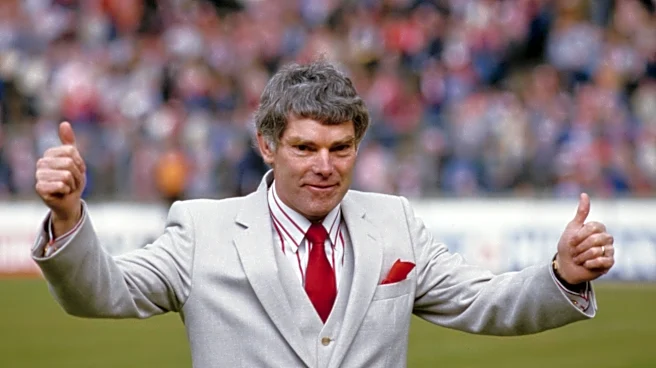





Len Ashurst was keen to get his own revolution underway – with seemingly little consideration for those around him.
After returning to the club as manager to replace Alan Durban, he had successfully secured top flight football for the season ahead – although how much he had to do with the final day 2-0 win at Leicester that rubber stamped safety is anyone’s guess.
Unusually, Ashurst had chosen not to travel or stay with the team before the game with relegation still a mathematical possibility – and
prior to kick off had got stuck in traffic, leaving player-coaches Pop Robson and Leighton James to hand in the team sheet and decide upon tactics.
While James – who’d been a regular all season – was dropped for the game, Robson started alongside James’ replacement Lee Chapman. And it was Chapman who scored the opener to set Sunderland on the road to a precious win, with 38 year old Robson sealing the deal on what turned out to be the last of his 182 appearances for the club.
Because Ashurst, it seems, was in no mood for sentiment. And on this day in 1984 – two days after that game at Filbert Street – the axe was being well and truly swung.
In truth, it had already begun prior to safety being certain. The team and fans went into the final game knowing Paul Bracewell would be sold to Everton after just one season at Roker – with Ashurst rumoured to be prepared to sell him for less than the club paid Stoke for him 12 months earlier.
That in itself is bizarre on a number or levels. Here’s a young, terrifically talented midfielder, coming off the back of an excellent season personally, and coveted by one of the country’s leading clubs. Sunderland were strapped for cash, and while Ashurst wanted money in to reinvest in the playing squad, holding out on Bracewell would seem the logical move.

However, it seems Bracewell – who was an Alan Durban man, having played for the former boss at Stoke – may have been too big a character for Ashurst to get onside; and it was deemed better to get him out of the door sooner rather than later.
While Bracewell was still under contract, a number of players’ deals were due to expire, and Ashurst wasted no time in clearing the decks – with Pop Robson, Leighton James, and Gary Rowell among the names to be jettisoned.
I’m sure that, with the right conversations with the three – two of whom had been part of Ashurst’s coaching staff and the other a bone fide Sunderland legend – the decisions would have been palatable, if disappointing.
However, letters were delivered to the three informing them their services would no longer be required – with no acknowledgement from the manager at all.

James received a letter through the post informing him he was being released, having arrived at Roker Park intending to take the reserve team to Stoke – instead he was asked to hand over his keys to the coaches room and be on his way.
I have no qualms about being given a free transfer. But it was disgusting to be informed by a letter which dropped through the door in the morning.
The letter wasn’t even signed by the manager—just the secretary. I’m also on the coaching staff and I’m certain the manager Len Ashurst had ample time to inform me himself.
I know for a fact that he told two youngsters who were getting free transfers, last week. The sickening thing is that there has been a lot of rubbish talked recently about the lack of honesty amongst the players.
But even though I’m on the coaching staff, no one had the decency to tell me I’m being freed.
If that wasn’t enough, I arrived at the ground and my keys for the coaches’ room were immediately taken off me. And I discovered, that behind my back, it had been arranged for someone else to take the reserves to Stoke.
Even though I had been given a free transfer I was prepared to see that through. I was even set to play.
What a shabby way to have to depart from the club. I have worked long hours for the club and didn’t expect to be treated like this.
I have no axe to grind with the club as a whole or the supporters, I wish them well.
I am just disgusted at what has happened over the last few weeks. We were just a couple of players short of being a decent side when Alan Durban was manager. But now Paul Bracewell is going to Everton and three or four others are likely to leave.
People will say I’m saying this because I’m an Alan Durban man, but I have been in the game long enough to accept whether people are good enough for the job.
Also given a free was Gary Rowell, who’d been top scorer in five of the six previous campaigns. He’d headed off with some of his teammates to Majorca, unaware of the letter landing on his doormat that morning – his wife desperately trying to get in contact with him to relay the news.
Meanwhile, Pop Robson had been assistant manager to Durban, and had been caretaker manager before Ashurst’s arrival, but the offer for Robson had been to coach the youth team the following year, a demotion he wasn’t too keen on.

Wholesale changes were envisaged, with skipper Ian Atkins, Barry Venison, Chris Turner, Mark Proctor and Lee Chapman all a rumoured to be available for transfer, with Ashurst deciding a scorched earth approach was needed when in reality it was tweaks to the work Durban had done.
Ashurst’s hardline approach hadn’t gone down well. Whether of his own volition or operating under a board mandate to cut costs, he’d cut back on players’ meals and put restrictions on the baths they could have, which didn’t enamour him to the playing squad, which James – who’d been an inspirational figure on the field at times as Sunderland secured safety – confirmed:
The last few weeks haven’t really been particularly enjoyable. Senior professionals like myself have been kept in the dark as to their futures, and that doesn’t help. It wasn’t that I was expecting any special treatment, but I would have thought I was entitled to some extra consideration.
Ashurst would reshape the side considerably over the course of the summer, with Gary Bennett, Howard Gayle, Steve Berry, Clive Walker and Roger Wylde all arriving at Roker – however the losses of James, Robson, Bracewell, Atkins and Chapman were significant, and ultimately the approach of Sunderland’s record outfield appearance holder Ashurst in the dugout left a bit to be desired, with Sunderland relegated by a clear 10 points come the end of the following season.