


For general manager Brett Veach, the message is clear: this offense is going to get more physical — and more intentional — in the run game.
“Everyone knows the potential and the flashes that (left tackle) Josh [Simmons] has shown, and then working on that interior with (left guard) Kingsley [Suamataia], (right guard) Trey [Smith] and (center) Creed [Humphrey]”
“I think it’d be a smart play to
take advantage of that interior trio there.” Veach continued, leaning into the identity shift. “To be more violent, to kind of utilize those guys and their strengths.”
That interior trio — built around physicality and cohesion — is exactly where Kansas City believes it can control games. Pair that with a backfield addition like running back Kenneth Walker III, and the vision starts to come into focus.
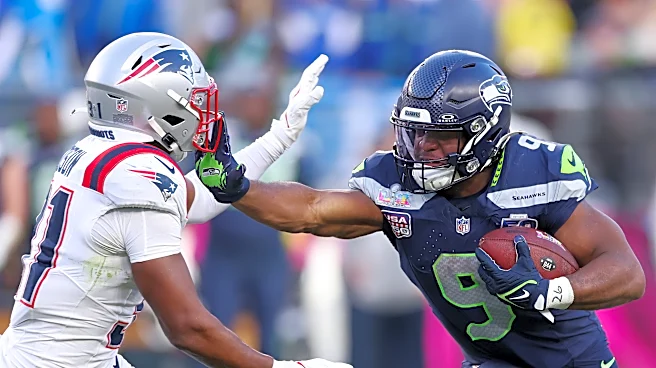
“So when you add a guy like Ken Walker,” Veach began to explain, “that was why he was so attractive to us: he has explosive speed.”
“He can do damage in the pass game,” Veach added, highlighting an overlooked factor in Walker’s game. “I don’t think he got enough credit for that because [the Seattle Seahawks] had [Zach] Charbonnet.”
But it’s the balance of power and explosiveness that stands out most.
“He squares his shoulders,” Veach said, describing Walker’s running style, “and he runs with power, and runs with violence, but also has some elusive qualities.”
“When you combine a back like that with as talented an inside three as you do,” Veach continued, bringing it all together, “I think it would make sense to want to go out there and impose your will on other teams’ defensive lines.”
That approach isn’t just about identity — it’s also about efficiency and sustainability, particularly for franchise quarterback Patrick Mahomes.
“It will be beneficial for Pat too,” Veach said, shifting to the bigger picture, “I don’t think we want him back there dropping back 50 or 60 times a game at the start of the season…”
“So I think that’s going to be something we’re looking forward to,” he added. “Certainly, with [Eric Bieniemy] coming back [as offensive coordinator], with his running back roots, there is going to be a high priority with that run game.”
That balance — between protecting the present and building for the future — remains at the core of how Kansas City operates.
“Each year presents a new challenge,” Veach said, “When you have Pat, there’s that mindset that you always have a chance to go out there and compete for a championship, compete for a division title.”
“I think the tricky part,” Veach continued, outlining the front office’s responsibility, “is trying to maintain that standard, but also keep an eye on the future, knowing that Pat is still going to be here for a long time.”
That long-term vision starts where it always has in Kansas City — up front.
“We always have to build this thing out, and build through the offensive and defensive lines,” Veach said. “And that’s where it starts.”
“Every team has that blueprint,” he added, “Once you get the quarterback, you have to protect him, and then on the defensive side, get after the other team’s quarterback.”
Still, Veach made it clear that balancing immediate needs with long-term sustainability is a constant challenge.
“There are some of those maybe more immediate, short-term needs that you want to fill,” he said, describing the draft approach, “so it’s just a counterbalance of going out there and getting Pat what he needs now.”
“…but also keep an eye on the future,” Veach finished, “to make sure we can maintain this run.”
For a team that has built its identity around elite quarterback play, the next evolution may be just as much about what happens on the ground — and how forcefully they can control it.