
Whew, the Kansas City Royals roster looks much different now than it did at this point even a week ago. The Maikel Garcia-to-Seattle trade was a swift move that opened the MLB offseason trade market, and adding Bryce Miller, Jose Ferrer, and Logan Evans to the 40-man roster should help address the team’s clear need for pitching ahead of the hopeful 2027 season – whenever that may be.
The roster moves continued later in the week, when the team non-tendered reliever Anthony Gose, despite his 0.66 ERA
in 14 appearances last season. Gose generated plenty of chase in his brief body of work and had above-average fastball velocity, but a 13.7% strikeout rate and a 4.84 SIERA were anemic even in the void that was the 2026 Royals bullpen. Without minor league options remaining, Kansas City would have had to carry him on the Opening Day roster to test whether there was more in the tank for the 36-year-old. Royals leadership has maintained that improving the pitching staff is the priority this offseason. Retaining Gose would have called into question how serious that effort really was, and the heat remains on Kansas City’s front office. The team also designated outfielder Kyle Isbel and reliever Nick Mears, later non-tendering them, making them free agents.
They join a list of other non-tendered players around baseball, and they all fit a similar profile – rebound candidates, replaceable performers, or players who simply did not fit the team’s picture for next season. This is not a damning end for many of their careers, but rarely do these players go on to make teams regret the decision. The Royals non-tendered pitcher Taylor Clarke and outfielder MJ Melendez a year ago. Clarke’s 2026 performance in the Royals bullpen would have been a relief, but Melendez was hardly a factor for the New York Mets. Again, Clarke is the exception, and Melendez is the rule across the league.
Of more than 70 non-tendered players last season, eight had noticeably solid seasons with new teams. Most of the remaining players missed 2026 to surgery, went to Asia, or barely pitched or played in the majors.
David Fry, utility player
2026 stats: 214 PA (91 games), .201/.313/.364, 8 HR, 0 SB, 13.1% BB%, 27.6% K%, 93 wRC+, 0.2 fWAR
2027 projections (Steamer): 172 PA (41 games), .216/.299/.387, 6 HR, 1 SB, 9.4% BB%, 26.5% K%, 90 wRC+, 0.4 fWAR
Royals fans might remember David Fry’s two-run homer in Cleveland’s 12-9 win over Kansas City in late September, but Guardians fans remember a lot more. Fry was a seventh-round pick by Milwaukee in 2018 out of Northwestern State and arrived in Cleveland as the player to be named later in a trade for J.C. Mejia. By 2024, he was an All-Star with a 129 wRC+ and 14 home runs while catching, playing first base, and covering left field. He also hit a walk-off homer in Game 3 of the ALCS. Not bad for a throw-in.
The last two seasons have not been kind. Fry missed the start of 2025 recovering from an elbow injury, and his season ended in late September when he was hit in the face by a pitch. In between, he hit .171/.229/.363. In 2026, he got back behind the plate and moved all over the diamond, but Cleveland optioned him to Triple-A Columbus midseason, and his contact quality never came back. His 86.3 mph average exit velocity, 6.4% barrel rate, and .271 xwOBA describe a hitter whose walks were doing most of the work.
Cleveland chose not to pay his projected $1.9 million salary and tendered contracts to the rest of its class, which left Fry as the only Guardian cut loose.
Of everyone on this list, he may be the best fit for what Kansas City says it wants. He hits right-handed on a team that ranked 19th in OPS against left-handed pitching, and he can catch, which would let Salvador Perez and Carter Jensen spend more days at designated hitter or first base without carrying a dedicated third catcher. He also covers both outfield corners and first base, giving the bench real flexibility. That flexibility extends to the roster itself, with three minor league options remaining and control through the 2029 season.
Much like Schneider, Fry is not an Opening Day lineup piece. The question is whether the 2024 bat survived two years of injuries. A Royals hitting staff that emphasized contact last season would need to fix his work inside the zone, where he made contact just 79.4% of the time in 2026. If that clicks, Kansas City gets a versatile right-handed bench bat with All-Star pedigree for close to the league minimum.
Davis Schneider, first baseman/outfielder
2026 stats: 156 PA (69 games), .145/.310/.315, 5 HR, 1 SB, 18.6% BB%, 32.7% K%, 84 wRC+, -0.2 fWAR
2027 projections (Steamer): 146 PA (35 games), .208/.332/.379, 5 HR, 2 SB, 14.5% BB%, 29.1% K%, 102 wRC+, 0.4 fWAR
As a mustached man myself, I have long admired Davis Schneider’s distinct look with the Toronto Blue Jays. Rarely do players taken so late make it to the majors, but Schneider made an impact in Toronto after debuting back in 2023. Even with a shaky 2024, he was worth 3.5 fWAR thanks to a 109 wRC+ and largely passable fielding at second and third base, with some work in left field. He played only 252 games across his first few seasons, filling in as needed and performing best as a depth piece rather than an everyday regular. Much like Nick Loftin in the Royals picture, Schneider was that guy for the Blue Jays.
But Toronto decided Schneider was not worth paying his first year of arbitration for that role, projected at $1.3 million according to MLB Trade Rumors’ Darragh McDonald. He has team control running through 2030, but he took steps back at the plate and in the field early last season, to the tune of -0.2 fWAR and negative fielding marks at both second base and left field. It did not help that he posted a career-high 32.7% strikeout rate, even paired with a career-high 18.6% walk rate.
Schneider could not find regular playing time or dominant enough results to warrant more work in 2026, and the Blue Jays optioned and recalled him four times last season. His swing decisions buoyed his reputation within the organization, but he could not maximize them with poor contact quality, and that made him expendable.
Why should the Royals look at Schneider? I believe there is a role-player fit in Kansas City, especially in a lefty-heavy outfield. His infield experience would come in handy if Loftin goes into Opening Day as the starting third baseman, with pinch-running specialist Tyler Tolbert serving as the team’s only utility option. Schneider is not a player Kansas City wants in the Opening Day lineup, but having him available off the bench is not a terrible fit.
The key to getting more out of him is fixing his bat-to-ball struggles. With new hitting minds in the dugout last season, Kansas City had the fifth-lowest whiff rate as a team, and whiffs have been Schneider’s issue since his MLB jump. New hitting coach Hunter Mense has a strong tie to him after spending 2022 through 2025 in Toronto, and he would likely have the best idea of whether Schneider can improve at the plate in Kansas City. With no right-handed-hitting utility options waiting in the wings, Schneider would offer a controllable bench piece with MLB experience.
Matt Wallner, outfielder
2026 stats: 135 PA (34 games), .167/.259/.292, 4 HR, 0 SB, 7.4% BB%, 39.3% K%, 57 wRC+, -0.8 fWAR
2027 projections (Steamer): 163 PA (39 games), .215/.304/.411, 7 HR, 2 SB, 9.3% BB%, 32.2% K%, 99 wRC+, 0.2 fWAR
Some hitters make you hold your breath every time they swing, and Matt Wallner was that sort of batter not too long ago. The Forest Lake native and 2019 pick out of Southern Miss has the kind of bat speed that turns a mistake pitch into a souvenir, and he proved it with a 22-homer season back in 2025. Wallner was a flawed player when it came to contact consistency, but the remaining power potential kept a breakout seemingly just around the corner. The good and the bad, it was all there.
2026 leaned hard toward the bad. Wallner struck out in 39.3% of his plate appearances across 34 games before Minnesota optioned him on May 14, and he never made it back. It was not for a lack of production in the minors. He hit 25 home runs with a 125 wRC+ in 94 games for St. Paul. But Aaron Gleeman’s tracking showed he hit just .163 against Triple-A fastballs at 95 mph or harder, and that is a problem when big league bullpens throw that hard every inning.
With Walker Jenkins and Emmanuel Rodriguez arriving and Alan Roden and Luke Keaschall pushing for corner reps, the Twins had no room for a streaky lefty bat. Wallner was not even eligible for arbitration yet, so money was not the reason. Minnesota simply ran out of patience before he ran out of potential, preferring the younger, cheaper players ready to show what they can do.
All in all, Wallner is a pre-arbitration player with real power who could come on a minor league deal, since trusting him with a 40-man roster spot does not feel like the sound move. Kansas City needs right-handed hitters, and Wallner does not fit that bill. Like Schneider, his problem is swing-and-miss, and a Royals hitting group may have ideas for tightening his approach. If they can turn a 39% strikeout rate into something closer to 30%, the power plays anywhere, even at Kauffman Stadium. If not, a non-roster invite costs nothing.
Trevor Larnach, outfielder
2026 stats: 433 PA (122 games), .269/.352/.436, 13 HR, 2 SB, 10.4% BB%, 18.2% K%, 123 wRC+, 2.2 fWAR
2027 projections (Steamer): 398 PA (93 games), .254/.337/.422, 13 HR, 3 SB, 10.4% BB%, 20.2% K%, 113 wRC+, 1.2 fWAR
Usually a non-tender follows a bad season. Trevor Larnach got one after the best season of his career. The 2018 first-round pick out of Oregon State spent years trying to prove he belonged in Minnesota’s lineup, and a 102 wRC+ and 0.2 fWAR in 2025 did little to separate him from the pack. In 2026, he finally put it together, setting career highs with a 123 wRC+ and 2.2 fWAR while cutting his strikeout rate to 18.2% and walking at a 10.4% clip.
So why is he available? Part of it is timing. A left wrist sprain ended his season in mid-September, and general manager Jeremy Zoll framed his November wrist procedure as a “cleanup.” He is still expected to be ready for spring training, so the injury is not the real story. The bigger factors were his $6.3 million projected salary and an outfield crowded with cheaper options. Roden offers a similar offensive profile with more defensive and baserunning value and is not yet arbitration-eligible, while Jenkins and Rodriguez represent the future. Shelton called Larnach the “odd man out.”
The flaws are, of course, palpable. Nearly all of Larnach’s value lives in the bat, and he has posted subpar marks in the field in five of his six MLB seasons. He has also been a strong-side platoon bat throughout his career. His 131 wRC+ against righties last season set a high bar, one his 62 wRC+ against southpaws could only dream of reaching.
Larnach is the best player on this list, and the one most likely to make his old team regret the decision. Kansas City needs offense, and a hitter projected for a 113 wRC+ would slide comfortably into the middle of the order against right-handed pitching.
Needing right-handed-hitting outfielders and adding Larnach are not mutually exclusive. Pairing him with whatever right-handed bat Kansas City acquires would give left field and designated hitter a sturdy platoon floor. He likely will not come cheap heading into his age-30 season and his first shot at free agency. But in a shallow pool of outfield options, Larnach’s non-tendering could turn out to be his blessing in disguise. If he is anything close to his 2026 self, he is Clarke, not Melendez.
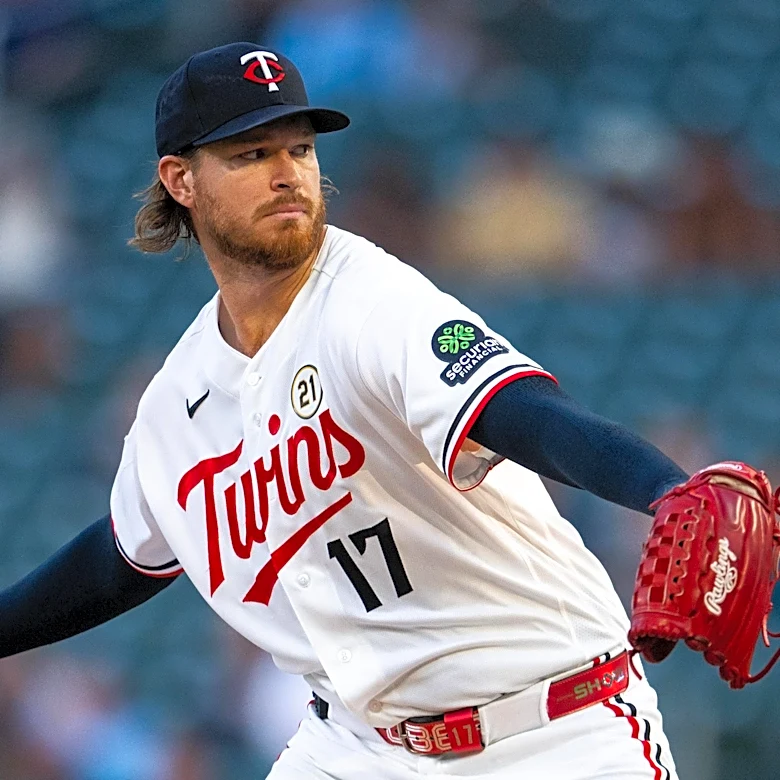
Bailey Ober, starting pitcher
2026 stats: 131.0 IP (25 G, 24 GS), 4.47 ERA, 4.61 FIP, 17.1% K%, 6.6% BB%, 1.44 HR/9, 34.8% GB%, 1.3 fWAR
2027 projections (Steamer): 135.0 IP (24 GS), 4.85 ERA, 4.93 FIP, 6.60 K/9, 2.37 BB/9, 0.9 fWAR
At 6-foot-9, Bailey Ober has always looked like he should throw harder than he does. That was part of the charm. Ober never needed velocity to get outs, using extension and deception to make a low-90s fastball play up, and it worked well enough to make him one of the more dependable arms in the AL Central. His best stretch peaked in 2024 with a 3.98 ERA across 178.2 innings and 2.9 fWAR.
Then the fastball started disappearing altogether. His four-seamer averaged 91.7 mph in 2024, 90.3 in 2025, and 88.3 in 2026. Ober adapted rather than collapsed. His changeup became his most-used pitch, and his sweeper became the weapon that decides high-leverage at-bats. His 4.47 ERA does not signal a collapse, but it did mark the end of his time as a dependable starter for the Twins, as the remaining arsenal was not good enough to carry the profile with the fastball so diminished.
The Twins decided that edge was not worth a projected $6.9 million through arbitration. After signing Sonny Gray, Minnesota had nine starters, Ober’s starts had become sporadic late in the year, and his diminished velocity likely made him hard to trade at that salary. Twins manager Derek Shelton sounded heartfelt about saying goodbye to Ober and another player we will discuss here. That is the business side of baseball, and it is the reality that shines through when a team is looking to get better rather than maintain the status quo.
Why should the Royals look at Ober? Innings. Over the last four seasons, he has thrown over 600, one of only 27 starters to do so. Kansas City used a franchise-record 37 pitchers last season, and Cole Ragans, Stephen Kolek, Ryan Bergert, and Luinder Avila are all expected to open 2027 on the injured list. Even with Bryce Miller joining Michael Wacha, Seth Lugo, and Noah Cameron, the depth behind that group is thin. There is still plenty of offseason remaining, but Kansas City going into the presumptive lockout with Tony Gonsolin or Randy Dobnak as the projected fifth starter tells me they did not learn from last year’s lessons.
The name recognition might be getting to me, but there is a spot for Ober in Kansas City on a prove-it deal. Getting that arm angle back up and ditching the sinker for a cutter could be ways Kansas City improves Ober in 2027, but it would take decisive communication to get him back on the right track.
Cole Sulser, relief pitcher
2026 stats: 56.1 IP (51 G), 4.31 ERA, 3.63 FIP, 3.56 SIERA, 23.7% K%, 7.2% BB%, 1.12 HR/9, 3 SV, 12 HLD, 0.6 fWAR
2027 projections (Steamer): 44.0 IP (44 G), 4.10 ERA, 4.20 FIP, 21.0% K%, 8.4% BB%, 0.1 fWAR
Like many complementary MLB pitchers, Cole Sulser’s transaction log reads like a well-traveled map. The Dartmouth product and 2013 25th-round pick has gone from Tampa Bay to Baltimore to Miami to Arizona, back to Tampa Bay, on to the Mets, and back to Tampa Bay again. His best work came with the 2021 Orioles, when he posted a 2.70 ERA across 63.1 innings with eight saves. Since then, he has mostly been the kind of veteran arm teams pass around on waiver claims.
That changed in 2026. Sulser had his largest workload since 2021, and only closer Bryan Baker and setup man Kevin Kelly made more appearances for the Rays. He also pitched in the ALCS and the World Series. He worked through a midseason injured list stint and returned in September. His 4.31 ERA looks pedestrian, but a 3.63 FIP and 3.56 SIERA suggest he pitched better than the surface results.
Tampa Bay non-tendered him anyway. Sulser was slated to make around $1.9 million and is out of options, so he cannot be sent to the minors. With one of the largest arbitration classes in baseball, the Rays needed the roster spot, though assistant general manager Kevin Ibach said Sulser is “certainly someone that we’d consider bringing back.”
If the Royals’ top priority is resurrecting a bullpen that was all but dead in 2026, the veteran Sulser is not a bad place to start. Sure, he has no flexibility to be optioned, but there is room for him to replace less seasoned relievers in Kansas City or supplant a guy like José Cuas.
Sulser is the opposite of a big spend. Remember Gose’s 13.7% strikeout rate and 4.84 SIERA? Sulser struck out 23.7% of hitters with a 3.56 SIERA in meaningful innings for a pennant winner. Unlike Gose, he makes an Opening Day spot easy to justify. He turns 37 in March, so this is a one-year bridge, not a long-term piece. Still, a reliable middle-innings arm for under $2 million is exactly the kind of “cobbling” owner John Sherman described earlier this year.
Rowan Wick, relief pitcher
2025 stats (NPB): 42.2 IP (40 G), 0.84 ERA, 1.39 FIP, 10.34 K/9, 2.32 BB/9, 5 SV
2027 projections (Steamer): 26.0 IP (26 G), 4.16 ERA, 4.15 FIP, 8.54 K/9, 3.71 BB/9, 0.1 fWAR
If Gose taught us anything, it is that position-player-turned-pitcher stories are fun but often short-lived. Rowan Wick is another one. The North Vancouver native was drafted by St. Louis in 2012 as a position player before moving to the mound, where he turned a mid-90s fastball into a big league career, mostly with the Chicago Cubs from 2019 through 2022. Across 146 MLB innings, he owns a 3.82 ERA, a 3.49 FIP, and 20 saves.
After bouncing through minor league deals in 2023, Wick took the road less traveled to Japan, and it paid off. He posted a 2.60 ERA for Yokohama in 2024, followed it with a 0.84 ERA and 1.39 FIP in 2025, and won a Japan Series title along the way. Then the elbow gave out, and he underwent Tommy John surgery in November 2025.
The San Francisco Giants signed him anyway last February, knowing he would miss all of 2026. He never threw a pitch for them, and this month the Giants declined his $800,000 option, designated him for assignment, and non-tendered him. Steamer projects him as a modest 26-inning reliever, and for a 34-year-old who has not pitched in the majors since 2022, even that might be generous.
He will almost certainly sign a minor league deal, and FanGraphs lists him with one minor league option remaining. That is exactly the flexibility Gose lacked. Kansas City could let Wick build back up in Omaha and call on him once his arm proves ready, rather than guaranteeing a roster spot on hope alone.
The upside is a reliever who struck out more than a batter per inning in each of his last two seasons in Japan and once averaged 95.2 mph on his fastball. Pitchers coming back from Tommy John often need time to regain their command, and Wick’s walk rates were never pristine, so patience is the price of admission. But in a bullpen that blew 26 saves last season, a free lottery ticket with a real track record is worth more than another arm that has already shown its ceiling.
Non-tendered players:
Catchers: Hayden Senger, Connor Wong
Infielders: Gabriel Arias, Leo Balcazar, David Fry, Nolan Gorman, Brett Harris, Christopher Morel, Davis Schneider, Trey Sweeney
Outfielders: Victor Bericoto, Bryan De La Cruz, Kyle Isbel, Trevor Larnach, Luke Raley, Taylor Trammell, Matt Vierling, Matt Wallner
Right-handed pitchers: José Buttó, Fernando Cruz, Moisés Chace, Jake Cousins, Josiah Gray, Garrett Hawkins, Jimmy Herget, Andrew Hoffman, Michael Grove, Luis Gil (signed by the Tigers), James Karinchak, Noah Murdock, Nick Mears, Max Rajcic, Dylan Ross, Ethan Roberts, Rowan Wick, Cole Sulser, Bailey Ober
Left-handed pitchers: Anthony Gose, Jake Miller, Carson Palmquist, Jared Simpson, JP Sears, Andrew Saalfrank, Blake Walston