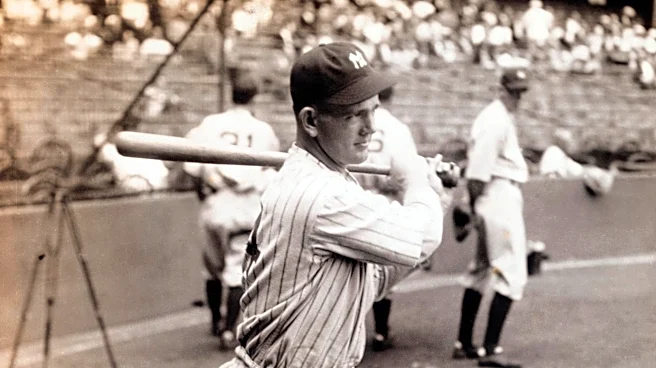






Before he had a chance to grow up and become affectionately known as “Babe Ruth’s Legs,” Samuel Byrd was known to his family as Dewey. While growing up in Birmingham, Alabama, Byrd excelled at basketball and baseball for Simpson High School. During his high school days, Byrd also found another sport to love, as he grew up close enough to the golf course to work as a caddie. Remarkably, both played a role in his long-term future.
Samuel Dewey Byrd Born: October 15, 1907 (Bremen, GA) Died: May 11, 1981
(Mesa, AZ) Yankees Tenure: 1929-1934
Following his graduating from Simpson High, Byrd worked as a bricklayer like his father while playing sandlot baseball. That changed in 1926 when the Southern Association’s Birmingham Barons signed Byrd to a contract and promptly sent him to the Jonesboro Buffaloes in Arkansas. In 59 games, Byrd posted a .348 average and led the league in hits.
Following that successful debut, the Barons tried Byrd out with the Knoxville Smokies for the 1927 season. Byrd caught fire again in the hills of Tennessee, batting .331 with 15 home runs. This performance landed him his big break. The New York Yankees purchased Byrd’s contract and assigned the right-handed outfielder to the Albany Senators for the 1928 season.
In Albany, Byrd kept rolling. His batting average jumped to .371, and he hit 18 home runs in 130 games. After that season, it was clear Byrd had a future in the big leagues. The Yankees invited him to spring training, and he made the club to start the 1929 season. The rookie had trouble finding playing time, as the Yankees’ outfield included Ruth, Earle Combs, and Bob Meusel. Wearing number 27 on his jersey, Byrd finished his rookie season with 202 plate appearances and slashed .312/.409/.471.

Meusel vacated left field prior to the 1930 season, but the Yankees used a rotation of players alongside Ruth and Combs. In his second big league season, Byrd appeared in 30 more games than he had as a rookie but only netted 52 more trips to the plate. Of the 92 games he appeared in, Byrd started only 54. This was when the nickname and honorific of being “Babe Ruth’s Legs” took hold, as Byrd was often used to pinch-run or serve as a defensive replacement for Ruth late in games.
The Yankees experienced some change prior to the 1931 season, as Joe McCarthy was brought in to lead the club and Ben Chapman was moved out of the infield to cover the spacious “Death Valley” in left. Byrd was locked in as the team’s fourth outfielder and continued to serve as Ruth’s late-game replacement. Byrd appeared in 115 games that year while starting only 45. In that role, he produced a .270/.349/.395 slash line.

The 1932 season was a magical one for the Yankees. The team won 107 games and went on to sweep the Chicago Cubs in the World Series. For Byrd, the season was much of the same: another solid year serving as the team’s fourth outfielder, batting .297 with a career-high eight home runs in pinstripes. Byrd appeared in one inning of the World Series, as you guessed it, a defensive replacement for Ruth in the final inning of the final game.
Byrd spent two more seasons in the Bronx, continuing to serve as the team’s fourth outfielder and primarily taking over for Ruth at some point during games. In 1933, he appeared in 85 games with 18 starts; in 1934, the numbers were 106 games and 42 starts. Perhaps not coincidentally, once Ruth’s time in pinstripes ended, so did Byrd’s, as the Cincinnati Reds purchased his contract ahead of the 1935 season.
The Reds let the 27-year-old Byrd start 111 games in 1935. In the full-time role, he slashed .262/.322/.406 with a career-high nine home runs. The 1936 season was not as kind to Byrd, as he returned to a reserve role, but he did achieve the rare feat of hitting a Jason Giambi-esque “ultimate grand slam,” a walk-off slam that turned a three-run deficit into a one-run victory against the Pirates. The Reds traded Byrd to the St. Louis Cardinals after the season, but he opted to retire rather than return to the minor leagues and started to pursue golf full-time.
Byrd’s passion and talent for golf were known throughout the majors. Byrd, along with Ruth and other teammates, played as much as they could, and many players at the time agreed that the Yankees’ odd man out in the outfield was actually the leader on the links. After just a few years, Byrd found himself competing at golf’s highest level. He finished third in the Masters in 1941 and fourth in 1942.

When he retired from professional golf in 1949 (incidentally, one year after Ruth’s passing), he had won six times on the PGA Tour while playing in 20 majors with four top 10 finishes. Today he still holds claim as the only person to ever play in both a World Series and the Masters Tournament.
After all his playing days were over, Byrd became a golf instructor. He taught people how to swing a club using a drill he picked up from the Babe himself, keeping a cloth pinned between his arm and body. In 1974, Byrd was inducted into the Alabama Sports Hall of Fame and got to enjoy those honors for seven years before passing away in 1981.
Whether you call him Dewey or Sammy, we wish him a happy birthday!
See more of the “Yankees Birthday of the Day” series here.