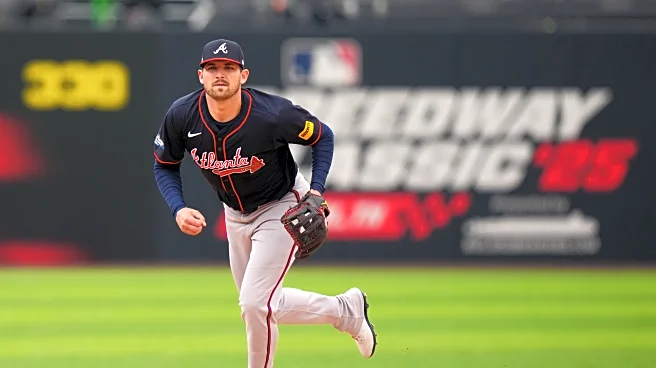

Austin Riley holds the largest contract in Braves history, and is tied for Matt Olson with the highest salary on the Club. Austin Riley also had a second straight disappointing, injury-shortened season.
After 2025, Riley and the Braves are still linked for seven years. At this point, it is what it is, but the Braves really could use an Austin Riley rebound in 2026. Before that, though, let’s get into his 2025.
How acquired
The Braves drafted Riley out of high school with the 41st overall pick of the 2015 draft. He famously had many teams that preferred him as a pitcher, but the Braves elected to develop him as a hitter.
Riley made his major league debut in 2019 and had some moments and plenty of home runs, but didn’t truly break out until 2021, with a huge 5.1 fWAR season despite some pretty butcher-ish defense. In the midst of a blazing hot summer (not talking about the temperature) in 2022, the Braves gave Riley a huge $212 million, ten-year extension that also included a $20 million club option.
What were the expectations?
Riley was monstrous in 2021-2023, putting up a combined 16.1 fWAR with a 136 wRC+ and no wOBA/xwOBA shenanigans. His hitting dipped a bit in 2023, but he actually played decent defense, so there wasn’t too much to complain about. That fWAR total, by the way, was top ten in baseball among position players in that span.
2024 was a weird year for Riley, as he massively underhit his xwOBA for the first time since the shortened 2020 season. His .361 xwOBA was very much in line with his .365 in 2023 and his .366 in 2021 (both of which came in easier hitting environments), but his .338 wOBA / 116 wRC+ was not very exciting. Riley’s season that year ended with a fractured hand, one of the later blows in what was best described as a plague of injuries that year. His defense slipped a bit from the gains he made in 2023, and he finished with 2.4 fWAR in 469 PAs, which came out to right around 3 fWAR per 600 PAs. It was a pretty steep drop from his 5+ fWAR production previously, but as noted, a lot of that was stuff he couldn’t control.
Given that, and assuming no lingering hand issues, it seemed safe to assume a bounceback from Riley in 2025. Hit bat speed only declined a bit, so there weren’t really any red flags to obsess over. Even assuming some basic regression to the mean, he still seemed like a 4-5 WAR guy, which is exactly where ZiPS had him ahead of the season (4.4 WAR in 604 PAs) — basically a line 30 percent above league average, with some below-average defense.
2025 Results
Well, expectations notwithstanding, 2025 did not go particularly well for Riley. While the rest of the team was doing weird approach stuff with walking and not chasing and swinging slower and who knows what else, Riley was seemingly immune to that, but not doing all that well anyway. He had an xwOBA in the .330s in April and in the .340s in May — while those really weren’t cause for concern as Riley’s seasons tend to involve mediocre months and ones where he goes thermonuclear and destroys pitching for long stretches — the issue was that things actually got worse in June and July, rather than him heating up. His .314 xwOBA in June was his worst calendar mark month since May 2024, and one of just two months where his performance was that low going back to the start of the short 2020 campaign.
He finished with a .328 xwOBA and a 103 wRC+ (from a sizable but not huge xwOBA underperformance). The xwOBA was the worst of his career since his 297-PA debut in 2019; the 103 wRC+ was his worst in a season where he got more than 300 PAs. His defense actually kind of rebounded to where he was in 2023, largely a credit to the hard work he put in on that front, but “Austin Riley, okay defender and okay hitter” is not what the Braves want to see. All in all, he had 1.7 fWAR in 447 PAs, which is about 2.3 fWAR per 600 PAs. Okay production, sure, but not Austin Riley level production.
What went right?
To be blunt, not much. His bat speed actually jumped over 2024, which is not something you can say about many of his teammates, and a lot of his contact quality stuff at least stayed really good, even if it fell off from earlier in his career. He also stayed pretty fast, with the highest sprint speed of his career. That suggests there aren’t really athleticism or health concerns with Riley broadly. And, as noted, while his defense wasn’t good, it was better than his prior years aside from 2023. Much of this suggests that Riley can rediscover what made him successful and isn’t necessarily declining, but he’ll need to actually get there.
He even had some cool moments offensively, like a game-tying double in extras to set up a walkoff win in extras a few pitches later.
What went wrong?
Alright, here’s where we’ve got a whole lot to say, as should be clear from the rest of this post.
First, we’ve got the injuries. Riley went on the shelf in mid-July with an abdomen strain, came back two weeks later, and then ended up shelved for the season after about a week of trying to play. Hopefully the core injuries and subsequent surgery are not indicative of long-term concerns, but we’re writing player season reviews here, not practicing medicine.
Beyond that, Riley’s stats slipped a bit in terms of exit velocity and hard-hit rate. After three seasons of very steady strikeout rates, walk rates, and whiff rates, all of those things slipped a fair bit, with his strikeout rate going from “yeah it’s high” to “oh man it’s high.“ Pitchers pounded the zone against him, and he never really adjusted, while his contact rate dipped for whatever reason. There also may have been pitch recognition issues, as he got an incredibly inflated meatball rate served to him, but had a meatball swing rate that dropped off from 2024.
Riley has always been kind of a weirdo, because you’d figure that a big strong guy like him would be killing fastballs and maybe even alive by secondaries, but instead, he’s hit secondaries really well for most of his career, especially from 2021-onward. However, his performance against fastballs has slipped from 2022-on, and fell from an average-y .375 xwOBA in 2024 to a not-so-great .352 in 2025. In addition, his performance against breaking pitches also cratered, so whatever was going on with him, it seemed to be more widespread than just being able to catch up to velocity or not. In particular, he really got eaten up by sliders and curves, especially in terms of whiffing on them in the zone. That, combined with some passivity, seemed to drive a lot of his offensive dropoff.
Maybe his bat control was affected by pain in his core. That might be optimistic, in the hopes that he’ll be just fine in 2026. Or, maybe there was another issue that won’t quite go away by itself.
But, there’s more to his 2025 misery than just the above. 2025 was also Austin Riley’s WPA vortex coming back with a vengeance. What is the WPA vortex, you ask? Well, back in 2021, when Riley was having a great season, he somehow had this bizarre circumstance: a 135 wRC+ in low leverage, a 160 wRC+ in medium leverage, and, wait for it… a 44 wRC+ in high leverage. Now, Riley was so good that year that it didn’t actually saddle him with negative WPA or anything, but…
…come 2025, things just got up straight-up comical. A 122 wRC+ in low leverage, a 111 wRC+ in medium leverage, and a 11 wRC+ in high leverage. This led to a clutch score of -2.10, the third-worst in baseball among anyone with 200 PAs. (Did you know that Ronald Acuña Jr. had the worst clutch score in baseball in 2025? He had a -11 wRC+ in high leverage. Dicing up PAs into leverage splits is weird.) Even if Riley doesn’t fully improve, at least he won’t drown in the WPA vortex in 2026. Hopefully.
If you had to pick a terrible Austin Riley game from 2025, you probably couldn’t outdo May 10, against the Pirates. Though the Braves ended up winning the game, Riley went 0-for-4 with a walk. He struck out to strand a runner on third in the seventh, made an error that let the Pirates tie the game in the eighth (with two outs and a runner on third), and then hit into a double play in the tenth.
2026 outlook
This really is the big question, isn’t it? If Riley can’t rediscover his star-level performance and production, the Braves are stuck with a pretty bad contract for the foreseeable future for a below average defender and unspectacular bat at third base, who may eventually need to move to first base or designated hitter. If he can, the Braves have an All-Star level producer slash darkhorse MVP candidate at third base in what should be his prime in the near term, under team control for the next eight seasons. There are, of course, possibilities that land in between those two outcomes, where Riley doesn’t recover his former level, but plays at a solid 3-4 WAR level.
One could look at Riley’s FanGraphs page and see a declining slugging rate since his 2021 season, be concerned about the direction of his performance over the past half-decade, and project that forward. I am more inclined to view 2025 as an outlier by itself. The differences from 2021-2023 look to me like normal variance in production and performance around a baseline of 135 wRC+ or so, rather than the picture of a meaningful decline in ability. The 2024 season was a clear decline in production, but the batted ball data still looked elite, so I’m not inclined to treat that as a true decline in talent or ability. The 2025 season was a legitimate step down, but given that it is a huge step down at the age of 28 in an injury-plagued season, I’m less inclined to treat is as a permanent drop in ability than I am to treat it as a lost season impacted by injury. That said, there is real concern that the whiff and squared-up rates won’t recover and were a result of some deeper issue beyond the core injuries.
ZiPS projects Riley for roughly a 3.5-4 WAR season and a 123 OPS+, which seems like a very reasonable projection, though the optimistic Braves fan in me wants to guess a bit higher for both. Steamer is even less hype, seeing his new talent level as 2024’s outputs, i.e., an above-average but not All-Star-level player.
As discussed above, the athleticism is still there, with the bat speed and sprint speed, and his chase rate remaining steady seems to reflect well on his swing decisions, reaction time, and eyesight. Those are ample reasons for me to believe in Riley as a rebound candidate after having the offseason to recover and work on his game. But, he’s got some work to do to get back to the level of production that got him his big contract.