
It’s easy to panic early in the regular season.
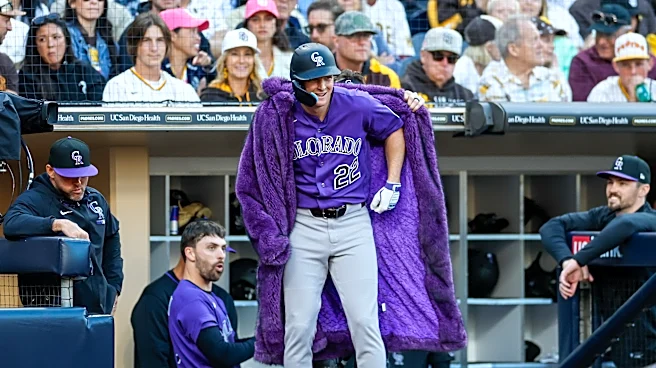
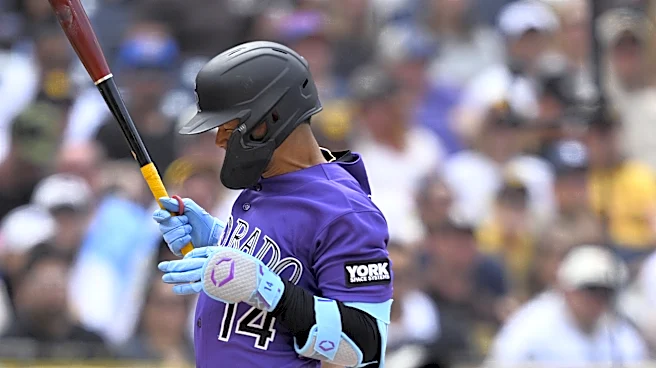
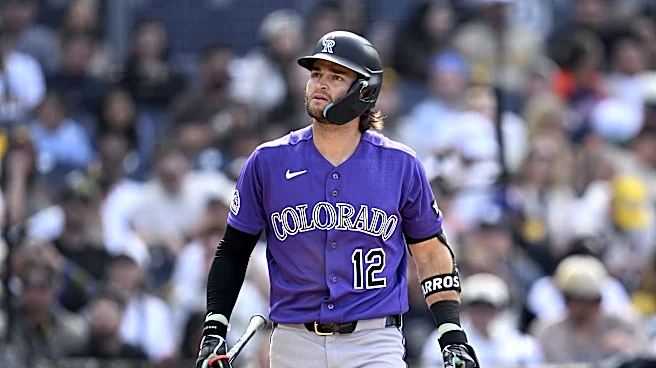
As the sample size of plate appearances continues to grow and success isn’t consistent, the temptation to pull the rip cord on certain young players grows ever more tempting. However, there is a difference between a player floundering and a player who just isn’t catching the breaks of success. A few weeks into the season, I find myself placing Kyle Karros in the latter category and asking this question: When can he break out?
Karros’ quick rise through
the Colorado Rockies system since being drafted in the fifth round out of UCLA in 2023 has been remarkable. Quickly displaying his elite glove talent in the field from the get-go, Karros snagged MVP honors in the Northwest League in his first full season in 2024 with his bat for the High-A Spokane Indians. Despite some injuries, he found success in Double-A the following year, leading to an explosive stint in Triple-A for a few weeks before settling in as the Rockies’ primary third baseman to close out the 2025 season.
There was a question whether the son of former Dodger great Eric Karros would prove capable of handling the hot corner regularly in 2026 and produce at the plate as his father did. The Rockies hedged their bets by bringing in the versatile Willi Castro as well as picking up Edouard Julien at second base. Youngster Ryan Ritter is also capable of playing third, so there were plenty of options heading into spring training.
Luckily for the Rockies, Karros had a strong spring training at the plate while continuing his elite work in the field, winning the job on Opening Day and at least showing the signs that he could handle the rigors of everyday work in the big leagues.
Which brings us to this point in time.
A quick look at his slash line, and it’s easy to scoff at Karros’ production. Entering the Houston series on Tuesday, he has batted .182/.294/.205 in 51 plate appearances over 16 games. He is 8-for-44 with just one extra-base hit and one RBI to his name.
Looking at those numbers, it’s reasonable to jump to the conclusion that he “isn’t ready,” but a deeper look into his performance warrants some grace and inspires some optimism that he can figure things out.
Karros has always been a player with solid plate awareness, particularly in the walk department. In his 43-game stint last season, he drew 15 walks (9.6% walk rate), which happened to be the 10th-most by a Rockies hitter last season. This season, he appears right on track to be able to replicate something along those lines as he leads the team with seven walks (13.7% walk rate). What helps is that he has seen the second-most pitches per plate appearance on the team at 4.07 P/PA.
On the flip side, he has generally struck out around 20% in the minors while averaging a 26.1% strikeout rate in the big leagues. Obviously, that is higher than league average and will hopefully improve with more time and experience, but it is tempered by his ability to draw walks. His 13 strikeouts rank fifth on the team, just ahead of T.J. Rumfield (12), but a 2:1 walk-to-strikeout ratio isn’t too shabby all things considered. He is a player who doesn’t typically chase out of the zone (16%) and generally is good at making contact on pitches inside the strike zone. Also, of his 13 strikeouts, six have come from swinging, while seven have been caught looking.
Karros’ main struggles have come against the breaking ball, where he’s slashing .111/.215/.167 with a 51.5% whiff rate. He’s also continuing to pound the ball into the dirt with a 45.5% ground ball rate and has managed just a 9.7% fly ball rate. Which means, he is smoking plenty of line drives at a 35.5% clip with a 38% hard-hit rate, but it’s just not doing anything to find the holes or do damage.
So what is to be done, and can he break out?
A look at his chart on Baseball Savant indicates the areas where Karros can work to improve.

His expected stats show he should have more success than he is getting, but for the most part, he is plateauing around being a league-average hitter at the moment in most categories.
The number that stands out the most is the bat speed.
As we’ve discussed in the past about bat tracking, a slower bat speed, combined with a shorter swing, generally lends itself to being a high-average contact hitter (see: Luis Arráez). On the other side of the spectrum, a fast bat with a long swing generally lends itself to a high slugging power hitter (see: Giancarlo Stanton).
When you get some sort of amalgamation of a slower bat speed with a longer swing, like Karros, you get a player who doesn’t necessarily excel in either area at the big-league level. They can become split between two different types of players as they struggle to find a footing. We can see Karros is elite at finding the launch angle sweet-spot on the bat, but the lack of oomph behind it due to bat speed is what is turning his batted balls into quick line drive outs.
He certainly isn’t floundering at the plate, but finding an edge in one direction or the other could go a long way for him.
At 23 years old, Karros is the youngest player on the Rockies, just behind Chase Dollander and Ezequiel Tovar. His massive frame and physical potential point to a player who should be capable of doing damage at the plate and be good for 15-20 home runs over time. He is still maturing and growing as a player, and he has the mental aptitude and physical tools to be an elite player at the plate.
So, when it comes to Kyle Karros, patience must be exhibited because he may just be a few adjustments and multi-hit games away from finding his footing and becoming the player that the Rockies hope he can be in 2026.
On the Farm
Triple-A: Oklahoma City Comets 9, Albuquerque Isotopes 6
A late-game surge wasn’t enough to overcome rough early pitching for the Isotopes in their loss in the series opener. Luis Peralta served as the “opener” for Albuquerque and was tagged for five runs on just one hit in 1.2 innings as he walked four batters and gave up a grand slam. Ryan Miller and Carson Skipper filled up the next few innings, combining to give up four runs in the next four innings. Luckily, the pen managed to keep things scoreless after that to give the offense a chance to respond finally. After managing just two runs through six, the Topes busted out a four-run seventh inning to close the gap. Cole Carrigg led the offense with a pair of hits and an RBI, while Adael Amador drove in a pair as part of his two-hit night. Unfortunately, the Isotopes went 3-for-11 with runners in scoring position and had just two extra-base hits, both of them doubles. They did draw nine walks against seven strikeouts, though.
Double-A: Richmond Flying Squirrels 11, Hartford Yard Goats 7
It was a rough night for Hartford’s pitching as every arm allowed at least one run in the loss. Connor Staine started the game and allowed five runs over three innings, while the four other relievers combined for six runs. The offense was rather lifeless through most of the game, scoring just two runs through the first eight innings. They then put up five in the bottom of the ninth, but it wasn’t enough to overcome the deficit. Dyan Jorge went 2-for-5, as did Bryant Betancourt, who delivered a three-run homer in the ninth. Aidan Longwell also drove in a pair as part of a two-hit night. Jorge and Longwell both had a double while Benny Montgomery delivered a triple in the game.
High-A: Spokane Indians 5, Vancouver Canadians 3
Quality pitching and a couple of big flies helped propel the Indians to victory. Brody Brecht started on the bump for Spokane and was dominant with six strikeouts against one walk and allowed just one run on three hits, but he worked just three innings. Of the 57 pitches he threw, 37 were for strikes. He gave way to Stu Flesland III, who worked four solid innings, allowing just two runs on five hits with three strikeouts. Offensively, the Indians got home runs from Kelvin Hidalgo and Alan Espinal, both of whom produced most of the hits. Hidalgo went 3-for-4 with an RBI, while Espinal went 2-for-4 with three RBI.
Low-A: Fresno Grizzlies 18, Ontario Tower Buzzers 7
Tanner Thach had a game to remember as he drove in about 10% of the Fresno Grizzlies’ runs in their victory over Ontario. Thach had four hits in the game, including a double and two home runs, a grand slam in the second and a two-run homer in the seventh, to drive in seven RBI on the night. The offense as a whole had 11 hits, with Derek Bernard producing three and Clayton Gray contributing two hits and two RBI. On the mound, Izeah Muniz allowed four runs, one earned, in 3.2 innings with six strikeouts. Brady Parker followed with 3.1 innings, allowing three runs on five hits with seven strikeouts. Yanzel Correra closed the game out with two scoreless innings.
Affected by Altitude Episode 206: Here Comes the Money | Rocky Mountain Rooftop
This week, Evan Lang and I talk about the Penner Sports Group buying a 40% stake in the Rockies before talking about the previous week’s games and players we’ve been impressed by thus far, and those we are a little worried about.
The time is now for the Rockies to make this obvious move | Rox Pile
Andrew Dill joins the calls of people clamoring for Charlie Condon to get the call from Albuquerque after the struggles of the Rockies’ offense and his own hot start in Triple-A.
Join the conversation!
Sign up for a user account and get:
- Fewer ads
- Create community posts
- Comment on articles, community posts
- Rec comments, community posts
- New, improved notifications system!
Please keep in mind our Purple Row Community Guidelines when you’re commenting. Thanks!