





Back when I was a lot younger, a little bit thinner and a lot less grey, in January 2002, I attended a lobby at the Houses of Parliament with a group of supporters from other clubs. Our cause, on that cold day almost 25 years ago, was part of an effort to convince MPs that safe-standing should be allowed at football matches in England and Wales.

That was my first involvement in the safe-standing campaign, something that I was to get increasingly involved in over the next 15 or so years. At the time,
though, this goal seemed virtually insurmountable, which is why tomorrow’s match vs Luton Town – at what to me will always be the Mad Stad – is so mind-blowing.
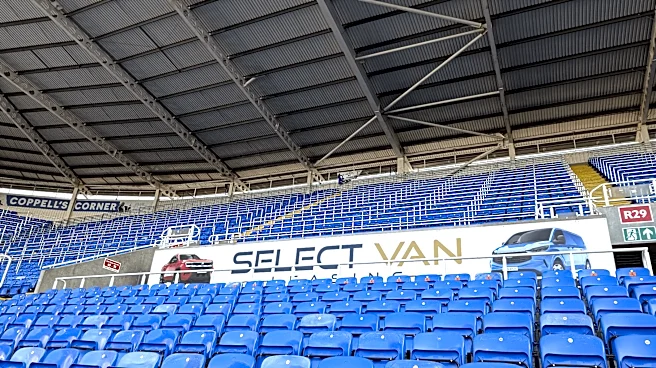
There’s actually a safe-standing area in Club 1871! Yes, football supporters can actually stand up vertically for the whole 90 minutes of the match, without being hassled by stewards, threatened with expulsion or being banned from the ground, or blocking the view of those behind them who don’t want to – or can’t – stand.
Yes, I’m aware that this is nothing particularly new, as safe-standing areas have been increasingly appearing at English grounds over the past five or six years. But for me, as a Reading supporter, the big thing, the unimaginable holy grail, was safe-standing coming to Reading. A big part of me wouldn’t believe that safe-standing had really arrived until it had arrived at Reading. And now it has, with surprisingly little fanfare or publicity for what I think is such a very big deal.

This safe-standing area covers both Club 1871, going from Row Q upwards, and also flows across into the back five rows of the away area, which means that 1,571 home and 332 away supporters get to experience football while standing.
But why was this such an impossible dream for me? If you’ll indulge me, I’ll take you back 25 years or so…
Back in 2001, the Taylor Report – issued in response to the Hillsborough disaster – was barely 11 years old, and had banned standing at all matches in the top two divisions of English football, with promoted clubs having three years to comply. Although the Taylor Report stated that “standing accommodation is not intrinsically unsafe”, the government of the time ploughed on and banned standing anyway.
Lord Justice Taylor also stated that football supporters would soon get used to all-seater grounds, but the reality is that there were a significant number of supporters, like me, who didn’t get used to it and couldn’t agree with the reasons behind it.
But, in a time so close to Hillsborough, and with a climate of rumour, disinformation, ignorance (and downright lies!) related to the disaster, it was fixed firmly in the minds of many that “standing equals hooliganism” and the numbers prepared to stand up and challenge this assumption were few and far between in those days, when supporter activism was only just starting to take off.
Frequently feeling like a lone voice, I did what I could to raise awareness and make the case for safe-standing whenever I could – for instance with an article in The Whiff a few months after the lobby to Parliament. But even 10 years later, in 2011, the ignorance and closed minds regarding what actually happened at Hillsborough were still deeply rooted in many – for example the editor of the Reading Evening Post when I had an article published which evangelised the idea of safe-standing at Reading.

By then, I’d become involved with the Football Supporters Federation’s safe-standing campaign, pushing the argument to government and others on a national basis.
It was always clear that the only solution to the impasse would be a political one, but key members of what was then the Football Licensing Authority, seen by the government as the technical experts on safety at sports grounds, were implacably opposed to any form of standing at grounds, so we found ourselves in a familiar loop where we’d make convincing arguments to a politician and they’d initially be supportive – but when they consulted the “experts” they came back with a hard “no”.
At the same time, we were frequently receiving the rebuff from government and politicians that “there’s no demand for it from supporters”, while all the quantitative data and supporter surveys consistently showed that supporters were 80%-90% in favour of dedicated safe-standing areas.
This was largely because the situation we found ourselves in due to the poor legislation was an absolute shambles, full of problems and paradoxes – supporters could legally stand “at times of excitement”, so those standing for “too long” faced the wrath of stewards and many were ejected from grounds, while the sight of rows bobbing up and down as games ebbed and flowed were commonplace. At the same time, those who couldn’t or didn’t want to stand might find themselves stuck behind someone who did, losing sight of the action, especially “at times of excitement”, and hassle between supporters was commonplace.
The obvious answer was to have dedicated areas for standers and non-standers, and with technology to make standing safe, a rail seating. Used extensively in Germany, these seats had bars to prevent what the FLA was most worried about – a progressive forward collapse with someone falling forward in a seated area dominoing into the person in front, and so on. But the FLA, and therefore the government, were still firmly opposed to even looking at the concept, even though many in football had accepted the idea and were enthusiastic.
But cracks were starting to appear in the establishment’s argument, and the long-established link between standing and hooliganism was further weakened by the Hillsborough Independent Panel, instigated in 2009 by the-then Culture Secretary Andy Burnham (I wonder what happened to him…) and which reported in September 2012. This completely exonerated supporters of any blame for the disaster, confirming that poor signage, a wholly inadequate ground with poor signage and no way to manage or measure the numbers entering enclosed pens, and – above all – cited the main cause as “a lack of police control”.
In December 2013, around 70% of Football League clubs supporting the idea of reintroducing standing accommodation, and asked the league executive to lobby government for a change in the rules prohibiting standing.
At around the same time, the “Safe-Standing Roadshow” was touring clubs to show them what safe-standing really meant in practice. I arranged for this to visit to the Mad Stad in early 2014 and the club’s decision-makers, including safety officer Ray Booth, were supportive and eager to explore ways this could be implemented, but of course the law – and the FLA, by then renamed the Sports Ground Safety Association – made this impossible.

Over the next few years the opposition to safe-standing was slowly being chipped away, with clubs like Bristol City, Peterborough United and Grimsby Town installing small-scale safe-standing areas (perfectly legal below Championship level, of course), while in Glasgow Celtic (the 1989 Football Spectators Act does not apply in Scotland) negotiated the introduction of a 2,600-capacity rail-seating area at Celtic Park in July 2016.
Meanwhile, a crowd-funding campaign being set up to fund the installation of a larger safe-standing area, for 550 fans, at Shrewsbury Town, successfully achieved its goal. I was particularly delighted by this, as I won two tickets to the Yellow Wall at Dusseldorf as a prize in this crowd-funding campaign, which was a simply phenomenal experience.
At the same time, the “there’s no demand for it” argument was finally laid to rest as a petition in support of safe-standing gained over 112,00 signatures in six months, guaranteeing a debate in Parliament on the issue.

This debate happened in June 2018, and the Sports Minister Tracey Crouch – a rare government minister who was sympathetic to football supporters – announced a government review into safe-standing, and the opposition Labour Party also added their support to a change in legislation.
By this point, momentum was unstoppable. Within two years there was a trial of safe-standing areas at both Manchester Premier League grounds, and from then on the idea has spread and spread to where we are today.
In a world where most of the war for supporter rights – ticket pricing, match scheduling, control by TV companies, over-commercialism, regulation and vetting of owners and so on – appears irredeemably lost, the fight for safe-standing is one where supporters did finally win a significant battle, in a struggle against overwhelming official opposition that took the best part of 25 years to play out. Although I was only a foot soldier in this struggle, and far more credit is due to many others than to me for this win, for me the focus was always of course, to see safe-standing in Reading.
So while it might not be a full-blown “rail-seat” installation as used in Germany and other places (which, I believe, would require significant structural alterations), the sight of safe-standing in the South Stand warms my heart and reminds me that, in a game which seems to be taken more and more away from supporters each season, there are still victories that can be done by working together and making the case for what is right for supporters, no matter how slim the hopes of victory seem.
And I’ll remember this every time I stand to watch Reading play at home – if my knees, which are now 25 years older than when this story started, can put up with me standing for a whole 90 minutes!