
The January transfer window is historically a terrible time to do any actual business. The teams that tend to be active in the mid-season transfer window are either good enough that they are looking for
the final piece for a title push, or bad enough that they’re desperate to spend money on players who could help keep them from relegation. Either way, while significant transfers CAN and HAVE happened in the past, they tend to be the exception rather than the norm.
Unfortunately, Tottenham Hotspur are closer to the second category than the first, and that’s not a very healthy or stress-free position to be in. Depending on how you crunch the numbers, Tottenham have a non-zero percent chance of being relegated this season under Thomas Frank — low enough to make it almost statistically irrelevant and not worth worrying about, but high enough to make it annoyingly tangible. The string of poor results under Frank, if you’re of a mind to be charitable, are due to a confluence of factors that include, yes, Frank’s poor job performance, but also too much football, a poorly-constructed squad, and another historic string of long-term injuries.
All along, when asked Thomas Frank has said that the club intended to be “active” in this January window, with clear holes in the squad and plenty of money to address them. But the line was also that any moves in January were going to be made with a long-term focus in mind: no panic buys, just players who can help Spurs in the short term AND the long term. To that end their non-youth incomings ended up being just two players: former Chelsea midfielder Conor Gallagher from Atletico Madrid, and 19-year-old Brazilian fullback Souza. One slotted straight into the first team, the other was one for the future, but might be thrust into the spotlight due to recent injures to Pedro Porro and Djed Spence. Gallagher was essentially a replacement for Brennan Johnson, whom Spurs offloaded to Crystal Palace for the same price (£35m). Meanwhile the club was linked to players such as Al-Ittihad’s Moussa Diaby and Al-Nassr/Fenerbahce’s Jhon Duran, as well as Monaco midfielder Maghnes Akliouche, none of which seemingly went anywhere.
All of this is background to the fact that, league wide, this was one of the quietest January transfer windows in recent memory. Not only did Tottenham Hotspur not make significant moves — very few clubs did. Aston Villa were more active than most, bringing in Tammy Abraham and re-loaning Douglas Luiz. Palace’s business was more about the outgoings than the incomings. Manchester City had probably the most significant window, bringing in Antoine Semenyo and Marc Guehi as they retool to try and catch Arsenal (notably quiet). Everyone else either stayed pat or nibbled around the edges of the squad with fringe loans or youth prospects. It seems that most clubs just simply did not want to make any significant moves one way or the other.
So again — the January window is hard, and this window proved to be more intractable than most. But that shouldn’t stop Spurs from being upset about how it played out. And there should be consequences for Spurs’ inaction at a time when they desperately needed an influx of good vibes and fresh talent.
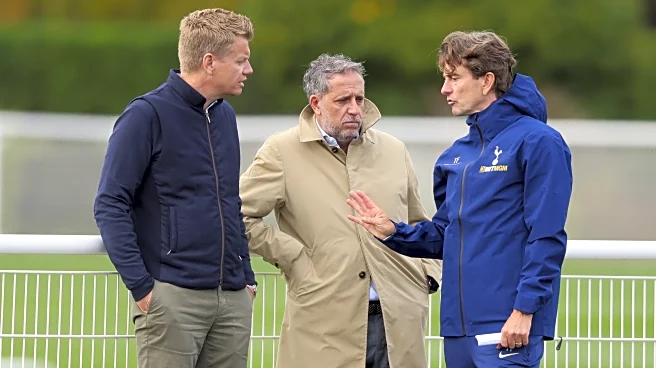
For all of the big talk Tottenham CEO Vinai Venkatesham and Co-Football Directors Johan Lange and Fabio Paratici made earlier this season about backing Thomas Frank and committing to creating a team that can compete for trophies on multiple fronts, the past two windows have proven to be something of a disaster. Summer acquisitions such as Mohamed Kudus, Joao Palhinha, and Randal Kolo Muani (loan) have either disappointed or been square pegs in round holes, while the £35m summer purchase of Mathys Tel appears at least for now to be an overpay relative to his current ability. While the late signing of Xavi Simons has proven to be an astute acquisition and Gallagher’s addition is at minimum useful, with the departure of Son Heung-Min this summer for LAFC and Johnson for Palace this month, Spurs are without their top scorers from the past two seasons and no longer have a viable identity. Who are they? What do they do? Who can they rely on now to put the ball in the ol’ onion basket? There’s no ready answer to that question, and it’s incredibly concerning.
That responsibility falls on the shoulders of co-sporting directors Lange and Paratici, and thus far neither have proven to be up to the task. Paratici gets something of a pass here, as he’s confirmed to be leaving the club for a Director of Football position at Fiorentina. But for all of Lange’s reputation as an astute identifier of talent, it’s mostly fallen flat as he seems to be targeting young players, or players with Skillcorner-esque physical attributes at the expense of technical ability and things like “passing” and “scoring.”
This is a club has been screaming for creative passing from central midfield, and the response has been crickets. While the club has nominally addressed the left back issue with the signing of Souza and tried to do more by targeting Liverpool’s Andy Robertson, Liverpool pulled the plug and Spurs seemingly had no backup plan. The attack is stymied by U-Ball and under-performance, but even with injuries there doesn’t seem to be the talent required to score goals and by extension compete at the highest levels of the league.
Thomas Frank has underachieved with the players at his disposal, but I am also convinced that the blame for Spurs’ malaise cannot be entirely laid at his feet. Lange, Paratici, and Venkatesham are equally culpable for Spurs being at the place they are at present. The palace coup that led to the departure of former chairman Daniel Levy from the club led to a vacuum that resulted in the most awkward reshuffling of executive deck chairs I’ve seen in football for a while. The reappointment of Fabio Paratici as “co-sporting director,” and then his subsequent resignation two months later to take a job at another club is embarrassing, and something that no number of awkward videos of them sharing a couch could shake. The lack of overall direction or clear plan for talent identification from both Lange and Paratici is equally frustrating. This is a Spurs squad that is unbalanced, poorly constructed, and underachieving, and that has as much to do with the people in charge of building it as it does with the manager on the sidelines.
Venkatesham, in his rare addresses to the supporters, and the new ENIC owners have talked a big game but have mostly swung and missed out over multiple windows. That’s more than just frustration, that’s incompetence. It’s led me to the conclusion that the club will not see significant improvement until changes are made at the sporting director level.
In an ideal situation, with Paratici now gone, the club would be wise to sack Lange, a sporting director who is both seemingly out of his depth and also notoriously reclusive to public scrutiny, and appoint a Director of Football with experience and vast football knowledge that can leverage the positive financial position Spurs are currently in to make big, targeted moves that address specific needs, while also being ruthless with players who are not living up to expectations. The squad clearly needs a significant refresh, and while that’s a daunting challenge, is it any harder than, say, winning a Europa League trophy? The club’s motto is To Dare is to Do but Spurs have done precious little Dare-ing, much less Do-ing.
Football clubs are slow-moving beasts at the best of times, and turning a supertanker like Tottenham around will take some effort, but if Spurs are to restructure in time to hit the ground running this summer, changes are needed now. That includes not only the manager, but also the overall recruitment structure. The club owes Tottenham fans this, if nothing else — admit that things aren’t working, explain in clear terms what needs to be done, and then make those changes quickly and with determination. Anything less only furthers the pattern of failure that has led us to this point.