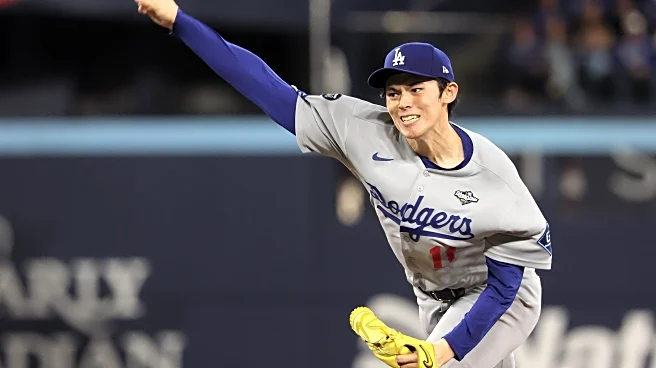

To understand Roki Sasaki’s rookie campaign, one must understand the notion of wabi sabi (embracing the beauty of imperfection), which was first popularized to American audiences through the seminal animated
hit King of the Hill.
As someone who followed Sasaki for two years before he came to the United States, I had a single thought watching him debut in Tokyo: uhhh, that boy ain’t right. This thought raised alarm bells because Sasaki was thrust right into the deep end and looked like he was ready to burst into the league after a strong abbreviated spring in the Cactus League.
Sasaki admitted he was a work in progress when he signed with the Dodgers. After getting tapped by the Dodgers to make his Major League debut for Game 2 of the Tokyo Series in a packed Tokyo Dome surrounded by countrymen with the baseball world watching, Sasaki was wild and showed flashes of the promise in that first game against the Cubs. His first three pitches were at 100 mph — that question of velocity would be the fulcrum of his rookie campaign.

Contrary to what Joe Davis said during Game 3 of the World Series, Sasaki was not “terrible” during his first month in the Majors. In his first eight appearances, Sasaki was not necessarily bad, but he did not look like the super prospect I had been studying for the past two years. He made eight starts, posting a 4.72 ERA through 34.1 innings pitched.
While Sasaki showed promise in his debut, his initial problems showed up fairly early after a poor domestic debut against the Detroit Tigers at home: Sasaki was striking out far fewer batters (6.29 K/9 innings) and walking far more batters (5.77 BB/9 innings) than he was in Japan (10.5 K/9 and 2.6 BB/9, respectively, for Chiba Lotte in 2024 as comparison).
Sasaki had battled oblique and other injuries during his final campaigns in Japan. His fastball velocity, which had been near 100 mph in Japan, was suddenly topping out at 92-95 mph while pitching for the Dodgers. The path of Sasaki’s fastball requires velocity to be effective. Moreover, Sasaki’s primary outpitch, his super forkball, acts like a cross between a knuckleball and a circle change-up, and often flutters outside of the zone.
Jack Harris, then of the Los Angeles Times, summarized the issue in mid-May:
So far, his trademark splitter has been an effective weapon, yielding just a .158 batting average to opponents while generating whiffs on 35% of swings. His lesser-used slider has been a fine secondary option, with opponents batting just three-for-12 against it while coming up empty on 33% of swings.
Sasaki’s fastball, on the other hand, has been susceptible to the improved level of hitting he has faced in the big leagues, resulting in a .253 opponent batting average, a .494 slugging percentage, almost as many home runs allowed (six, not even including two others that were robbed on leaping catches by Andy Pages) as strikeouts generated (eight), and a 10.1% whiff rate that ranks fifth-lowest for four-seamers among qualified MLB starters.
The Dodgers tried to have Sasaki hold back his fastball velocity to navigate his injury issues, but that strategy did not work. He pitched well enough for his first MLB victory in Arlington on April 19th (6 innings, 2 ER, 3 BB, 4K), but was stymied by Kirby Yates’ implosion in the ninth inning. Sasaki did not notch his first victory until May 3 against Atlanta.
On May 13, the Dodgers announced that Sasaki would be placed on the injured list with a right shoulder impingement, which ultimately would keep the rookie right-hander out until August 14.
His hips don’t lie
Sasaki rehabbed with Triple-A Oklahoma City with uneven results. Sasaki made five starts for the Comets, in which his fastball velocity ticked up from what it was in the Majors, but not nearly where it should be. Dave Roberts was disappointed about Sasaki’s lack of progress and foreclosed his return to the Dodgers in 2025 unless he seriously improved:
“Again, I think the main thing for Roki is just performance. Increasing his velocity and command. Just pitching well,” Roberts said. “We’re in a playoff race. So he’s got to continue to raise his level to be here.”
“Like I said a couple weeks ago, we’ve got to go with our best guys,” said Roberts of Sasaki seeing October. “And this is the time, right now. And again, Roki has gone through a lot this year. And he still has a ton of talent. We just want to see more.”
“I am surprised. Because the talent level is certainly there,” Roberts said after Sasaki’s most recent start [on September 2]. “The performance, the stuff hasn’t been there. I think there needs to be a tick up in stuff. And also against Triple-A hitters, you would expect more.”
Jeff Passan of ESPN reported that Sasaki said he was willing to overhaul his mechanics at the Dodgers’ Arizona complex. Per Passan’s reporting, which should be read in full, it is not an understatement to say that Director of Pitching Rob Hill and Pitching Performance Coordinator Ian Walsh saved Sasaki’s, and by extension, the Dodgers’ season.
For months, officials throughout the organization had worked to gain Sasaki’s trust, cognizant of how loath he was to offer it. President of baseball operations Andrew Friedman, general manager Brandon Gomes and manager Dave Roberts all had let Sasaki know they hadn’t lost faith, even as he’d gone from the major league rotation to minor league mediocrity. They would provide whatever tools he needed as the season went on.
…Hill and Walsh broke down the answers and emerged with a suite of options to help fix the issues. They believed that Sasaki’s troubles stemmed from his pelvis tipping forward, which caused him to rotate too early. During the pitching delivery, energy builds in the body, ripples up to the arm and is projected onto the ball at release. Any disruption — even something that goes unnoticed by the naked eye — can wreak havoc. And with Sasaki, that havoc equaled 7 mph of fastball velocity going AWOL.
On Sept. 5, Hill and Walsh presented [their analysis]. In particular, they believed the set position of Sasaki’s back leg could fix what ailed him. During the deposition, Sasaki had shown them videos from the 2022 and 2023 seasons, when his stuff was at its best, and his back leg wasn’t nearly as extended. By flexing the back leg, with his knee starting over his toes, Sasaki could avoid hinging his pelvis and delay it from dragging his center of mass forward too early, which prevented his front leg from having enough time to stabilize.
“Rotating the pelvis early is just death to everything,” Hill said.
[emphasis added.]
On September 9, while striking out eight, Sasaki gave up three runs in 4 2/3 innings of work against the Sacramento River Cats in Oklahoma City. While the stat line is unremarkable, for the first time since Spring Training, Sasaki looked like the Monster of the Reiwa Era.
Up, down, out was the mental cue that Sasaki used to transform his season.
The Dodgers did have a path for Sasaki to return in 2025: the bullpen. After a couple of final outings in Oklahoma City, 99 days later, Sasaki returned to the Dodgers on September 24 against the Arizona Diamondbacks in what served as a de facto tryout for the postseason bullpen. Sasaki passed with flying colors.
Sasaki made two successful relief outings in the final week of the 2025 regular season campaign. In his initial campaign, hitters had a slash line of .221/.342/.404 against Sasaki, which improved during the postseason.
The look of a killer
“When [Sasaki] came back, I told him he’s got a different look now,” Roberts said. “He’s got the look of a killer.” Moreover, Sasaki started carrying himself with the swagger of someone who belonged with the Dodgers.
Sasaki was a starter in Japan and essentially learned to be a reliever on the fly. Michael Baumann of FanGraphs best described the conundrum using Sasaki in the postseason, considering that Sasaki had primarily been a starter on a once-a-week schedule in Japan before this year:
Making Sasaki the closer was the right decision, but it’s not like Roberts could just declare it so and use him the way [Phillies Manager] Thomson used Jhoan Duran or [Blue Jays Manager] Schneider used Hoffman.
Sasaki broke out during the postseason run, posting scoreless outings during both the Wild Card round against the Cincinnati Reds and the Division Series round against the Philadelphia Phillies. Sasaki was primarily a two-pitch pitcher in the postseason run: his fastball and his super forkball. During the entire postseason run, hitters had a .182/.300/.273 slash line against the young phenom.
Based on the bullpen’s struggles in 2025 (most notably Blake Treinen and Tanner Scott), Dave Roberts did not declare that Sasaki was the Dodgers’ closer until after NLDS Game 2, when Treinen nearly coughed up the lead without recording a single out.
Sasaki gave a bravura performance in Game 4 of the NLDS, where he entered the game in the eighth and went three perfect innings, striking out two. It was the first time in MLB history that a pitcher had a perfect eighth, ninth, and tenth in a series-clinching victory, of which Dave Roberts was all smiles afterwards:
“Oh my gosh, you’re talking about one of the great all-time appearances out of the pen that I can remember,” Dodgers manager Dave Roberts said after the game. “Certainly given where he started this year, what he is as a starting pitcher, to go out there and not only go one inning, two innings and then three innings, and to do what he did gave us a huge boost.”
However, Sasaki had to be bailed out by Treinen in Game 1 of the NLCS, as fatigue began to show, when he surrendered his only run of the entire postseason against the Brewers. Moreover, Sasaki’s velocity slowly started to dip for the rest of the postseason run.
However, this success should really come with an asterisk, especially in the World Series, where Sasaki walked a tight rope in Game 3 and had one of the ugliest throws to first in recent memory. Moreover, no one will ever forget Sasaki’s final pitch of 2025.
For as bumpy as this half frame got in Game 6, it is worth remembering that the Blue Jays literally ran themselves out of the inning and into November baseball. Hence, another example of the imperfection, yet the success of Sasaki’s rookie campaign. Sasaki will return to the rotation in 2026. He will not participate in the 2026 World Baseball Classic. Even with all of his trials in 2025, Sasaki only turned 24 in early November.
Sasaki had developed a cutter while at Triple-A but did not use it upon returning to the Dodgers. Whether he further develops that pitch or tries to revive his slider will likely give MLB hitters something else to worry about, provided that Sasaki remains in the rotation. If Sasaki’s velocity can remain elite, the sky is literally the limit for the Monster of the Reiwa Era for his sophomore campaign.
2025 particulars
Age: 23
Stats: 1-1, 10 G, 36 1/3 IP, 28 K, 22 BB, 4.46 ERA, 5.80 FIP, 5.75 xERA, 1.431 WHIP, .3 rWAR, -0.1 fWAR
Postseason Stats: 3 saves, 9 G, 10 2/3 IP, 6 K, 5 BB, 0.84 ERA, 3.70 FIP, 1.031 WHIP
Salary: $760,000 (with a signing bonus of $6.5 million)
Game of the year
Sasaki’s Game of the Year is NLDS Game 4’s bravura performance against the Phillies. Nine up, nine down.
Roster status
Sasaki has one year of service time and has three options remaining.