
Everyone in the world of sports media has their reasons for getting into the field. For some, it is an extension of their fandom; others want to make a name for themselves and let everyone know their feelings on a team, league, or sport.
In 2021, I began covering Ohio State women’s basketball because I wanted to tell women’s sports stories from my own backyard. Before that, I wrote, for free, about the NWSL at the national level from my home in Central Ohio for a website. The people on that site wrote mainly
about basketball, but the daily conversations I read, and sometimes joined, rekindled a love of basketball that I lost in years prior.
I did not have any specific insight into the team or women’s college basketball, but I have always believed that if you want to try something, you should do it. Using the name of my outlet and a chunk of stories across women’s and men’s soccer that I had amassed over nearly a year, I emailed Ohio State’s sports information director (SID) to see if I could get a credential to cover games in person.
Now, four years and nearly 1,000 articles later, my goal of telling those stories has not changed, even if it is now with a different outlet. I have never used my Buckeye basketball beat for clickbait. The one thing that directs my writing is the question, “Would I want to read about this if I were a fan?”
I have followed that mantra to a fault. When I interviewed for a full-time national women’s basketball writing job, I did not make it through the first round of interviews, and part of that might be my answer for how I choose my writing topics. I did not mention anything about page clicks or data on how my previous articles fared with the algorithm. I stuck with the mantra.
My first longer-form feature was about forward Tanaya Beacham, a graduate senior backup forward for the Buckeyes. I chose that story because I loved the way Beacham brought energy to the game whenever she got on the court, and we were both from Northeast Ohio. Beacham talked about ice skating as a kid because she liked the donuts at the end of practice.
Over the years, consistent coverage earned me Big Ten voting privileges and hopefully the trust of the fans, coaches, and administration, but especially the players, which is the most important.
On Sunday, I drove to the Schottenstein Center for a basketball game for the 74th time as a member of the credentialed media. After an onslaught of uncompetitive nonconference games, a top-20 matchup between No. 19 Ohio State and the No. 4 UCLA Bruins was a game I anxiously awaited.
That matchup was different for media row. Over the years, the cast of fellow writers has changed many times, but currently, there are three of us who show up to nearly every game. Two of the three were out because their outlets needed them to travel to Texas for Ohio State’s College Football Playoff matchup against Miami.
Something to know about college basketball is that teams do not follow any sort of media availability standards, unlike the WNBA, NBA, or NFL. Some arenas allow the press to talk to both teams postgame, some only allow it for the home team, and in one arena, I have interviewed Ohio State coaches and players in the narrowest hallway you can imagine. Think about halfway down the shrinking hallway in “Willy Wonka and the Chocolate Factory.”
Over my previous non-NCAA Tournament trips to Ohio State, only four other games featured media availability from both teams. With that in mind, Sunday would have been No. 5, but I went into the game thinking I was going to be the lone wolf at media availability.
Here was the plan. While I also contribute to The IX Basketball’s Big Ten coverage, since I was there as an Ohio State beat writer, the SID and I decided that if I had any questions for the Bruins, I would let them know in the second half.
When that time came, I did not have any questions, and here is why — I was not writing any stories from the perspective of UCLA. Another thing about me, on top of writing about whatever I want, is that I hate bothering people. For years, asking questions has been the bane of my writing existence. I love the writing part, but not usually the process of getting the materials I need to write. My questions improved over the years, and I can go into any press conference with nothing in my head and come away with soundbites to throw into an article, but on Sunday, I did not want to waste UCLA’s time.
Any questions I was going to ask would be Ohio State-specific. If I did ask UCLA questions that were about their own team, they were likely going to land on the cutting room floor. Nobody at the other outlet I contribute to had questions either, so I respectfully told the SID that I did not need to take up any of their time, and they could move on to their next destination, thousands of miles away from home.
Could I have asked questions? Sure. Was it necessary for the work I was doing covering the Buckeyes? No.
There was no UCLA press conference. I attended the Buckeyes’ press conference, and 45 minutes after the final buzzer, I walked to my car and past the Bruins’ bus that had most of the team sitting inside.
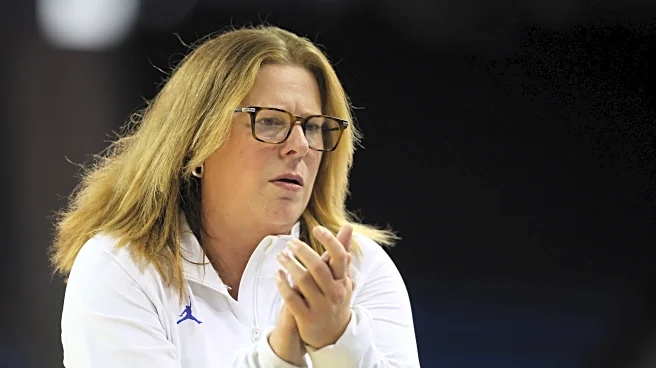
Later on Sunday night, UCLA head coach Cori Close used her platform to share her frustration with the lack of media at the ranked-vs.-ranked matchup. In a virtual press conference following the game, only one Bruin-specific outlet logged on, Benjamin Royer from the Orange County Register. Close voiced her frustration in that one-on-one interview.
“Honestly, if I’m being really blunt with you, the energy in the building was great, but having no media here at all from either team or either — no AP, no nothing, doesn’t say a lot,” Close said on Sunday. “We’re the only double-ranked game out today; the only one in the country, and we had no media day today. No media here. You’re the only one that’s asked to talk to me. And credit to you, but I don’t mind if you print that either. Like, for the only game that had two ranked opponents to not have more coverage over this particular game — disappointing, honestly.”
Over the last two seasons, I have been in a few press conferences with Close, and I have enjoyed each one of them. Simply hearing her responses to the questions of others, and a couple of my own, built an admiration and respect for her.
At the end of each press conference I attended, and probably every one she does, Close thanked the media for telling the stories of women’s basketball. It shocked me the first time I heard it, and it is something I will always remember. It added to the level of respect that I have for Close.
Unfortunately, social media and clickbait outlets did their thing with her comments following Sunday’s game. They wrote about a quote where Close vented her frustration at the lack of people covering her team’s games. Despite being in attendance for the game, I caught a small amount of social media frustrations at the lack of coverage, as I am sure my peers who were unable to attend have as well.
I went through my feelings on the quote and moved on to writing about Ohio State’s matchup on Wednesday against Purdue. A game I will cover from my home before I drive to Bloomington, Indiana on New Year’s Day to write a feature about the Michigan State Spartans against the Indiana Hoosiers. A trip I will pay for out of my own pocket.
Then, Coach Close shared a second quote with Front Office Sports.
I agree wholeheartedly that the Bruins deserve more attention, as does the entire sport, but a writer paid “pennies,” as my wife tells me (please know that I love every single check I receive, SB Nation!), is a small fish to fry.
Direct the frustration specifically to the editors of newspapers and online sites that cover UCLA or women’s college basketball in general, and ask why, even when the team did its own virtual presser, only one outlet attended. Talk to ESPN, which has only come to Columbus in the regular season when Caitlin Clark was on the court. No CBS Sports. None of the countless women’s sports aggregators. Nothing.
Go to the Big Ten itself and see if it can move some of its lobbying dollars towards enticing the media to make sports other than football a priority.
The ones who do come to the games are tired, stretched too thin, and could leave the industry as a whole for better pay, hours, and less stress. I know that my wife, family, and full-time employer would all love the pieces of me that I pour into writing about basketball nearly every day from October through April. My car would love to have back the over 3,500 miles I drove in 2025 to Bloomington, South Bend, Ann Arbor, Detroit, College Park, Indianapolis, and multiple trips to the Ohio State campus.
It is no shock that journalism of every kind and at every level is dying, be that for financial, political, or competition purposes. However, attacks against those who do show up do not help anything. I recognize that Close’s initial comments were directed both at the local outlets that cover her team and national sites and publications, but they still did sting.
The audience for women’s sports in general — and women’s basketball specifically — has grown tremendously in recent years, and I agree with Coach Close that there should be more attention on both the Bruins and the Buckeyes. But instead of criticizing the writers who — if they are like me — would love the resources and bandwidth to tell more stories about these teams and their sport, instead, the questions should be asked about why local and national outlets, which have all seen the financial benefits of covering women’s sports, continue to refuse to invest in women’s sports coverage.
So while I do bristle at Close’s assertion that no one covered Sunday’s game, I appreciate and feel her frustration at the continued underrepresentation of women’s basketball in the larger college sports media.