








While we wait for the Cubs to resume the 2026 season after back-to-back postponements, I thought I’d take this opportunity to present a few more of my thoughts about the A’s and their move to Las Vegas.
Note that I didn’t say “proposed” move to Las Vegas. As most of you know, I’ve been skeptical that they’d ever get the stadium built there.
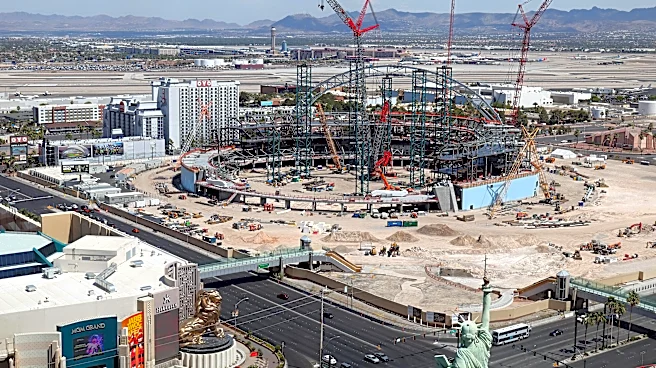
But now that is happening. Construction has begun on the ballpark on the Las Vegas Strip and it continues at a pace that should get the A’s there by the original
2028 date.
So let me say before I get into this: I was wrong. The A’s will move to Las Vegas. They’ll play one more year in Sacramento and then should open things in Nevada for the 2028 season. Mea culpa.
I’m writing this article not only to say that, but to react to some things said by A’s owner John Fisher in this article in The Athletic by Evan Drellich that was posted last week. My initial reaction was: Yes, the A’s will move to Las Vegas, but… will they succeed there? It’s not as cut-and-dried as you, or John Fisher, might thing.
Here’s the point, summed up by Drellich:
Fisher needs to build something else in Las Vegas: credibility.
If the A’s are to be successful in Sin City, Fisher will have to court not only locals, but some of the estimated 100,000-plus visitors who are in town on an average day. To snare those travelers, he’ll need sturdy relationships with every major hotel and casino.
In other words, his task is to sell his new city on not only his ballclub, but himself.
This is absolutely correct. Further to the “relationships with every major hotel and casino”:
Tourists arriving on the Strip for a handful of nights will have to decide whether to watch acrobats at a Cirque du Soleil show or catch a ballgame.
Again, 100 percent true. For example: When the Cubs play in Las Vegas, sure, I’ll be interested in going. Once. The key for Fisher is to get people to do this sort of thing more than once. As noted by Drellich:
When the A’s open their doors, big-name teams like the Los Angeles Dodgers and New York Yankees likely will always sell well. Casinos will be jockeying to have the best tickets available for clients and high rollers to catch names like Shohei Ohtani and Aaron Judge.
But midweek, when lesser teams are in town? That could be a different story.
Further, Las Vegas will become MLB’s smallest TV market (40th in Nielsen rankings, just a bit bigger than Jacksonville), though by metro area rankings it’s growing quite fast — currently 29th, about 2.4 million people, a bit smaller than Pittsburgh. But a lot of those people are from somewhere else, it’s quite the transient population. The question is: How do you build a local fanbase out of that population? You can’t succeed just by getting tourists to go to games.
Here’s another issue, per Drellich:
The stadium is supposed to account for nine acres on a 35-acre lot. Bally’s, the casino operator, has said it wants to build two hotel towers and 500,000 square feet of retail, dining and entertainment around the stadium. But Bally’s might never see the project through.
That would leave the A’s holding the bag for some key infrastructure efforts — and, at least for a time, with an empty lot outside their otherwise state-of-the-art venue.
Nine acres, incidentally, is a very small footprint. That’ll be only a bit larger than Target Field’s eight-acre footprint. Wrigley Field also sits on an eight-acre campus, a bit larger than Target Field.
Fisher thinks he has an idea that can make it work:
To Fisher, the local fan is “definitely a different customer” than the one who drops into the city for two nights.
To gain the trust of the former, the A’s are trying a grassroots approach: community outreach, donations to youth baseball leagues, and so forth. If a Dodgers fan living in Vegas has a 10-year-old who becomes an A’s fan, eventually, Fisher believes, the parents will jump on the same bandwagon.
“Over time we’re going to convert the people here who support the Brewers, who support the Dodgers, who support whatever the team,” Fisher said.
The A’s want to show they’re not “just another team from California that moved to Vegas,” Fisher said, making a reference to the Raiders’ relocation, but that they’re going to be “Vegas’ team.” He acknowledged that process would take time, however.
These are good ideas and a way for the A’s to become part of the community. The Raiders work in Vegas because an NFL team plays once a week and is mostly a TV attraction. The NHL’s Golden Knights have succeeded, in my view, at least in part because they became a good team immediately, making the Stanley Cup Finals their first year and winning it five years later. If the A’s want to become that sort of team, Fisher will have to spend money on players. Here’s what he said about that in the Athletic article:
The team has made a lot of noise over the past two winters by locking up its young players — something Fisher virtually never did in Oakland. Lawrence Butler, Brent Rooker, Tyler Soderstrom and Jacob Wilson are all under contract for the start of the team’s tenure in Las Vegas, so long as they remain on the club.
But Fisher left open his options when asked if he would consider trading those players in advance of the team’s relocation. Last summer, the A’s dealt the best relief pitcher in baseball, Mason Miller, to the San Diego Padres. Miller was not under a long-term deal, however.
“I think we thought Mason Miller would be with us forever,” Fisher said. “He is a one-of-a-kind athlete, and the greatest closer in the game, but at the time that we decided to trade him to San Diego and get (shortstop Leo) De Vries in return, it made a lot of sense.
“If you had asked me a month before, what are the chances of this, I would have said, you know, zero.”
As noted here, the A’s do have some good young players that they have locked up. They’ll need to develop more and spend in free agency for fans to believe that Fisher is serious about winning.
The article notes that there are still some issues to be settled, including whether Bally’s is going to complete a proposed casino next door to the stadium that would also provide some parking for baseball games. If not:
In Bally’s stead, there are three projects the A’s appear likely to need to take up on their own: a parking garage, a central utility plant and a plaza with pedestrian access to the ballpark from the strip, which is Las Vegas Blvd.
Without Bally’s, the A’s are likely to build a 1,500-stall parking garage rather than one with a capacity for 2,500, at a cost of anywhere from $60 million to maybe as much as $100 million, Hill said. The construction could be phased, however, so that eventually, Bally’s or someone else could expand the number of available spots.
But what then of parking in the meantime? In a vacuum, 1,500 stalls are probably insufficient for an MLB stadium. But plenty of other parking options already exist near the ballpark, including a large lot across the street heading south.
So clearly, this is all still a work in progress.
One thing now appears certain: The Las Vegas Athletics (and honestly, I hope they are called that rather than just “Vegas,” as the hockey team is) will begin play in their new stadium in 2028. From there, we’ll see if they’re going to have long-term success.