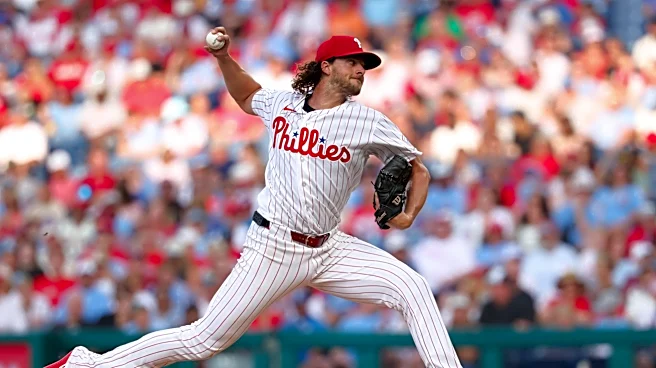

Aaron Nola stepped off the mound on Monday having delivered another quality start, his third in his last six games. He allowed three runs over six innings and departed with the Phillies down 3-0. But Nola had kept the Phillies stagnant offense in the game long enough for them to come alive against the Nationals bullpen in what would become a 6-3 win. Of course, he got to that quality start in typical Aaron Nola fashion though, as he surrendered two home runs to bring his league-leading total to 28
homers allowed, outpacing Nathan Eovaldi of the Rangers by four.
Since the start of July, Nola has a 4.37 ERA across 6 starts. It’s still not necessarily what you would want from someone like Nola, but it’s a welcome alternative to the 6.04 ERA he had in his first 17 starts of the year. The Phillies have been desperate for some stability in the back of their rotation, and for the most part, Nola has provided that over the last month.
He’s done it with a tangible adjustment that can be pointed to as the reason for his success. Nola’s usage of his changeup has slowly increased starting with his start on July 5th. He threw the pitch 19 times on 98 total pitches that night, or a 19% usage rate. Prior to that start, Nola had been using the changeup 16% of the time on average this season. In the games following that start, the usage has continued to climb, plateauing at 36.6% in his start on July 28th.

It’s perhaps no coincidence that he’s allowed three runs or less in all but one of those starts, and the one in which he allowed five runs on July 22nd was the lowest percentage of changeups (17.6%) since the trend began. Showcasing the offspeed offering has allowed Nola to keep hitters off of his fastball, a pitch that was getting demolished earlier in the season. Opponents are hitting .264 off of Nola’s four-seamer since the start of July as opposed to .388 combined in the previous months.
But of course, it will always be hard to trust Nola even when there is a clear adjustment to point to as a key to his success. He’s notorious for showing signs of promise before it all slips away in a barrage of balls going over the fence. Look no further than his .281/.325/.510 opponent’s batting line with two outs or his league-worst 10 home runs allowed with two strikes. Nola has cultivated a reputation of letting bad innings snowball into disasters, a trend that has accelerated since the start of his nightmare 2025 season. Even if he starts a game off well, it will always feel like he’s minutes away from disaster until he leaves with the quality start intact.
However, the Phillies have given themselves no choice but to put their trust in Nola and his adjustments. They opted not to address their already thin starting rotation at the trade deadline, instead choosing to roll with Nola and the newly recalled Andrew Painter to be their fourth and fifth starters. The pitching staff will ultimately live and die with its top three of Cristopher Sánchez, Zack Wheeler, and Jesús Luzardo. But after that, they need quality innings at a minimum, as every game will be important down the stretch and trying to find rest for an overtaxed bullpen along the way will be paramount. The Phillies need Nola to continue his recent string of success, serving as nothing more than at least a serviceable back of the rotation starter.
If that is an uncomfortable thought, it should be. But this is the route the Phillies and Dave Dombrowski chose when they did not trade for a starting pitcher at Monday’s trade deadline. Uncomfortable or not, they have to buy in to Nola’s new pix mix finally being the solution to his struggles, because they have left themselves no other option but to do so.