



Compared to last year’s squad
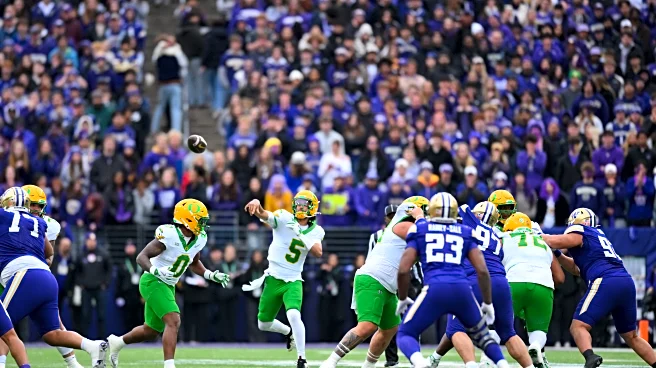
, the 2025 team showed a noticeable downtick in passing efficiency and explosive rushing. The downturn in both of these metrics can be directly traced to an offensive line that was over dependent on transfers and had a clear talent ceiling at the tackle positions.
Despite playing teams of varying quality and posting different scoring outcomes — opening against Montana State in the middle of back-to-back FCS title runs, then an Oklahoma State team that’s 4-20 over the last
two seasons; a highly conservative game plan against a Penn State team that turned out to be on the verge of collapse, then a much more pass-heavy game plan against Indiana on its title run — charting the offensive line’s cumulative error rates over time generally followed the reverse logistic-regression model hythoday’s observations over the years have documented about the transfer effect. There was little improvement early, followed by noticeable improvement after the halfway point of the season, then only marginal improvement afterwards. The spike in run blocking errors late in the regular season coincides with a series of injuries, while after the opening round game against James Madison the line was facing the most talented defensive fronts they had all season against Texas Tech and in the Indiana rematch.
Center Laloulu was the only returning starter from 2024 and his error rates took a notable dip in 2025. The fact that both his pass and run error rates suffered is troubling, but the increase in error rates is about in line with what one would expect with him being on a line with three first-year transfers. Iuli had some experience at right guard from last year and was slightly better in pass protection in 2025 but his run blocking error rate increased by more than 10%. This is even more than the expected average increase due to the transfer effect. It is also notable that, however briefly, he was benched in the second half of non-competitive games as Harkey and long-time reserve OL Kawika Rogers saw a few snaps at right guard. Transfer Pregnon was a rock at left guard, his performance being above what I would have expected given the transfer the effect and essentially evening out the average effect along the whole line by off-setting Iuli’s sharp decline.
While the interior of the line was a concern mostly due to the transfer effect, there were additional concerns raised by hythloday’s off season study of OTs Harkey and World. Although World moves ideally for a left tackle his overall strength and conditioning was poor and he didn’t have enough time in Eugene to effectively address this. As such he regularly resorted to grabbing his opponents and was fortunate to play in a league where the standard for calling offensive holding is quite high. Harkey on the other hand, while more technically sound and a violent run-blocker (sometimes too violent) has a ceiling on his mobility that limited him to playing right tackle and probably will have NFL teams thinking of him as a guard on their draft boards. During the regular season the offense could usually endure these issues, but in the post-season they became major liabilities.
Improving this unit in 2026 is priority number one for the team if they hope to make it back to the semi-finals and possibly move on to the national championship game. Much of the inefficiency in the passing game can be laid at the feet of QB Dante Moore having to scramble or get the ball out quick in the face of pressure.
The errors in the run game on my tally sheet were normally not egregious enough to prevent successful efficiency runs for a few yards. What we did not see from this unit was the precision necessary to get near the 20% threshold for explosive runs, specifically between the tackles, needed to stress better defenses. This is such a notable exception for the last 20 years or so of Oregon football we may return to the topic in the off season. We will certainly be looking at the possible line ups we could see next season and how many transfers might see significant playing time as the roster settles over Spring and Fall practice.
At quarterback Dante Moore played the first full season of his career, save for about one half missed against Wisconsin due to a broken nose. He posted an overall error rate of 18.39% on my tally sheet, which is a far cry from the less than 13% rate for elite quarterbacks. While he needs to improve in reading the defense, going through his progression, and calmly executing his mechanics in the face of pressure (with access to the season’s all-22 film I could do a more detailed breakdown in the summer if readers are interested), I put more responsibility for the passing game’s shortcomings on the offensive line and play calling than on Moore specifically. For instance, the drop back passing game when screen passes are taken away Moore had 53.79% efficiency, 24.55% explosive rate, and 9.82 adjusted yards per play. While Stein did lower his screen pass rate to 9.23% this season, close to FBS average, the performance numbers on these plays were quite low and a rate closer to between 4%-5% would have been more rational.
All of the Ducks’ primary wide receivers had very good to excellent numbers on a per-target basis. At the beginning of the year WR Dakorien Moore was by far QB Dante Moore’s (no relation) preferred target. I actually think this hurt his efficiency numbers as Dante had a habit of forcing the ball to him when there were no receivers wide open or pressure was getting to the quarterback. Gary Bryant Jr. was generally a later read in most patterns, and had the misfortune to be frequently targeted on screen passes, but his overall numbers were still very good regardless.
After injuries to these top two targets, former third option WR Malik Benson stepped up as the most targeted wide receiver and thrived. At the start of the year WR Jeremiah McClellan was primarily used as an extra blocker and rarely targeted, leading to pedestrian numbers. Thrust into a larger role he also stepped up admirably, without the early season drag on his efficiency I don’t think he would be much behind Benson on a per-target basis.
From very early in the Iowa game (when Bryant was hurt) Oregon turned into a primarily 12-personnel team. Even before this TE Kenyon Sadiq had been a frequent target, but afterwards spent more time split out from the formation and was frequently the quarterback’s first read. His role also changed to include quick routes in key third and fourth down situations. He also took Dak’s place as the target the ball was most frequently “forced” to. Combined these factors dragged his per target numbers down later in the season despite no loss in his ability.
By contrast, fellow TE Jamari Johnson truly blossomed when on the field with Sadiq. Defenses were in a bind having to cover two excellent tight end targets simultaneously and often gave Sadiq priority, which may have led to Ja. Johnson quickly becoming the most effective downfield target Oregon had. He was usually operating as an in-line tight end but split out on occasion as well. Both tight ends have work to do to refine their blocking (I have both around 30% run blocking rate on my tally sheet, at least 5% higher than acceptable), but Ja. Johnson should continue to be a major factor in the passing game next season.
The running backs were generally only used for check downs in the passing game in 2025, much as they had been in 2024 despite more diverse use in OC Stein’s offense in 2023. Veteran RB Noah Whittington was most frequently targeted of the backs by far, and his numbers are indicative of the kind of targets the group was getting. The exception to this was RB Dierre Hill, who in addition to often being targeted on screens when split out from the formation also was asked to run more complex downfield patterns. Though he wasn’t targeted very often I’ve included his numbers in the above passing target table as I think they indicate he (if not the other running backs) may have a larger role in the passing game going forward.
Veteran RB Noah Whittington was the most frequently used back throughout the season, and saw far more snaps in single back formations than any other member of this group. His overall numbers were far below his last healthy season in 2023, but based on his tape that is mostly a product of the offensive line in front of him. Early in the year while nursing a minor injury long time reserve RB Jayden Limar stepped in and performed well enough that I thought he would have a place in the rotation had he chosen to return in 2026. The staff appeared to trust only these two experienced backs in obvious passing situations, not wanting to risk using their talented underclassmen in situations that may involve blitz pick-up.
Bruising true freshman RB Jordan Davison saw increasing use as a single running back toward the end of the year. His superior success rate is due to a combination of his size and quick feet allowing him to better compensate for less-than-ideal blocking than the other backs, as well as his frequent use in short yardage situations that are high success probability in any case. On a per carry basis, the best ball carrier Oregon had was true freshman RB Dierre Hill. Hill was most often seen split out or used in 2-back sets (usually with Davison). Whether due to a combination of not wanting to over-tax the smaller back, or because his speed lent his skill set to specific play calls (probably a bit of both), Hill didn’t receive as many carries as his per-rush numbers would have indicated he should have. It does bear mentioning that many of his longest runs came early in the season against less talented defenses he could simply outrun to the perimeter of the field. Against better defenses later in the season this became a far more difficult prospect if the blocking was poor, which it too often was.
Two back sets were a regular part of the offense in 2025. With Whittington exhausting his eligibility, RB Jay Harris leaving and Limar earning excommunicate traitoris status through the portal, I’m unsure how often we’ll see the “thunder and lightning” combination of Davison and Hill both on the field in 2026. These departures do make room for R.-Fr. RB #21 Da’Juan Riggs, who only saw garbage time snaps in 2025 before his season was ended by injury, to earn his way into the rotation during the off season.
The QB run game was a bigger part of the offense than I would have anticipated this year, with Moore keeping on reads and being used the primary ball carrier so the running back could serve as a lead blocker. The spike in Moore’s efficiency numbers when carrying the ball is mostly attributable to the surprise factor and getting these playcalls in short-yardage situations when only a couple of yards converts the down. Later in the season the surprise wore off and they became less effective. Moore is not as mobile or instinctive a runner as Bo Nix or Dillon Gabriel, but he did show enough speed to keep defenses honest by reading back side defenders. My hope is that the called runs will be reduced next year as I don’t think such plays are the best use of his talents.