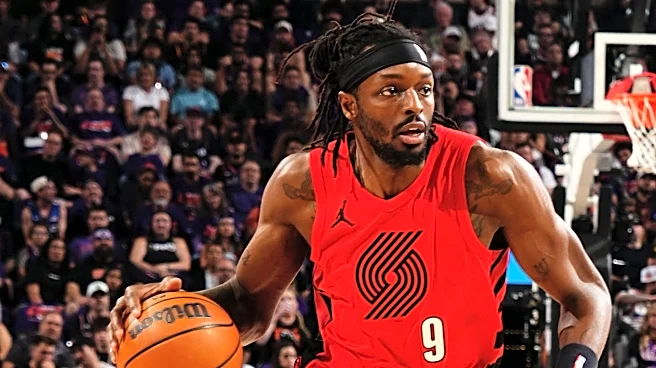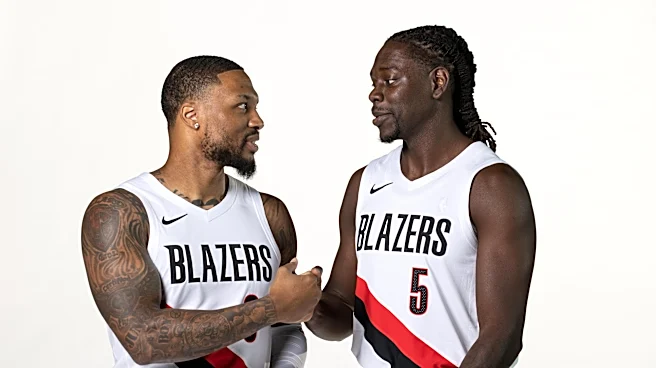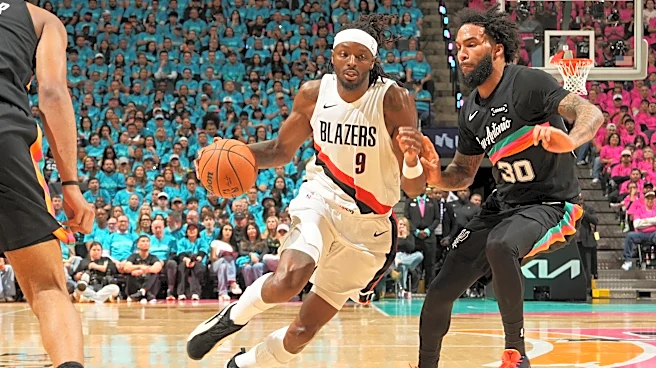



Jerami Grant is now employed by the Memphis Grizzlies. The former Portland Trail Blazers forward was sent to Tennessee in June as part of the deal for Ja Morant. Not before spending four years in Portland, largely carrying the team during some of the bleakest days of the recent rebuild.
Grant arrived in Portland during the summer of 2022, to join Damian Lillard in a final attempt to get that incarnation of the Blazers into the NBA Playoffs. The front office used the trade exception garnered in a CJ
McCollum deal, a first round pick, and two seconds to snare Grant from the Detroit Pistons.
A year later, the team re-signed the versatile forward to a five-year, $160 million contract, even after Lillard’s franchise-changing trade request. Though the amount was gaudy, there was no way the Blazers were letting an asset walk for nothing regardless of whether Lillard was a member of the locker room.
During his four Portland seasons, the 6’8 Grant averaged 18.8 points on 38.9 percent from three, 44.9 percent from the field, to go with 3.8 rebounds, 2.4 assists, 0.8 steals and 0.8 blocks. Most recently, he secured the win that got the Blazers into the 2026 NBA Playoffs, toppling the Phoenix Suns with a steal and a final-second bucket.
Grant arguably spent his prime years in Oregon, serving as a two-way forward capable of doing a little bit of everything.
What We Liked
I’ve seen a number of flippant, “good riddance” comments about the 32-year-old’s departure, including “he never felt like a Blazer”, “we’ll get the same production from Micah Potter” and he “had a propensity for falling down”. At each comment I rolled my eyes, wondering if people actually watched the games or were simply parroting what they saw on the internet.
Grant was a Blazer. For a couple of years ensured the franchise wasn’t devastatingly bad. He may have held onto the ball but that was because the young guys hadn’t shown an ability to do it themselves. I think back to the night of the 2024 NBA Trade Deadline when the Blazers hosted the Pistons. Grant finished the overtime loss alongside rookie Toumani Camara, Ashtan Hagans, Matisse Thybulle and Jabari Walker. Anfernee Simons left the game early with injury. Grant was the only guy able to generate any semblance of offense.
Even during these lean years, his usage never topped 26 percent, which is particularly notable during the 2023-24 season with he and Simons were the only two players capable of putting regular points on the scoreboard.
Sadly, Potter, who’s a strong chance not to make the roster, isn’t 1/15th of the player Grant is. The similarities end at the fact that they can both shoot from the power forward position. Potter isn’t half the defender Grant is, can’t play make, defend or pass at anywhere near the level that Grant can. Grant can guard positions one-through-four and has served as a point-of-attack defender for periods during his Portland tenure.
As for the “falling down” assessment, facepalms need to be executed far and wide. Grant has indeed been stopped while driving to the rim, as have Luka Doncic, Shai Gilgeous-Alexander and Kevin Durant. Do you know what the stats indicate? Last season, Grant had a better drive conversion rate on 3.0 attempts a game (40 percent) than Jalen Johnson, Desmond Bane, and Deni Avdija. He also had a better rim finishing rate on 4.6 attempts (64 percent) than Tyrese Maxey, Jalen Brunson and Stephon Castle.
More than that, among forwards, his 38.9 percent on 6.1 attempts from three was good enough for eighth among forwards, behind only Rui Hachimura, Pete Nance, Adama Bal (eight games), Royce O’Neale, Moses Moody, Nicolas Batum and Max Strus. That 38.9 percent was also the best on the roster for someone who took more than 3.5 attempts a game. Even with Damian Lillard’s return, this increasingly imbalanced Blazers team will again be one of the worst three-point shooting teams in the NBA with Grant’s departure not improving the situation.
Grant plays a position of need and is perhaps one of the rarest types in the modern NBA with his size, two-way ability and a reputation for boasting multuple strings in his bow.
What We Didn’t Like
Grant’s contract is the sticking point. It’s a lot, especially under this current CBA. The sweet-spot deal for him probably would have been something in the realm of five years and $100 million. That amount should have been enough to reflect Grant’s contribution while being low enough to move, yielding a positive return.
Rebounding was an issue and a facet Grant himself has acknowledged as a weak point. I’m not making any excuses for him, because I think he’s genuinely a subpar rebounder, but the fact that he has largely guarded perimeter players in Portland hasn’t helped his numbers. On offense he has lived predominantly on the three-point arc. Ultimately, a player of his size and ability should have been pulling down more boards.
There were a handful of games he did go missing. Whether this was due to a lack of engagement or something else, remains to be seen. But if we’re being honest, these nights were a serious minority when you look at the length of stay as a whole.
Finally, and this is more an organizational issue than Grant’s, but the veteran forward got sat every March and April, except during his fourth and final season, in order to help the Blazers tank. It would have been nice to see him get close to 82 games but it wasn’t in the franchise’s best interests.
Conclusion
I’m not suggesting it was right for Grant to remain a Blazer, but the vitriol surrounding his departure has been largely unwarranted. The versatile two-way 6’8 forward now finds himself on a Grizzlies team stacked with young talent and will again be tasked with playing the veteran role.
The Blazers were fortunate to have someone like Grant in order to keep the young roster above water during their own rebuild. The fact that he’s getting this kind of flack on his departure is pretty sad and relatively shortsighted. Both he and the Blazers can now move on and start fresh but I think it was important to get the facts on the table.