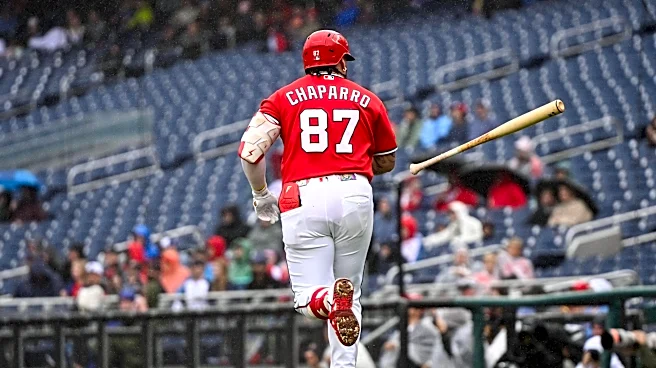


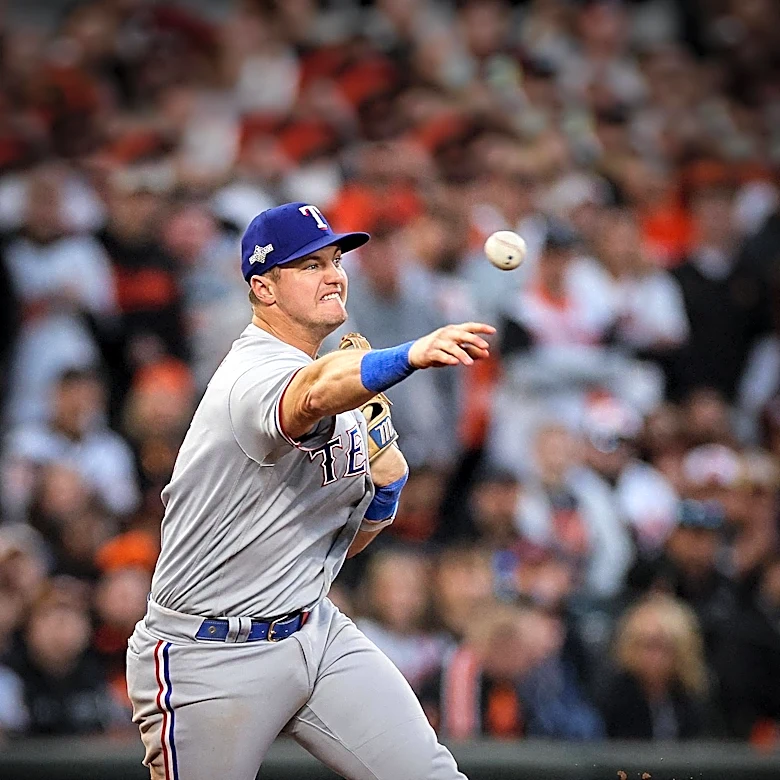

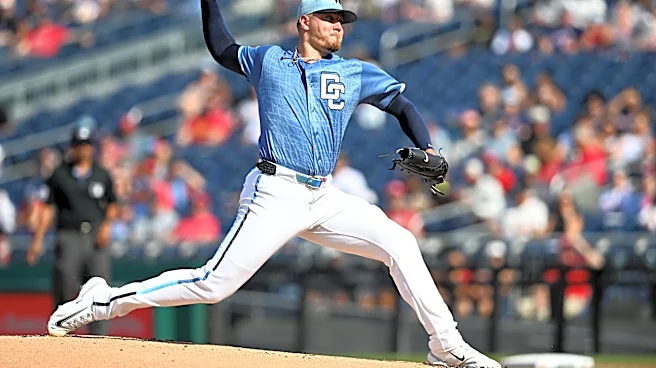
This season, the Nationals had a lot of hitters emerge. However, you could make a strong argument that Andres Chaparro was the best of the bunch after the All-Star Break. After struggling to get things going as a part time player in the first half, Chappy burst on to the scene down the stretch.
In the first half, I wondered why Chaparro was even on the team. The 27 year old seemed like the ultimate Quad-A player who could dominate in AAA but couldn’t replicate that success against big league pitching.
With a .586 OPS in the first half, and big league struggles in the past, it just seemed like Chappy was not that guy.
Things changed in the second half though, and I think you can point to one swing as the turning point. The Nats were playing in Sacramento when Chaparro absolutely unloaded on a Jose Suarez fastball. He sent the pitch 467 feet, hitting the ball over everything.
That swing unlocked a new version of Chaparro. During that first road trip after the break, Chaparro hit 3 homers and gained a ton of confidence. Before that swing, Chaparro was just trying to show he belonged. However, that monster blast proved to him that he could compete and thrive at this level.
There were more big swings to come from the Nats hulking slugger. Chaparro hit .299 with a .998 OPS in the second half. He also crushed 12 homers, including two on the final day of the season. It was a shocking and awesome reversal of fortunes.
One of my favorite things about Chaparro is just how majestic his home runs are. When he gets a hold of one, you usually know it is gone. With his steeper bat path, his homers tend to hang in the air longer than most. The best example of that is his first homer on the last day of the season. I was at that game, and it felt like time stopped as we waited for that home run ball to reach the seats.
It is really tough not to be blown away by what Chaparro did in the second half. That generational run gave him great season totals. For the year, Chappy hit .263 with a .360 OBP, an .885 OPS and 13 homers in just 83 games. He only had 198 AB’s, though it felt like it was more than that. His impact in that smaller sample was very loud. Chaparro’s 141 wRC+ is an elite number.
Heading into next season, I would like to see Chaparro get a shot at every day playing time, or at least something close to that. Despite his reputation as a lefty masher, Chaparro had very even splits. He had an .888 OPS against lefties and an .880 mark against righties.
The Nats showed they are willing to turn platoon guys into everyday players if it is earned. We saw that with Curtis Mead, and I think Chaparro could be another example of that. He was facing more right handed pitching at the end of the year, and I hope that carries over. We actually wrote about how he could be more than a platoon guy during his monster run.
Right now, Chaparro’s primary competition for at bats against RHP is Abimelec Ortiz, who struggled mightily down the stretch. Even though Ortiz is left handed, I think Chaparro is the better option against righties. That could change as we get into the 2027 season, but right now, Chaparro is much more proven.
The biggest drawback for Chaparro is his poor defense. Ideally, Chaparro would be a DH who plays first base occasionally. This season, Chaparro mainly played at first base, where he did not look great. He also got a few games at third, where I do not think he can play.
However, if he hits like he did this season, you simply have to get his bat into the lineup. Chaparro demolished fastballs, does a great job pulling the ball in the air and takes his walks. He is not a contact hitter by any means, but a 23.2% K rate is totally manageable.
With his big finish to the season, Andres Chaparro positioned himself nicely heading into next season. I think he deserves a shot at everyday playing time. It took him a while to establish himself, but like so many other Nats hitters, he took a major step forward this season.
Season Grade: A-