
After a dog-faced ugly loss to University of Portland earlier in the week, the question on every fans mind was how would the Zags (and Mark Few) respond. Would they rally? Play out of their absolute minds?
Leave with a convincing win? Or would the loss shell-shock them so thoroughly that they’d cough up the next one in a tight turnaround, like they did last year in their consecutive losses to Oregon State and then Santa Clara. The Zags opened things looking a little flat, but after a whistle-heavy second half, the Bulldogs had pulled off a 20 point win in a very hostile, raucous road environment.
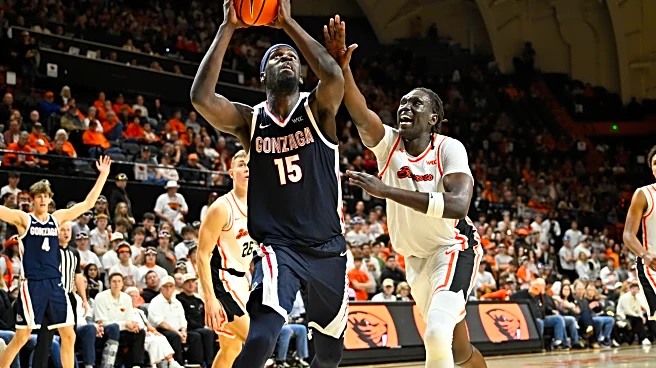
Gonzaga absorbed the noise, leaned into its strengths, and imposed control when the game demanded it, pulling away for an 81-61 win against one of the biggest, tallest frontcourts in the conference. Graham Ike led the way, continuing to build a legitimate All-American résumé and strengthening his case atop the WCC Player of the Year race. In a building that unraveld Gonzaga, the Zags last year, this year’s squad responded to their lone in-conference loss with authority.
First Half
From the opening tip, the Bulldogs went straight to Graham Ike, looking for early interior points and a way to quiet a building that overwhelmed them a year ago.
It was back and forth for the opening minutes Gonzaga showed active hands on the perimeter, forcing som early turnovers but also committing some careless fouls. Neither team separated before the first media timeout, with the Zags up narrowly and struggling to control the glass against Oregon’s massive frontcourt.
Gonzaga didn’t grab their first rebound until five and a half minutes into the first half, and when Adam Miller picked up his second foul at the 14-minute mark, the rotation thinned. Tyon Grant-Foster and Davis Fogle entered alongside Mario Saint-Supery, and tried to get some buckets in space or get downhill towards the rim. The Fogle/Grant-Foster combo is one that is becoming increasingly potent of late, both offering length and explosiveness that opposing teams struggle to contain. But by this point, Gonzaga had shot just 5-for-14 and continued to lose the rebounding battle by a substantial margin.
Offensively, the Bulldogs looked cramped and harried. Innocenti was blocked twice at the rim in transition, and Gonzaga’s interior defense kept rotating late on the help-side in the low-post, allowing some easy buckets for OSU’s bigs. But once Grant-Foster and Fogle checked in, Oregon State stopped scoring from the field, living at the free-throw line as Gonzaga clawed back on the strength and versatility of Graham Ike’s offense.
Midway through the half, a Coeur D’alene Casino commercial cut through the broadcast, featuring Graham Ike alongside bestie Braden Huff, smiling and loose, playing golf and getting massages. The timing felt cruel. Every empty possession that followed, every short miss in the lane, underscored how much the Bulldogs have missed Huff’s versatility, spacing, and connective scoring since suffering a knee injury a couple weeks ago. Even in a commercial break, his absence managed to loom over the game. Few was unusually candid in his post game comments on the potential return of B-Huff: “It’s not even close right now…“ Yikes.
With eight minutes left, Steele Venters checked in for the first time and Braeden Smith returned, but the problems remained. Penetration continued, Smith quickly picked up his second foul, and Gonzaga leaned heavily on Ike to maintain a 26-22 lead with 6:30 remaining.
Gonzaga maintained a four-point lead with no turnovers, but three starters sitting with two fouls. Oregon State responded by shooting over the top, hitting three after three to pull within one as the Zags tried to pull away. Smith stabilized the offense with four assists in eight minutes, and Ike pushed his total to 15, but Gonzaga still could not get consistent stops inside. The Beavers entered the bonus with two minutes left and the pressure mounted.
Grant-Foster continued to impact the game everywhere, filling the “Warley Work” role of flying around defensively, attacking the glass, and drawing contact at the rim, but–as has been the case lately–failing to draw whistles. Up two with a minute left, Gonzaga forced a shot-clock violation, its best defensive possession of the half.
Ike drew yet another foul with one second left and knocked down both free throws, sending Gonzaga into halftime up 38-34 with 19 first-half points.
But the offensive imbalance was clear. Saint-Supery, Fogle, Miller, Venters, and Smith combined for two points and one rebound in 31 minutes. Gonzaga leaned almost entirely on Ike, with Grant-Foster and Warley cleaning up possessions where they could. Oregon State went 5-for-7 from three. Ike and Innocenti never left the floor, and Gonzaga’s lead felt very precarious.
Second Half
Gonzaga opened the second half with the same starting group, and the margin for error vanished almost immediately. 12 seconds in, Jalen Warley picked up his third foul on a clear reach under the basket, followed moments later by Johan Munch doing the same for Oregon State. Fouls stacked up fast on both sides, four in the first two and a half minutes of action, setting the tone for a half governed as much by whistles as execution.
Braeden Smith briefly gave Gonzaga breathing room with a pull-up jumper, his first shot of the night, pushing the lead to nine. Warley soon picked up his fourth and headed to the bench, forcing Gonzaga into a Grant-Foster-at-the-four look. The offense held. Smith found Grant-Foster for a powerful alley-oop after a missed layup the possession before, and despite Oregon State trimming the lead to five, Gonzaga kept generating enough structure to stay ahead.
The middle stretch of the half became chaotic. Fouls piled up at a staggering rate, both teams entering the bonus before the 12-minute mark, with virtually nothing called at the rim and everything else called everywhere else. Oregon State stayed close by shooting over the top, hitting threes from multiple spots and reaching 8-for-13 from deep, but Gonzaga countered with control and execution. The Zags continued to protect the ball, racking up assists and limiting mistakes while punishing OSU in the paint.
The game finally broke open on Gonzaga’s terms. Davis Fogle slipped a screen for a dunk, Grant-Foster added free throws, and Gonzaga went on an 8-0 run to build its first double-digit lead. From there, the Zags slowed the pace, forcing Oregon State into longer possessions and limiting transition chances. Even as the Beavers continued to hit threes, their offense never sped up enough to seriously threaten the margin.
Graham Ike closed it. He crossed the 30-point mark with four minutes remaining, set a new career high with 35 in the final minute, and exited after playing 39 of 40 minutes, a new season high for the big man. Gonzaga finished with just two turnovers in 40 minutes, bled the clock late, and walked out of Gill Coliseum with an 81-61 win. The building emptied early, but Ike’s career defining performance will go down as one of the most complete games a Gonzaga center has ever played.
Key Stats & Observations
Outside of Graham Ike, Gonzaga’s first half was flat. They once again avoided small-ball entirely, choosing to ride Ike, who delivered one of the most dominant performances of his career: 35 points, seven rebounds, 11-for-18 from the field, 8-for-9 at the line, one three, two assists, and just turnover in 39 minutes.
Gonzaga held Oregon State to 44% shooting but allowed the Beavers to hit 56% from three. Fortunately, that imbalance was offset everywhere else. The Zags won the paint by a massive plus-40 margin, scored 13 points off nine Oregon State turnovers, and finished with just two turnovers of their own, a season low and a clear reflection of sharper passing everywhere on the floor.
Free throws also finally held up for the Zags. Gonzaga went 14-for-16 at the line, with Grant-Foster (usually one of the squad’s shakiest free throw shooters) hitting all four of his attempts. With Warley saddled with foul trouble, Tyon quietly finished with 15 points and seven rebounds, supplying the downhill pressure Gonzaga needed when foul trouble reshaped the rotation.
Saint-Supery struggled from the field at 2-for-9 but made both of his baskets in key moments and added five assists. Gonzaga’s point guards combined for 11 assists, with Braeden Smith handing out six in just 13 minutes. His scoring has lagged, but his ability to get the ball where it needs to be and at the right moments remains an essential part of the Gonzaga offensive arsenal.
After getting carved up by Joel Foxwell last week, Gonzaga leaned heavily on Emmanuel Innocenti for on-ball defense. Few clearly noted the problem. He logged a season-high 37 minutes against OSU, and despite contributing much offensively (four points, two assists), he dictated Gonzaga’s defensive pressure and grabbed five of his six total rebounds on the defensive end). Fouls dictated much of the second half, but Gonzaga absorbed the disruption by leaning on Grant-Foster and Davis Fogle, whose decision-making improved as the game settled.
The concerns for the Zags remain familiar. Adam Miller, Steele Venters, and Innocenti provided little offensively, and Gonzaga continues to lean extremely heavily on Ike in the absence of Braden Huff. The Bulldogs get Washington State on a short turnaround this coming Tuesday, still searching for a more sustainable offensive balance.