
The Green Bay Packers’ hiring of Jonathan Gannon as their defensive coordinator will likely bring about changes to the structure of the Packers’ defense. As highlighted on this website by our own Justis
Mosqueda, the Packers will almost certainly be transitioning from Jeff Hafley’s predominantly single-high or two-high spin structures back into a predominantly split-safety quarters/cover-7 world under Gannon . The changes in these structures don’t just impact the coverages, but also how the team approaches defending the run.
Every defense has to start from the foundation of how they are going to stop the run. If you just leave gaps unattended, the offense can just churn down the field like a knife through a nice soft stick of butter. It’s boring, it’s unexciting, it’s not sexy, but it’s a necessity to avoid getting walked down the field. In most of these two-high quarters-based structures, the idea is not that you are a man light in the box, despite generally being a man down at the snap, but to use both safeties as alley fillers to get to even numbers or even being +1 by the time the ball gets to the second-level. However, for this to work, the front has to buy time for those safeties to get there from depth. But because the box count is initially a man short, the front needs to not just be accountable for a single gap, or you’ll leave a free gap too early for your safeties to fill. Cody Alexander of Match Quarters describes how you account for this in these systems when discussing the Rams in a Substack post from 2022.
The D-line is playing a gap-and-a-half technique meaning they step to their primary gap, but not aggressively enough to get leveraged (react-attack). As the anchor point (DL) steps to his gap or man, he will react to the block of the O-lineman before then attacking the ball carrier. Playing this knock-back and “slower” technique allows the Rams to play their “fit” Safety from depth, leveraging the potential of a pass.
In order to successfully make this work, the key is that you have to slow-play this. While in many single-high structures (like Green Bay often employed under Hafley), your front can be more aggressive, trying to penetrate gaps to generate tackles-for-loss because you are matching your box numbers to available gaps, in two-high structures, you’re not. The gap shooting defensive tackles can be smaller and less sturdy when engaged because they are only responsible for one gap. This works better for guys like Devonte Wyatt, or, probably most successfully for the Packers in the past fifteen years, Mike Daniels.
However, in a situation where the defensive tackles are playing gap-and-a-half, the speed is less valuable. They simply won’t be asked to shoot gaps to try and generate splash plays, but will instead be asked to hold their water, buying time for the linebackers to ensure the opponent isn’t running play-action, and most importantly, buying time for the quarters safeties to fill the alleys on the edges. The front is supposed to clog up the middle, spill runs to the edge, where the linebackers and play-side safety can come and clean it up for a mild gain. It’s not splashy, but it can be effective with the right personnel.
The problem for Green Bay is that they do not have the right interior defensive line personnel for this. Last year, they played Colby Wooden, who was about 275-280 pounds when drafted, at nose tackle for much of the season. While he has substantially bulked up since then, he’s still well undersized for a nose tackle in any scheme, let alone one that would have him responsible for more than just his own gap.
Filling the massive hole at nose tackle may be done through the draft, but in truth, Green Bay probably needs to completely revamp the nose tackle room and move Wooden back to three-tech full-time in this scheme. However, Green Bay is unlikely to go into free agency significantly this spring, and even if they did, this free agent class does not present much in terms of good nose tackles. With the cap rising around 10% per year, it’s unlikely that legitimately good players get to free agency much anymore. The Packers also are going to want to maximize the compensatory picks they will get for the 2027 draft this offseason. With several free agents of their own who can contribute to this, don’t expect Green Bay to spend much on true free agents. However, “cap casualty” cuts by other teams do not factor into the comp pick formula. These are players who are cut or waived by their team, rather than have their contract expire.
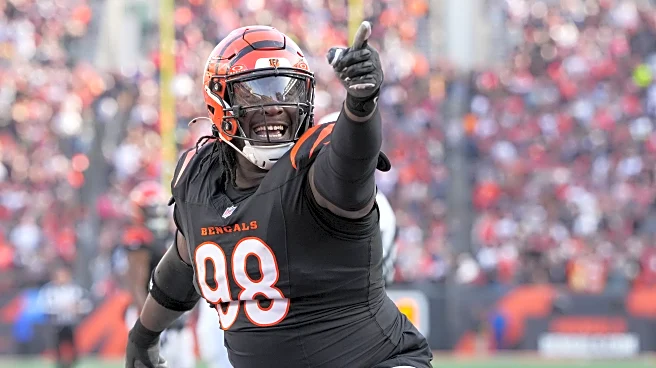
Trying to figure out who is potentially going to be a cap casualty across all 32 teams is difficult, but Over the Cap does a projection each year of possible cap casualties. And this year, they project that former Packer T.J. Slaton may be cut by the Cincinnati Bengals, who signed him to a two-year, $14M deal last spring. Slaton is due just north of $6.6M from the Bengals this season, a price they may deem too high for a player who saw his snap counts decline somewhat as the season progressed. The Bengals are not cap-strapped whatsoever, as they come into the off-season with north of $45M in top-51 cap space, but if Slaton were to reach free agency, it’s unlikely he would command nearly $7M in cash in 2026, so the Bengals may see fit to prioritize those resources elsewhere.
For Green Bay, this would present an opportunity. Slaton is a very limited player, but could provide Green Bay what it now needs: a run-stuffing and gap-eating nose tackle. Green Bay has seen this before, as in his final year, the Packers were significantly better at stopping the run when he was on the field. When Slaton was on, the Packers allowed a full yard-per-carry less than when he was off, and their opponent’s success rate was just 33.8% compared to 59.8% when he was off. He’d give Green Bay next-to-nothing in the pass-rushing department, but that would not be his role. He would play almost no third-and-medium or third-and-long, and that is why you have Micah Parsons, Devonte Wyatt, and Lukas Van Ness. Helping to get those players into situations where they can pressure the quarterback would be his only job.