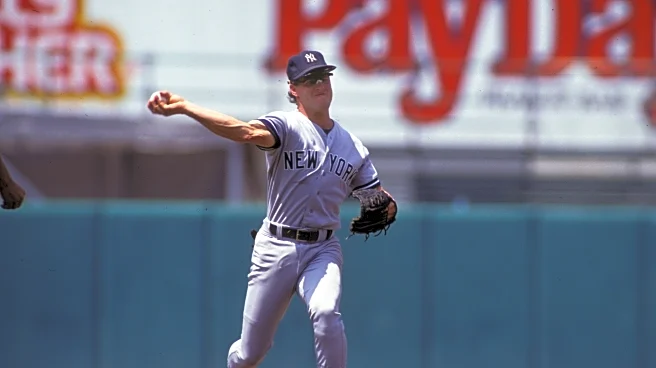

Sometimes in life, you end up at the right place at the wrong time. Steve Sax was an excellent ballplayer, making five All-Star teams during a distinguished, 14-year career. You could make a strong argument that the best years of his career were spent in pinstripes. And yet, despite his success in baseball’s biggest market, Sax is barely remembered as a Yankee. It was a simple case of terrible timing — and not just because he had the misfortune of being blamed for every unsolved murder in New York
City by some overzealous cops while passing through Springfield.
Steve Sax
Signing Date: November 23, 1988
Contract: Three years, $4 million
Steve Sax grew up in West Sacramento, California — best known in baseball circles as the current home of the Athletics. After earning All-City, All State, and All-American honors his junior year at James Marshall High School, the infielder was taken by the Los Angeles Dodgers in the ninth round of the 1978 MLB Draft. He immediately got to work outperforming his draft position, hitting .328 in 131 Rookie league at-bats. After continued success in A-ball, the 21-year-old earned a job as the everyday second baseman at Double-A San Antonio for the 1981 season.
Sax conquered this next level, too, hitting .346 with 34 stolen bases through 115 games. When mainstay Davey Lopes, who had just earned his fourth straight All-Star selection, went down with a groin injury in August, the Dodgers leapfrogged their young phenom straight to the big leagues. He filled in admirably down the stretch, hitting .277 while playing capable defense. When Lopes returned by season’s end, Sax was relegated to the bench, grounding out in his single World Series at-bat as LA toppled the Yankees in six games for their first title since 1965. Still, he was a champion at just 21-years-old.
But Sax showed enough to prompt GM Al Campanis to break up his championship infield, trading Lopes to Oakland to open a spot for his young middle infielder. Sax rose to the challenge, hitting .282 while swiping 49 bags and playing strong defense as he took home NL Rookie of the Year honors. The tenacity that Campanis had recognized during Sax’s first stretch in the majors was widely noted as well, with the 22-year-old drawing comparisons to Pete Rose (The Sporting News even dubbed him “Steve Hustle” in a memorable headline). “I’ve patterned myself after (Rose),” Sax said after winning his rookie honors, acknowledging the connection to baseball’s soon-to-be hits leader. “I’m a very aggressive player, and try to give 100 percent all the time. I try to force mistakes and make things happen.”
Heading into 1983, the world appeared to be at Steve Sax’s feet. That’s when the unthinkable happened: the Gold Glove-caliber defender inexplicably lost the ability to make the routine throw to first base. The affliction — familiar to Yankees fans who watched Chuck Knoblauch go through it during his tenure in New York — became widely known as “Steve Sax Syndrome” as Sax was the first high-profile position player on record to experience the mental block. The issue would plague him on and off over the next couple of seasons before resolving itself.
“Steve Sax Syndrome” didn’t prevent Campanis from handing its namesake a five-year, $3-million extension before the 1984 season that would keep him in Dodger blue through the end of the 1988 season. And, while he never quite fulfilled the promise of his rookie campaign, he was largely healthy and effective over the length of that deal. This stretch included a career year in 1986 in which the 26-year-old hit .332 with 40 swipes, garnering MVP votes and receiving the only Silver Slugger Award of his career.
Sax was still installed at second base when the Dodgers made another title run in 1988. One of two members of the 1981 squad still on board (along with Mike Scioscia), the veteran hit .300 to help LA overtake Oakland in a series best remembered for Kirk Gibson’s walk-off in Game 1.
Sax hit free agency for the first time after that season. After Campanis, one of Sax’s earliest boosters, was fired the year prior for making racist remarks in a TV interview, new GM Fred Claire appeared less interested in retaining his second baseman. “This is our final offer,” he reportedly told Sax. “If you think you’re getting screwed, don’t sign it. If you think you can get a better deal, take it.”
That’s exactly what Sax did. On November 23, 1988, the 28-year-old signed a three-year, $4-million deal to join the Yankees and replace an aging Willie Randolph at second. The 34-year-old former Yankees captain signed a deal with the Dodgers shortly thereafter as the longtime rivals flipped All-Star middle infielders. Sax’s new deal was $500,000 more than his former employer had offered him, but there was more than money that separated the two front offices. ”There was a great difference in the tone of negotiations between (Yankees GM) Bob Quinn and Fred Claire,” said Sax, who also met with owner George Steinbrenner during his courting process. ”The attitude was completely different. The Yankees treated me as someone they greatly respected. I felt it wasn’t the same with the Dodgers. I felt Claire was really aloof. The tone of voice he spoke to me in and the way he looked at me really turned me off.”
Sax was an immediate success in his new home, hitting .315 while collecting 205 hits and earning an All-Star selection in his first season in New York. His manager, franchise icon Bucky Dent, was effusive in his praise for his new star, telling the press that Sax “has done an outstanding job. He plays with super intensity. He’s always into the game. I love him.”

Unfortunately, it wasn’t enough to get a pitching-starved Yankees team back into contention. They finished 74-87, the worst record yet during Steinbrenner’s 17 years at the helm, as only the 100-loss Tigers allowed more runs. It only got worse the following season, when the team lost 95 games, still their poorest showing since their days as the Highlanders. Unsurprisingly given the team’s futility and Steinbrenner’s short fuse, this was also a period of managerial flux — during Sax’s three years, the team twice changed managers in-season and suffered under the leadership of two first-time managers in Dent and Stump Merrill.
The team’s performance seemed to get to Sax in 1990 when, after an All-Star first half, he struggled to the finish, hitting just .250 in the second half. New York Post writer Joel Sherman noted the frequent victim of the star’s frustration during that season: “Those flying bats and slammed helmets (he broke five helmets in 1989) are not an act, but rather the symbols of his fury, of the rage of a player who plays with his soul as evident as the number six on his uniform.”
Nonetheless, while the Yankees lost 90 games again in 1991, Sax rebounded admirably, hitting .304 with 50 extra-base hits while making a career-low seven errors at second. Despite receiving a four-year, $12.4 million extension before that season, Yankees GM Gene Michael traded him after the year was through as part of a revamp that also included signing Danny Tartabull and Mike Gallego.
Michael pried established MLB starter Melido Perez as well as pitching prospects Domingo Jean and Bob Wickman loose from the White Sox in the blockbuster deal. Sax was made expendable by the ascent of top-100 prospect Pat Kelly, who hit .336 during his time at Triple-A in 1991 and appeared in 96 games with the Yankees as well. “We wouldn’t have traded Sax if we didn’t have that kid sitting there,” Michael said of his belief in Kelly’s ability to replace his leadoff hitter. For his part, Sax was circumspect. “I didn’t want to be traded. I didn’t want to jump ship now. I thought the Yankees were turning the corner. I knew Pat or me had to go.”
While none of the players acquired for Sax were still active in pinstripes by the 1996 World Series, the trade was a shot over the bow by Michael in his bid to remake the Yankees during the period when Steinbrenner was banned from baseball and unable to interfere with his decision-making. Perez had a sensational 1992, pitching to a 2.87 ERA in 33 starts, before he began to fall off. Wickman had a couple of useful seasons in New York’s bullpen before he was shipped off in ‘96 as part of the deal that netted the Yankees playoff bullpen hero Graeme Lloyd. Jean only ended up appearing in 10 MLB games.
Sax’s career, which had seen an encouraging resurgence in 1991, fell of a cliff after he left New York. In his first season in Chicago, the 32-year-old hit a career-low .236. That would be his last full season, as injuries and ineffectiveness limited him to 64 games over the next two seasons with the White Sox and Athletics before he retired. Sax finished his career with 1,949 hits, 44 stolen bases, five All-Star selections, and two World Series rings. His stint in New York was a mass of contradictions: the consummate gamer forced to toil in obscurity while playing for the game’s most iconic franchise, turning in some of the best baseball of his career while the Yankees played some of the worst baseball in their history.
See more of the “50 Most Notable Yankees Free Agent Signings in 50 Years” series here.