



After diving into Fernando Mendoza’s first game at Indiana against Old Dominion
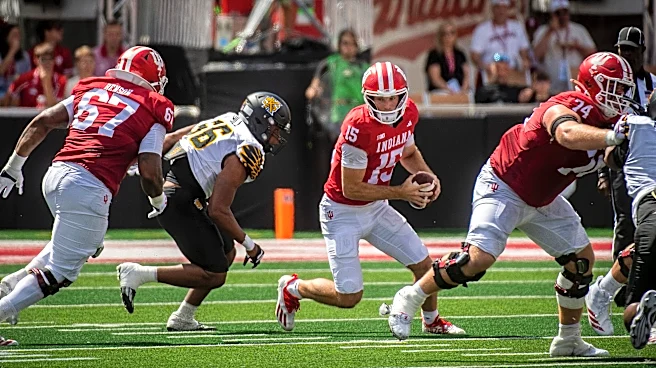
, up next in the Las Vegas Raiders’ Mendoza Mania series is the 2026 NFL draft No. 1 pick’s Week 2 performance against Kennesaw State.In the season opener, the Cal transfer looked like a quarterback who was still learning a new offense and building chemistry with a new set of teammates. While he didn’t play poorly by any means, it was far from the Heisman Trophy winner’s best performance of a fantastic season. But Mendoza
bounced back quickly, as the game against Kennesaw was his first impressive outing for the Hoosiers.
He completed 18 of 25 passes (72.0 percent) for 245 yards and four touchdowns with no interceptions in the tune-up game against the Owls, showing much improved chemistry with his receivers than the week before.
Mendoza’s timing with his wideouts was off in the season opener, but that changed rather quickly as he was throwing with much better anticipation in Week 2.
On this play, the defense shows Cover 4 or quarters pre-snap, with a two-high look where the safeties and outside cornerbacks are all lined up at about the same depth, give or take a yard or two. However, they rotate into Cover 3, where the boundary safety moves to the middle of the field, while the field safety stays at about the same depth and the cornerbacks bail post snap.
Meanwhile, Mendoza starts his read to the short side of the field but quickly moves off of it since the defense has that covered with three defenders to take care of two receivers on shorter routes. So, he works to the other side of his progression and decides to take a gamble.
With the curl-to-flat defender staying deep, it’s going to take a perfect throw to connect on the deep curl route, where the pass has to be on time and in the right spot to prevent the defender from making a play on the ball for a PBU or interception.
Luckily, Mendoza throws with excellent anticipation by starting his motion before the receiver is out of his break, and the ball is perfectly layered where the defender can’t get to it, but the receiver can rise up to make the catch for a first down and roughly 15-yard gain.
To be honest, this is a throw or risk the No. 1 pick should probably avoid in the NFL, with the major increase in competition. No offense to the Owls, but that isn’t exactly Derwin James Jr. trying to make a play on the ball.
However, the big takeaway here is the improvement in Mendoza’s anticipation after just one week, on top of the ball placement and arm strength to get the job done. The latter wasn’t even mentioned above, but this is an NFL-level throw, going from the far hash to between the numbers and opposite hashmark down the field.
Here’s another example of much improved timing and anticipation, just with a much simpler read.
The defense just runs quarters here, where the cornerbacks have no safety help over the top. So, once the corner at the bottom of the screen opens his hips to turn and run to protect against a deep route, Mendoza knows the out route will be open and starts his throwing motion before the receiver is out of the break.
That, combined with good arm strength/velocity on a throw from the far hashmark to outside the numbers, gives the cornerback no shot to prevent the completion for an easy first down. This is another NFL-level throw, considering the anticipation and distance the ball has to travel.
The timing on this play isn’t as obvious, and it may seem like a simple slant route for an open touchdown, but there’s a little more nuance than that.
Indiana is running an RPO, where the quarterback has to make a couple of quick decisions. The first is whether to hand the ball off or not. With the slot receiver motioning across the formation and pulling the WILL linebacker out of the box, Mendoza makes the correct read by aborting the run play since the middle of the field will be open for the slant route, especially with the other linebacker crashing hard downhill on the run fake.
To keep the middle of the field open, Mendoza starts his read by eyeing the slot receiver, who was in motion, on the wheel route. That gets the defense to continue to flow toward the sideline. However, one of the safeties wisely opens his hips and is in a position to drive on the slant route. So, the quarterback can’t hit the slant right away because the receiver is going to get crushed if he does.
The problem is that the offense had to leave the end man on the line of scrimmage unblocked to execute the run call, meaning the defense has a free rusher and the pressure is coming. But Mendoza stays calm, holds onto the ball for an extra half second to prevent the safety from being able to deliver a big hit at the catch point, and then lets the pass go for a touchdown right before taking a hit from the free rusher.
In a way, this was a self-sacrifice to points on the board.
This play doesn’t exactly fit into the overall theme of Mendoza’s timing improvement, but it is the first example of him and Elijah Sarratt starting to form excellent chemistry together.
Throughout the season, those two became known for connecting on back-shoulder passes. However, that wasn’t something that happened overnight or was an immediate connection. It took until Week 2 for them to connect, and the play above was the first of many notable back-shoulder catches.
The breakdown is pretty simple here. The defense is in Cover 1, meaning the nickel corner is man-to-man with no safety help against the slot fade route. Granted, the corner is in a pretty good position, where he isn’t allowing any separation against Sarratt. But there’s no defense for a perfect pass in this situation, and Mendoza delivers by putting the ball high and outside, where only his guy can get it for a touchdown.
Now, it wasn’t all perfect for Mendoza against Kennessaw State, as he did have a few missed opportunities. But this does show a great in-game adjustment, as this is the same play call as the slant that he threw for a touchdown above.
For some reason, he stares at the wheel route a little too long and is late to see or recognize that the slant is wide open for an easy first down. By the time he gets to that part of the progression, it’s too late and the pressure is coming, resulting in a bad sack. That’s the symptom of a quarterback who is still getting comfortable with a new offense.
To clarify, this play happened before the touchdown. So Mendoza clearly recognized his mistake and made up for it later in the game.
This time, Mendoza gets baited into a throw that ends up being a PBU and could have been worse.
The Owls roll into Cover 3 post-snap, with one small wrinkle. The curl-to-flat defender on the strong side of the formation or wide side of the field initially turns his shoulders and works toward the sideline to make it seem like he’s flowing toward the flat. However, he actually speed turns and gets depth to take away the blaze out from the slot receiver.
Meanwhile, especially with the running back running a flat route, Mendoza thinks the curl-to-flat defender will stay low, so the slot receiver will be open with the outside receiver occupying the cornerback on the flood concept. Obviously, that doesn’t happen, and the quarterback nearly throws an interception. That’s a pick in the NFL, and the rookie can expect to see coverages just like this if he continues to get baited into throws at the next level.
To end on a high note, Mendoza did have a few good scrambles in this game, and the play above was one of the best examples of his pocket management.
The defense runs a simulated pressure, where the standup linebacker on the line of scrimmage drops into coverage while the off-ball linebacker on the side of the formation blitzes in the A-gap. The offensive line is concerned with the middle linebacker creeping toward the line of scrimmage pre-snap, and runs a half-slide protection away from the blitzer, where the center turns left.
That means the right guard is responsible for the right A-gap. However, the guard widens to pick up the defensive lineman and doesn’t see the blitzing linebacker until it’s too late. So, the defense has a free rusher in the backfield. However, Mendoza doesn’t panic and escapes the pocket to avoid the pressure while keeping his eyes downfield.
Meanwhile, the secondary is rolling into Cover 3 and has the frontside of the read covered. The outside cornerback takes the go route, the free safety has the seam, and the curl-to-flat defender sinks to take away the deep out route. While the backside dig comes open, the pressure forcing the quarterback to roll out in the opposite direction makes that throw too risky.
So, Mendoza pulls the ball down and makes the defense pay for playing a deep coverage by picking up the first down with his legs. What started as a potential negative play with the lapse in protection that gave the defense a free rusher, turns into a positive one for the offense that moves the chains and sets up a scoring opportunity.
Next up is Indiana’s last “cupcake” game on the schedule, with a matchup against FCS Indiana State, where Mendoza outdid this performance with a five-touchdown outing.