
The NFL offseason ebbs and flows, and after a few relatively quiet weeks a big one awaits. On Thursday, the 2026 draft will kick off in Pittsburgh, and it will be an opportunity for the New England Patriots to add to a roster that already won them a division title and earned them a Super Bowl berth last season.
Naturally, our focus will mostly be on the draft in the coming days. It is therefore also no surprise that this week’s Sunday Patriots Notes are heavy on draft talk. Enjoy.
Bottom-up approach to drafting
Speaking in the simplest
of terms, NFL teams operate in two spheres when it comes to making decisions in the draft: they either draft for need or go with the best player on the board regardless of position. While the second approach is definitely preferred, as head coach Mike Vrabel made quite clear earlier this offseason, the Patriots cannot make these decisions in a vacuum either.
Executive vice president of player personnel Eliot Wolf pointed this out during his pre-draft press conference at Gillette Stadium this week.
“I think it’s easy to look at a piece of paper or a depth chart right now and just kind of see what our needs are right this second, but you also have to factor in who’s going to be a free agent next year because this isn’t just a one-year filler. This is a long-term commitment, especially with the early-round guys that you think are going to be there,” Wolf explained.
“So, I like to look at it more along the lines of what don’t we need? Because there’s a lot less of that when you look at it that way. Center is always a good one. If you have two really good centers, you’re not going to draft a third center. Everything has to work together. So, I think about it as, what can we eliminate from consideration? Especially when you’re picking down at 31 and at the end of these rounds, it’s a little bit harder to predict exactly who’s going to be there. So, you just have to make sure that you’re going to pick a good football player at any point.”
Wolf’s bottom-up approach to identifying draft targets creates an interesting dynamic, because it also shows how the team feels about its current roster at the moment a pick is made.
Staying along the interior offensive line, the Patriots have all three starters — Alijah Vera-Tucker, Jared Wilson, Mike Onwenu — as well as top backup Ben Brown under contract for multiple years. From that perspective, no investments are needed. However, Vera-Tucker has an extensive injury history and Onwenu is set to enter free agency next March, meaning that guard might just be on the draft wish list.
If the Patriots come out of the draft without any interior linemen added, though, it can be interpreted as a vote of confidence in the current personnel. At least if we apply Wolf’s “eliminating what we don’t need” strategy.
Importance of 30 visits
The window for NFL teams to host draft prospects at their own facility closed earlier this week, and so far we know of 24 so-called 30 visits as well as a pair of local ones for the Patriots. While they are not permitted to work players out on the field during those sessions, they are still a valuable tool for the club.
“It’s very important,” said Wolf. “We bring guys in for a variety of reasons, whether it’s to get medical, to get them in front of Mike [Vrabel]. If it’s a guy we like that doesn’t have a lot of red flags, we’re like, ‘Hey, Mike’s going to love this guy.’ We do some of that.
“Then if there are some questions about the character, their learning, the position fit or again, like one that I mentioned earlier, we think this guy is definitely going to be able to play X-receiver, but we want to bring him in and make sure that we think he can play multiple spots and how early could that be. So, there’s a variety of reasons that we bring guys in. They’ve been great this year. We haven’t eliminated anyone, as we’ve done in the past. So, it’s been positive.”
Last year, the Patriots hosted six of their eventual 11 selections at Gillette Stadium leading up to the draft.
Visit flexibility
As with the draft itself, flexibility also is a key component of the meetings process. For the Patriots, this means adjusting plans on the fly — something that happened with two prospects targeted for 30 visits.
Florida edge rusher George Gumbs Jr. was scheduled to visit Foxborough last week, but the meeting was ultimately cancelled by the team. Meanwhile, it wanted to bring Texas A&M guard Chase Bisontis in but a scheduling conflict prevented that meeting from ever happening.
Trade winds a-blowin’?
The Patriots are the owners of the 31st pick in the draft, but them making a selection in that spot is not guaranteed. Depending on the board, some movement might up or down might happen; Eliot Wolf and his team do not seem averse to giving up that selection or other assets in pursuit of their targets.
In general, trading is commonplace on draft weekend, and the Patriots making at least one move is highly likely. They have done so in every draft since 1999.
This year, there are several potential areas to look at regardless of what happens in Round 1. For example, they have five selections between the 191st and 224th picks on Day 3, and all of those selections being made is not expected to happen. They also are on the clock 125th and 131st overall in the fourth round, meaning that one of those selections also could be used to manipulate the board.
One thing to keep in mind, though: since taking over as the Patriots’ quasi-general manager in January 2024, Eliot Wolf has never traded away a draft pick to acquire a player directly.
Upped involvement
Even though Eliot Wolf and the scouting department — including VP of player personnel Ryan Cowden, college scouting director Tony Kinkela and his assistant Matt Evans, senior personnel executive Alonzo Highsmith, VP of football administration Matt Groh and research director Richard Miller — are spearheading the Patriots’ draft efforts, their coaching staff also is involved. Whether that be assistants attending visits or taking to the road or Mike Vrabel himself getting involved, the entire process is multilayered.
That involvement is nothing unusual for a hands-on coach like Vrabel, but Wolf has seen some change compared to their first year together in 2025.
“Very involved,” Wolf said. “He’s been in there with us probably a little bit more than he was last year, just because I know, there’s the coaching staff, he’s — this is me putting words in his mouth — probably more comfortable just where things stand from that standpoint. But he’s been in there. He’s been contributing. He’s watched a ton of the players. I think he tries to watch every player that we give to each position coach.
“He watches that whole – they call it the coaches list. So, he has an opinion on these guys, and it’s helpful because sometimes there are players that the scouts like, me included, and he’ll be like, ‘Well, this is the reason that maybe this guy’s not the best fit for us,’ so we can continue to compile all the information together.”
Draft room premiere
The Patriots’ 2026 draft will be the first with the team operating from its brand new headquarters adjacent to Gillette Stadium. And to hear Eliot Wolf describe it, there is a lot of excitement going around.
“The reaction from some of the players that are on the team that have come through here, as well as some of the pre-draft visit players that have come through, it’s been pretty cool,” he said. “Guys from big programs like Georgia and Oregon that have outstanding facilities are commenting on the space that the Krafts designed and developed along with their group. It’s been really cool. We have a brand-new draft room, which what does that mean? Everywhere, there are screens. We don’t have the little magnets anymore, which a lot of people are very excited about, but from a technology standpoint, it’s state-of-the-art. It’s first-rate.”
Wolf mentioned senior software engineer Mike Aronian, data engineer Keithen Shepard and the aforementioned Ryan Cowden as helping make the environment as user-friendly as possible for the team both leading up to the draft and when the action begins come Thursday night.
AFC East outlook
While we are focused primarily on the Patriots here, a look beyond also can’t hurt every now and then. With that, let’s take a look at their division rivals and what they might be up to come the draft.
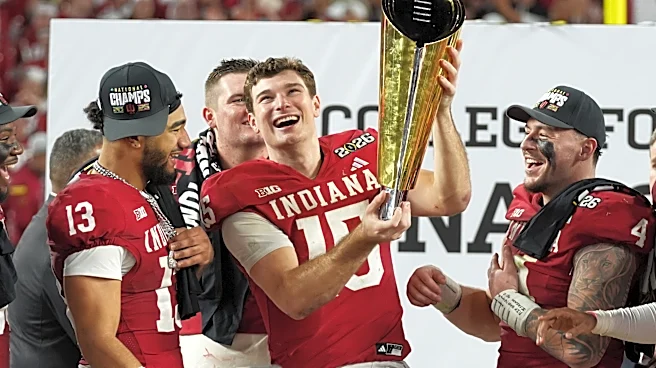
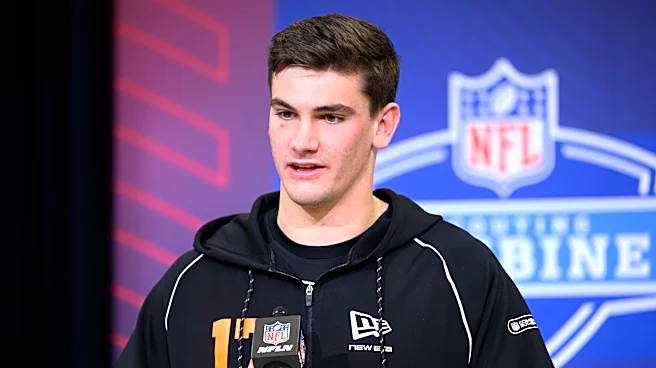
New York Jets: In other years, the Jets would be in prime position to pick a quarterback to fill what has been a major need for years. However, with Fernando Mendoza headed to Las Vegas and no other QBs worthy of first-round status, they will have to go elsewhere at No. 2 and at No. 16. As is the case with the next team we’ll look at, edge and wide receiver are two potential targets. As for quarterback, it might come at No. 33 overall in the form of Alabama’s Ty Simpson.
Miami Dolphins: The Dolphins will pick 11th and 30th overall, and there are multiple ways they could go especially considering that they signed Malik Willis as their quarterback of the immediate future this offseason. Wide receiver is a major need after they traded Jaylen Waddle to Denver, but they are also looking for improvement on the edge and at cornerback. They do have plenty of capital, but the new regime has plenty of work to do.
Buffalo Bills: The Bills are set to pick 26th overall on Thursday, and their primary needs include the linebacker position — both on the edge and in the middle — as well as wide receiver. Buffalo did acquire D.J. Moore in a trade with the Bears, but the receiver room seemingly remains a work in progress as it so often has been for the team in recent years.
Pick quantities
Through a series of trades, the Patriots upped their draft capital for 2026. Starting out with their seven originally-assigned selections, they are now up to 11 of them. Only the Pittsburgh Steelers (12) have more, with three other clubs — Dolphins, Ravens, Jaguars — tying New England for second place.
On the other end of the spectrum are the Chargers and Falcons with five picks apiece. The lowest total belongs to the Super Bowl champions, who have just four picks available.
Accountability needed
The Patriots players returning to work this week will give Mike Vrabel a first opportunity to set the tone for the 2026 season. It also will allow him to speak to his team about one of the most talked-about off-field stories of the team’s offseason so far, the photos showing him and NFL insider Dianna Russini at an adults-only hotel in Arizona.
Those photos might not be as damning as they are being presented by outlets all across the media landscape, but they nonetheless created a distraction even with Vrabel not being investigated by the NFL. Shutting out distractions and not hurting the team through off-field actions is a key talking point for Vrabel as a culture-first coach, and with that story still circulating, he likely will use it as an opportunity to set the tone for his team.
Frankly, he has to.
Week ahead
The NFL is entering one of its busiest weeks, not just because of the draft. On Monday, the Patriots will be back in the facility for the first time this offseason to start their voluntary workout program; as usual, a majority of the roster is expected to be present. While no media availability is scheduled for that day, two of them will likely be made available following Tuesday’s workout.
On Wednesday, the window for teams visiting draft prospects at their college facilities will be shut. And then, finally, the big day.
On Friday, 8 p.m. ET, the first round of the NFL Draft will kick off in Pittsburgh. The Patriots are on the clock 31st overall, which means that they will make their selection fairly late. However, the NFL reducing pick times from 10 to eight minutes this year might slightly speed things up.
Thursday will be Rounds 2 and 3 as well as the potential introduction of the Patriots’ first-round pick at Gillette Stadium, followed by Rounds 4, 5, 6 and 7 on Saturday. Following the seventh round, the scramble for undrafted free agents will begin.
Also, some Pats Pulpit housekeeping: expect our annual Patriots Big Board — a collaboration featuring multiple staff members — to drop early in the week. From there, we will bring you our usual wall-to-wall coverage of the draft.