

If you’re tired of only experiencing NBA expansion in GM Mode on 2K, you might not have to wait much longer for the real thing.
During the NBA Cup earlier this season, Silver made it clear expansion was on his mind, with Seattle and Las Vegas widely viewed as the next two markets in line. Now, The NBA Board of Governors is poised to vote on expansion this summer, as reported by the Dallas Morning News.
“Not a secret, we’re looking at this market in Las Vegas,” said Silver, speaking from the NBA Cup
host city. “We are looking at Seattle. We’ve looked at other markets as well. I’d say I want to be sensitive there about this notion that we’re somehow teasing these markets, because I know we’ve been talking about it for a while.”
Expansion carries ripple effects for every franchise in the league, but those effects don’t feel evenly distributed. Top-heavy teams built on star power alone may have an easier time parting ways with their deep-bench pieces, while teams built on depth, internal development, and cost-controlled contributors may face more difficult decisions.
You can probably see where I’m going with this.
The Celtics arguably fall more into the latter category, which is where the conversation can start to get uncomfortable. Before we go there, let’s first take a closer look at what NBA expansion entails, and consider the roster decisions Boston must face as soon as next summer.

How the NBA expansion draft works
If the league follows precedent from previous expansions (most recently in 2004), the framework would look something like this:
- Each existing NBA team can protect up to eight players
- Only players under contract, restricted free agents, or players with options can be protected
- Unrestricted free agents cannot be protected
- Each expansion team can select one player from each existing franchise
- Once a player is selected from a team, no additional players from that team are eligible
- Teams that lose a contracted player while over the cap receive a trade exception equal to that salary
Regardless of the year, the expansion draft would likely take place between the NBA Finals and the Draft, with protected lists submitted privately ahead of time. Expansion teams (assuming Seattle and Las Vegas are both approved) would then alternate selections, with each existing franchise eligible to lose no more than one unprotected player.
This process might be manageable for rebuilding teams. It’s far more complicated for deep, ever-competitive ones.
Why expansion will hit the Celtics differently
The Celtics don’t have a problem finding eight players they like. On the contrary, having to choose which player they’re willing to expose, especially after spending decades getting to this point, will be among the tougher decisions Brad Stevens faces as President of Basketball Operations.

Let’s look more closely at who will (likely) be safe and who could be at risk.
The near-locks
If expansion were happening in the next couple of seasons, Boston’s protected list would almost certainly start here:
- Jayson Tatum (4-years, $259.8 million)
- Jaylen Brown (3-years, $183 million)
- Derrick White (3-years, $97.8 million)
- Payton Pritchard (2-years, $16.1 million)
- Sam Hauser (3-years, $34.9 million)
- Neemias Queta (1-year, $2.7 million team option)
These six occupy different lanes, but they all arrive at the same place. Losing any of them would either compromise the Celtics’ competitive ceiling or remove contract value that far exceeds its cost.
Tatum and Brown anchor the franchise’s timeline and salary structure. Everything is built around them. White functions as connective tissue across lineups, giving the Celtics flexibility that becomes more valuable in the postseason. Pritchard’s contract sits among the league’s better value deals for the league’s reigning Sixth Man of the Year. Hauser’s shooting gravity solves a specific problem Boston would otherwise need to pay significantly more to address. And Queta’s appeal lies in role clarity and cost efficiency at a position where those traits are rarely found together.
This means six of the eight protected slots are already spoken for, without much debate.
The tough calls
That leaves two protection spots for a group of more than two players the Celtics would very much like to keep developing:
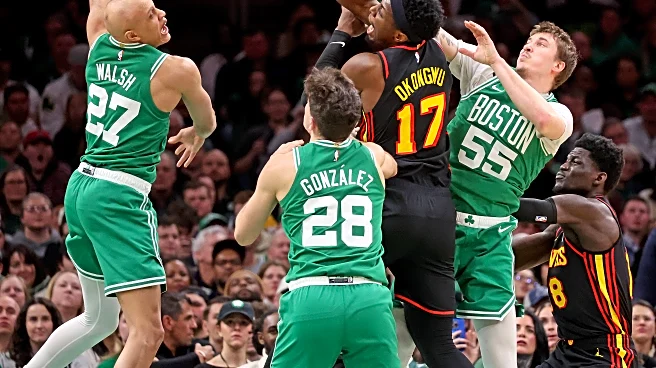
- Hugo Gonzalez (Rookie-scale contract (Year 2))
- Baylor Scheierman (Rookie-scale contract (Year 3))
- Jordan Walsh (Rookie-scale contract (Year 4))
- Luka Garza (1-year, $2.8 million)
- Amari Williams (2-years, $2.7 million)
Gonzalez represents long-term upside tied to size and skill development. Scheierman has already translated improvement into rotation trust, which matters when projecting real NBA usefulness rather than abstract potential. Walsh brings defensive range and physical tools that typically take years to cultivate and rarely hit the open market at a low cost. Garza offers reliable depth at a minimum salary, and Williams profiles as another cost-controlled developmental piece at a position where teams cycle through options quickly.
From Boston’s perspective, these players serve different roles at different points along the same competitive window.
The question expansion forces into the open is how the Celtics define that window right now.
While the 25/26 season was widely framed as a transitional year for Boston, the results suggest something closer to real contention, especially with Jayson Tatum set to return. That creates a tension between prioritizing the best available contributors around the Jays and continuing to invest in younger players who could peak alongside them. Expansion doesn’t allow for a hedged answer. It requires Boston to decide how much future value it’s willing to expose in order to maximize the present.
Expansion will inevitably change the Celtics
There’s also a human side to this that’s hard to ignore. Seattle is long past owed an NBA team, full stop. What happened to the Sonics still hangs over the league, and bringing basketball back to that city feels less like expansion and more like course correction. If the NBA is serious about adding teams, Seattle shouldn’t be a debate.
Las Vegas brings its own appeal, but the optics of placing a franchise at the center of legalized gambling while the league is actively trying to rein in betting-related fallout aren’t the best.
For the Celtics, none of that changes the immediate reality. Expansion applies pressure in places that rarely get discussed, and Boston is built in exactly those places. Years of smart drafting, patient development, and value hunting create real advantages (and real exposure) when the league grows.
That’s the cost of doing things the hard way and doing them well. If When expansion comes, it’s worth understanding now how much of the Celtics’ hard work can realistically be protected once the league decides it’s time to make room at the table.