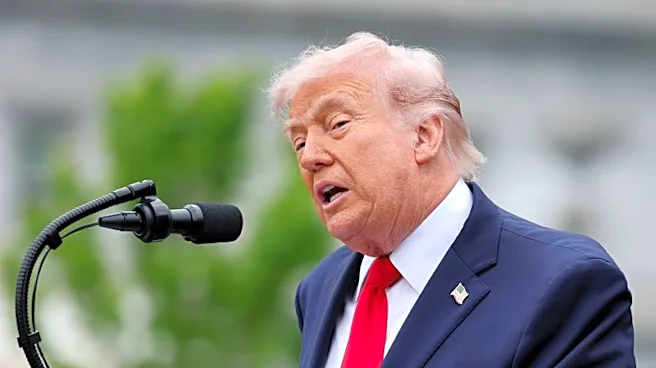








In the midst of spring camps for football and the precipice of the transfer portal opening for basketball, president Donald Trump opened the flood gates. The 47th president of the U.S. signed an executive order on April 3 calling for the NCAA to make changes to their rules regarding how the transfer portal and eligibility should work, focusing hard on “protecting the future of college sports before it’s too late,” according to the White House’s fact sheet.
The executive order recommends that the NCAA
brings back the multiple transfers rule it had until April 2024, which states that players can transfer once without penalty, but would have to sit out a year (using their redshirt opportunity if possible) if they wanted to transfer again. It also states that the NCAA should redefine eligibility to be a 5-for-5 system where athletes have five years to play five seasons. Finally, Trump added a condition to the order where athletic programs that break the NCAA’s rules would be reviewed and, if foul play is found, could have scholarships/funding pulled.
Outside of the main things people are discussing on social media, there are other important items added to the order that deserve to be highlighted as well, such as protections in revenue sharing for women’s collegiate sports and for medical/mental health support for athletes.
The order is not perfect in my eyes, and I do wish that the government did not get involved in the world of college sports. However, there is a lot of good that can come out of it and, with some revisions to include things that would make it even better, would influence a great change to college sports, especially for mid-major schools like the ones the populate the Mountain West, soon to be Pac-12, American and other conferences. Here’s why and how.
Players want their money, but it’s been getting crazy
It is of no surprise that since players have been able to cash in on their name, image and likeness that many of them are just chasing a pay day. Before I go forward, I just want to acknowledge that college athletes deserve to be paid for doing advertisements both at the universities they play at and by whoever wants to hire them as a celebrity guest. However, there have been some cases that are just plain ridiculous.
One of the most popular instances of bag-chasing came last year with former Tennessee, now UCLA quarterback Nico Iamaleava. After signing a three year, $8 million deal to play for the Vols, it was reported that the then-redshirt sophomore wanted to renegotiate his deal to be around $4 million per year after leading the Vols to a College Football Playoff appearance. Tennessee did not want to accommodate Iamaleava’s requests, so he hit the transfer portal to seek that amount, which resulted in him getting a $1.5 million deal with UCLA.
Iamaleava still wound up with a really good paycheck for playing collegiate sports, which is deserved because he is a good quarterback that, with the right weapons, can put up great numbers. But, the greed that comes with being a great player in the professional sports world (nearly $50 million a year for a quarterback is not as good as some will say) has seeped into college sports, and not just at the power four level either.
Insert former UNLV, now James Madison quarterback Matthew Sluka, who was told that he was going to get $100,000 from the NIL initiative for transferring to Las Vegas, but never received it. He wound up redshirting to keep his final year after basically being back-stabbed by the organization. This is an example of the reverse, where a player is told he/she would get their money, but the coaching staff and/or NIL representatives screws the player out of it because they either couldn’t actually do it or decided against it.
Trump’s order will hopefully fix these issues, as players won’t be able to bounce around to whatever program has enough money to afford them after one good, all-conference season. If the recommendations were put in place, players would have to assess if the money they would transfer for is enough to use their one free transfer, which is still a greed-filled assessment, but should shrink the number of athletes in the portal year after year. It basically makes Nevada Football head coach Jeff Choate’s viral quote about players getting paid after developing at a G6 school like Nevada so much more potent, which is good for the health of college sports overall.
Retention at the G6 level is horrific
It does not take a deep look into the transfer portal statistics to see that there are SO MANY athletes who wind up leaving their program on a yearly basis. A lot do it for understandable reasons, like if they aren’t getting the playing time they want, coaching changes lead them to want to seek out either their old coach or a new one with a similar style or any internal issues behind the curtain with a program. However, this problem has gotten out of control as of late.
The proof is in the data, which has been revealing. ESPN’s Max Olsen reported that during the most recent college football transfer portal cycle, over 6,700 division one players entered their names in the portal, including 25 percent of all FBS scholarship players. About 263 of them come from the Mountain West, which comes out to about 22 players per team entering the portal. James Madison University, one of the two mid-major schools in the 2026 CFP, had 23 players enter the portal, with head coaching turnover and national attention being the two most likely reasons why so many entered.
To put into perspective on how bad it has gotten, during the first year of the current model in 2019-2020, 1,583 D1 college football players entered the portal, nearly 4.25 times less than the amount of athletes who entered in this year’s cycle. Now, that was the first year that things went through a full cycle, which will have lower numbers since there wasn’t a clear understanding of the politics surrounding the portal at that time. However, seeing that number grow by over quadruple that amount is astonishing.
Everything the NCAA has allowed to happen with the transfer portal has been so damaging to the consumer’s psyche, especially at the mid-major level, that fans celebrate when a player who is expected to leave because they are just that good doesn’t. At Nevada, the community celebrated the return of football players like true freshman Carter Jones and senior, all-MW defensive lineman Dylan Labarbera. They are currently giving the same treatment to sophomore forward Elijah Price and junior wing Vaughn Weems who announced their return to the silver and blue earlier this week. The fact that we are celebrating sticking with a program after having a good and/or standout year is a sad reality of good players not sticking around to grow not only the program, but themselves as well.
Trump’s recommendations will help aid this rampant problem the same way it will fix the greediness from the financial situation. On top of figuring out which program will pay the best for your current array of skills, athletes would have to assess the talent development side of the program’s looking at them as well. If a player is a three-star prospect with offers from a handful of mid-majors, they would have to pick which program will be a good long-term fit to grow into what they want to be, whether that’s at a blue blood after a couple years of training or going to the league after a few years. If an athlete is a five-star, it’s about which program can hone them in and get them to the league as ready as possible. All of that would need to be considered so much more, which would favor those already prepared.
Too punishing on the athletes, not enough on the programs
Even though it’s good, the order’s recommendations are not great, as basically everything is changing to punish the athletes and nothing outside of possible sanctions for the athletic programs/conferences that do not follow the rules if the NCAA puts them in place. If anything, as much as I’ve been saying the recommendations could lead to good, the blue bloods and other powerhouses are still going to be able to pay a player bonkers amounts of money that would basically be the entire salary of a starting lineup in either basketball or football.
Also, let’s be real here, these are just recommendations, which can be adapted or just flat out ignored. So, it’s time I throw out an idea of my own. While keeping the five years, five seasons (with redshirt added) item, I think there should be a system in college sports similar to that of international soccer after the first transfer.
In this system, athletes would have one free transfer that would not cost their first non-JUCO school anything. However, say an athlete wanted to leave their second school, then instead of just entering the portal, the athlete would enter the “transfer market”, where schools can “buy out” a player from their current program and sign them to theirs. Using this model, athletes would be considered employees under the athletics program, and would be expected to sign contracts either each season or for a designated amount of time, like what Iamaleava did with Tennessee.
A transfer market system would be the best overhaul the NCAA could do simply because it has the greatest shot at balancing the scales between the power four and group of six conferences. For a hypothetical example, let’s say Nevada found itself another Isaiah World, a soon to be star offensive lineman that transferred in from…New Mexico State due to not being utilized the way he wanted to be. The Pack signs him to a three year, $600,000 dollar contract that has room for negotiations after every season in case he does extremely well. He plays there for all three seasons, and eventually works his way up to just over $500,000 during his junior year.
After a couple seasons with the Wolf Pack and getting a lot of attention for only allowing three sacks in three years, that lineman decides to go to a power four school because he could get nearly triple the amount of money there and would see his draft stock shoot up to dang near a first round pick depending on how his senior year goes.
Rather than just saying thank you and having to replace an amazing star at that position (which they would have to do anyways), Nevada would then be rewarded for their efforts in developing this offensive lineman by getting that $500,000 from whatever power four school would look to sign the player, which then could be used to get either another star player in that position or invest in another. The power four schools had no problems getting $20-40 million for their NIL initiatives, and could easily get more from their current/ex-pro alumni or successful donors to pay those fees.
However, on the other hand, there are the mid-major conferences, which average between $1-10 million dollars given to their football players per team according to The Athletic. The overwhelming majority of mid-major schools are under the $5 million mark, while the top power four schools averaged between $13-30 million spent on their rosters in 2025. That disparity can cause problems for any mid-major to get talent from the power four conferences due to the insane amount of money they can give to an athlete, especially one that is a high caliber, five star prospect (I mean, just look at Iamaleava).
While it is a valid criticism, especially since I definitely see this playing out, I don’t think it’s a certainty of the solution. Many of the former power four players who seek out group of six schools are not necessarily the ones making copious amounts of money, and realistically do not care about the money as much as they do playing as much as possible with whatever eligibility they have left. A Mountain West school not named UNLV will have to get some more help from boosters to afford 10+ transfer fees to power four schools in a year. But, a school like Nevada, who would have to pay zero power four schools for a transfer in their 2026 class in this system, would be in great shape while getting money from four separate programs for their transfers.
In conclusion…
College sports are in a difficult time right now. It is amazing that players across all sports are finally being paid for the publicity that they bring to their athletic programs. But, it does not take a magnifying glass to see the problems that those programs, especially mid-majors, are having with this new system.
Something needed to be done and/or recommended, which is why Trump’s executive order is a good thing. It gets people, especially important people who can actually implement new systems, talking about what should happen in order to keep paying players but bring back the feeling college sports used to have. The recommendations themselves are not going to save college sports, and if all are taken at once, might even make it more restrictive as a whole. But, some of them are good and should be used, and when combined with another idea that isn’t as restrictive (such as the one I issued above), could be the shining light needed to get the NCAA back to better times.