

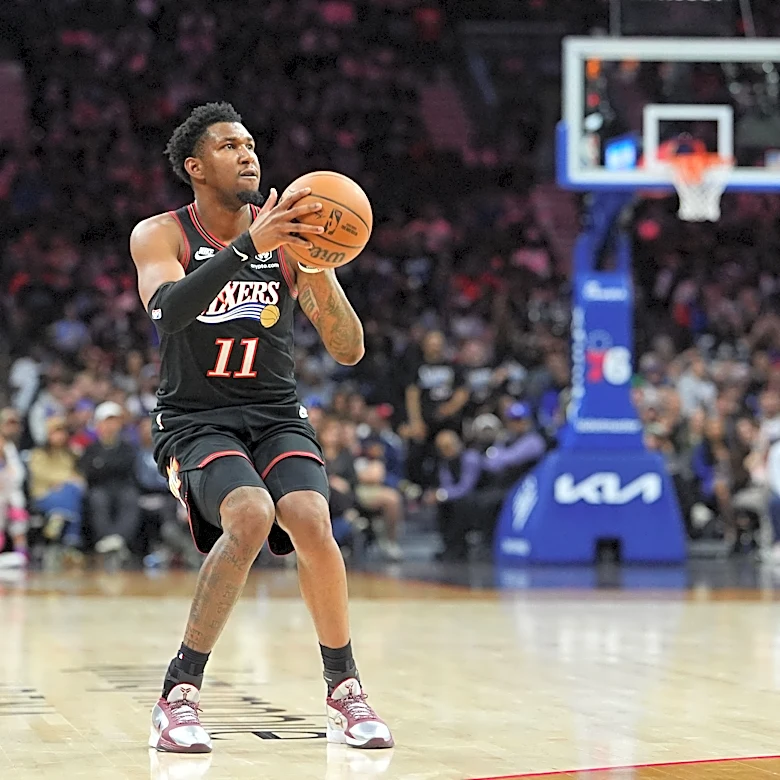
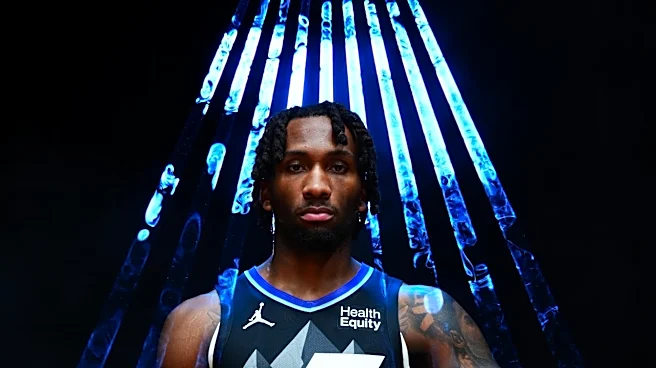
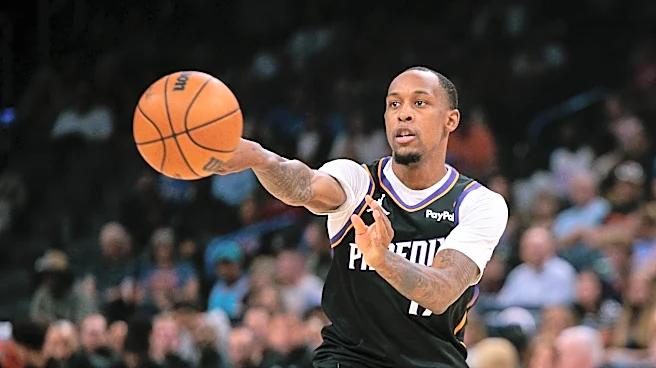

Every day, we’ll take a closer look at another member of the 2026-27 Phoenix Suns, examining what they bring to the roster and what their role could mean for the season ahead as we count down to training camp and the preseason.
Koa Peat
Forward, 6’7”, 245lb, 19 years old, Rookie
The Suns took a big swing when they traded up and drafted Koa Peat with the 30th overall pick in the NBA Draft. Peat has obvious strengths and obvious weaknesses. His strengths made him a projected lottery-level talent in high school.
However, his weaknesses in college and during the draft process caused him to almost fall out of the first round.
Peat has an incredible resume. He is a four-time Arizona High School state champion, he led the University of Arizona to its first Final Four in 25 years, and comes from a family full of professional athletes. He has all the intangibles and high character traits that will make him a fan favorite right away if he can get playing time on a deep Suns roster. Which is the biggest question mark for Peat going into this season.
Where does Peat get minutes this season in a crowded rotation at forward with Dillon Brooks, Miles Bridges, Rasheer Fleming, and Ryan Dunn all vying for minutes? And how quickly can Peat earn the trust of Jordan Ott and his teammates?
If Peat can get his now antiquated old-school style game to translate over to the new-school NBA, it will be a huge win for a Suns team that needs Peat to pan out for the future of the franchise.
Last Season
Last season at Arizona, Peat was one of the best players in the Big 12 and the entire country. He earned Third Team All-Big 12 honors despite missing three games with an injury/illness during conference play. He excelled in the biggest moments of the season, when he scored 30 points against Florida’s humongous front line in the first game of the season and later in the postseason.
He averaged a team-leading 17.1 points in the Wildcats’ run to the Final Four and elevated his all-around play when his team needed him the most. The in-state hero broke Sean Miller’s curse and got his team to the Final Four before losing to the eventual National Champion Michigan Wolverines.
What made Peat so effective with the Wildcats was how integrated himself within their offensive and defensive schemes. His basketball intelligence allowed him to still score and create for others despite the spacing limitations on the Arizona roster. He was effective playing off the Wildcats’ excellent guards Jaden Bradley and Brayden Burries while also finding his spots at the elbows and midpost areas with Arizona’s two big centers Tobe Awake and Motiejus Krivas. Even with two of the best rebounding centers in the nation, Peat still grabbed almost six rebounds a game, making Arizona the second-best rebounding team in the country. Defensively, he was a capable on-ball defender and knew how to use his thick body to keep opposing players out of the lane.
But the reason Peat was available for Phoenix late in the draft was his 3-point shooting, or lack of 3-point shooting. At Arizona, Peat shot 35% from the 3-point line on just 20 attempts the entire season. He did not make a single 3 during Summer League and struggled during the NBA Combine’s shooting workouts. His mechanics are a work in progress and have already changed considerably since his time in college, but not necessarily for the better. Although Peat does not have to be a knockdown 3-point shooter in his NBA career to be effective, the Suns will have to be creative in how they deploy Peat early in his career because of those limitations.
Contract and Roster Context
Koa Peat signed a 4-year, $15,031,531 rookie scale contract with the Phoenix Suns this summer and will be extension-eligible in 2029 and will enter 2030 as a restricted free agent. He joins Ryan Dunn and Rasheer Fleming as the Phoenix Suns’ young wings competing for playing time at the back end of the Suns’ rotation.
What He Brings
Koa Peat has a very unique style of play for the modern NBA game. Put Peat back in an era that was less three-point prolific, and he might have been a high lottery pick.
Peat has a unique blend of size and athleticism that makes him effective as a mid-post player and finishing around the basket both above and below the rim. Where Peat is elite is his footwork, whether he’s finishing off one or two feet. During his brief stint in Summer League, he showed an ability to take and make difficult shots on the block, at the elbows, and anywhere in between. Because of how physical he plays, Peat should be effective at getting to the free-throw line, where he shot 62% at Arizona.
Peat’s fluidity and touch make him an extremely difficult-to-stop locomotive in transition and attacking off of cuts. He can get his shot off in almost any situation and at unique angles. Even if the shot looks off balance, Peat has had incredible body control and soft touch to finish over and around taller defenders that should translate to the NBA.
Not only is Peat effective off the ball and in the midpost, but he can play on the ball as well. He handles the ball comfortably on the perimeter and was the Suns’ primary ball handler during Summer League outside of the point guards. He sees the floor well and is a good passer, especially dumping the ball off to his centers after penetrating to the basket.
Peat fills many needs for this Suns roster long term because he has the potential to be a good to elite isolation scorer that can attack mismatches with his versatility. He is another athletic body that the Suns can utilize to be a tough, gritty team that plays defense and rebounds at an elite level. Outside of his scoring and rebounding ability, he might be the best passing forward on this Suns roster right now. With Grayson Allen and Royce O’Neale gone, the Suns need to replace their shooting first and foremost, but also their undervalued secondary playmaking, and that is a void Peat can fill immediately.
What Needs to Improve
The main weakness for Peat is easy to diagnose but difficult to fix. He is not a three-point shooter, and to survive in the NBA without a consistent jump shot, he has to be elite at another skill, whether that’s defensively, playmaking, and/or rim pressure. The Suns already do not have many shooters on the roster, so Peat only adds to that problem.
Long term, if Peat adds a consistent three-point shot, the sky is the limit for what he could be. If all he ever becomes is a very consistent midrange jump shooter, he will still be an effective player because of everything else he brings; it will just take that organization prioritizing players that fit with Peat, which is not what this Suns roster has right now.
The other area where Peat has to grow if he is going to play minutes this season is his motor and conditioning. This especially stood out during Summer League, where he was often the last guy getting back on defense because he did not sprint or was the final player in the frontcourt on offense. With Peat’s spot on the roster right now, it will be his effort and skill set doing the little things that could make the difference between him playing for the Suns or the Valley Suns this season.
Prediction
While most NBA teams usually give their exciting young players the runway at the NBA level to develop, the Suns have taken a different approach by making their players earn their opportunity before it is given. While it was frustrating to see Rasheer Fleming and Khaman Maluach “waste away” on the bench last season, it could be beneficial for both of them long-term for their development. My prediction is that the Suns will bring Peat along slowly this year, just like last year’s rookies.
Here is why this is a good thing: it will give Peat a chance to work on his shooting mechanics and hopefully develop a passable NBA three-point jumper and work on refining his body. The Suns can work on completely overhauling his mechanics if needed and building them back from the ground up without having to stress him in NBA games, which can be detrimental during the process of reworking someone’s jump shot. As for his body, he already has the strength, but can he tap into even more athleticism if he cuts 10 pounds and adds it back in explosive muscle?
While this is my prediction, it would not surprise me if Peat is an immediate impact player as a rookie because of his unique skillset as a scorer and playmaker. If both Ryan Dunn and Rasheer prove not to be efficient enough 3-point shooters, there are so many other things Peat brings to the table that could vault him above the other young.
Stat Prediction: 40 games, 4.0 points, 2.1 rebounds, 0.9 assists, 45/30/70 shooting
Final Word
While we all want to see Koa Peat play for the Suns this season, and we all want to talk ourselves into the hometown hero being the next young star to lead our franchise into the future, there is a reason 29(ish) NBA teams decided not to draft Peat. The Suns are swinging for the fences, hoping that Peat turns into a star, but they could easily strike out. It is going to take Peat time to develop into the fully formed version of himself, but what gives me the confidence Peat is going to be a great Phoenix Sun is because:

Koa Peat is a winner.
He won championships in high school, he won the Big 12 regular-season and tournament championships, and he delivered Arizona its first Final Four appearance in 25 seasons. The Suns likely won’t win a championship in the near future, but Peat has proven that he can win anywhere, and he has an unbelievable opportunity to win at home.