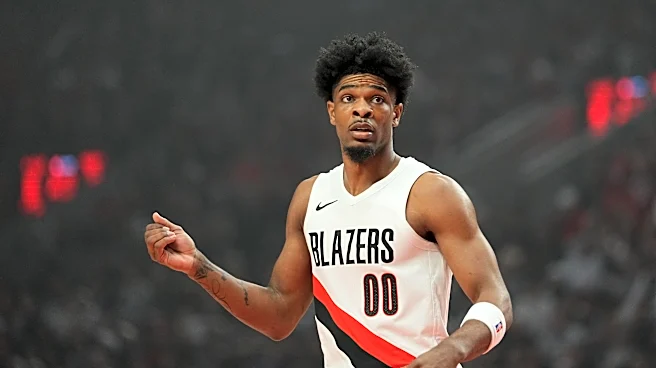

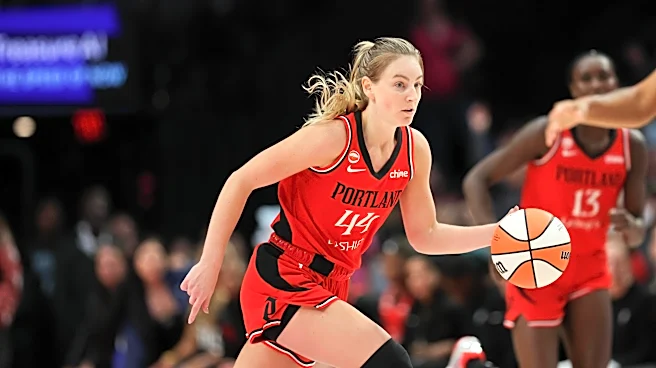
Each rookie extension signed by an NBA player this summer serves as a reminder that the deadline for Portland Trail Blazers guard Scoot Henderson’s potential agreement looms. If no deal is made between Scoot and the Blazers by October 19th, the third-overall pick of the 2023 NBA Draft will play out the final year of his contract before hitting restricted free agency.
As a restricted free agent, Scoot will be able to seek a new contract elsewhere, but the Blazers will have the right to match that deal
and retain his services. If Portland neglects to provide a rookie extension for Henderson, it doesn’t necessarily mean he’s leaving next offseason, but it also doesn’t guarantee he’ll stay.
Let’s look at the forces working against Scoot Henderson securing a rookie extension, examining why it hasn’t happened yet and why it might not ever.
Performance and Depth
There’s just no way to sugarcoat the fact that Scoot Henderson’s play on the court hasn’t lived up to his initial hype. His rookie season started out rough and pretty much stayed that way. Since then, Scoot’s role on the team has only shrunk, with his minutes per game trending down from 28.5 to 26.7 and 24.9 each successive season.
If the Blazers brass viewed him as an integral part of the future, they would figure out a way to pay him a fair deal and get him under contract for years to come. Other players in his draft class, like Victor Wembanyama, Keyonte George, Amen and Ausar Thompson, and 2024 secound-rounder Pelle Larson have carved out essential roles on their teams and have been extended accordingly. With Damian Lillard, Jrue Holiday, and Ja Morant ahead of him on the depth chart, Scoot Henderson’s role on the Blazers has never been murkier.
The Guard Market
It’s a buyer’s market for guards who lack elite size. Former Blazer Anfernee Simons, who was coming off of a contract that paid him an average of $25 million a year, just signed a deal that pays him just $6 million per season. At age 27, he’s just beginning his prime years as an athlete. Simons isn’t the only one feeling the pinch. Former 20-point scorer Cam Thomas still doesn’t even have a contract.
Teams aren’t afraid to cut bait on smaller guards whom they spent high draft picks on, either. The Pistons shipped out 2022 fifth overall pick Jaden Ivey last season. He currently doesn’t have an NBA contract. The Timberwolves did the same to Rob Dillingham, even though they spent a 2031 unprotected first and a 2031 first round swap for the rights to draft him with the 8th pick in 2024. Teams aren’t bound by the sunk cost fallacy when it comes to discharging underperforming draftees.
The 2026 NBA Draft added to the glut of guards on the market. Ten of the first eighteen players selected were backcourt prospects. Many teams that might otherwise invest minutes into developing a young guard like Henderson already have one, or more, on their roster.
Restricted Free Agency Blues
For the most part, restricted free agency isn’t as competitive as it used to be. Gone are the days when NBA front offices were willing to offer huge deals to big-name players to try and lure them away from their teams. The last time it happened was when the Pacers agreed to a max deal with Deandre Ayton that the Suns matched way back in 2022.
If a restricted free agent does switch teams, it’s much more likely that it happens via sign-and-trade. Recent examples are Walker Kessler going to the Lakers and Peyton Watson to the Cleveland Cavaliers this past offseason, Nickeil Alexander-Walker went to the Hawks in 2025, Grant Williams went to the Mavs in 2023.
When a front office attempts to sign a restricted free agent from another team, it typically a modest offer for role-players from franchises constrained by the second apron. This is how the Grizzlies won the services of Quinten Post from the Warriors with a three-year, $30 million contract. The Thunder also tried the same tactic when they offered the Nuggets’ Spencer Jones a two-year $12 million deal, which Denver matched.
The most likely scenario to play out is a restricted free agent failing to find a lucrative contract on the open market. That allows their current team to use that lack of interest as leverage to negotiate a more affordable deal. It was rumored that Josh Giddey was seeking $30 million a year before settling on the $25-million-per deal he signed with the Bulls in 2025. The Pistons are currently using the same tactic with Jalen Duren, with that situation still unresolved.
The Blazers front office faces little risk in letting Scoot Henderson reach free agency next offseason. If he finds a competitive offer on the open market, Portland has the power to match or get something in return via sign-and-trade. If he doesn’t, the Blazers can use that leverage to sign him to a team-friendly contract.
Tom Dundon
Putting aside his frugal reputation, Tom Dundon’s brief history as Blazers owner has shown him to be unhurried in matters of negotiation. Whether it be an arena lease deal or a head coaching search, he doesn’t seem to mind waiting until the brink of a deadline if he believes it will get him a better deal.
It wouldn’t be surprising to see Dundon take a similar stance with Scoot. While October 19th is the deadline for a rookie extension, it is by no means the deadline to retain control over his future. Pushing the decision until next offseason maximizes the owner’s leverage, while providing another full season to evaluate Scoot’s play before committing.
Henderson’s Interest
If Scoot believes there are better opportunities for him elsewhere, there’s no reason for him to tie himself to a franchise where he’s buried on the depth chart. His career is young enough that he can still turn it around, but he needs a bigger role to do so. Exploring other options could be worth the risk, particularly if the alternative is accepting a low extension offer reflective of his diminished standing and performance.
Verdict: Extension Unlikely
Between Henderson’s underwhelming early production, a flooded guard market, and the leverage provided by restricted free agency, all signs point to the Blazers letting the October 19 deadline pass without an agreement. With owner Tom Dundon in no rush to commit early and Scoot potentially looking for a larger role to reboot his career, taking a wait-and-see approach benefits both sides. While hitting restricted free agency doesn’t rule out a long-term future in Portland, a rookie extension right now seems improbable.