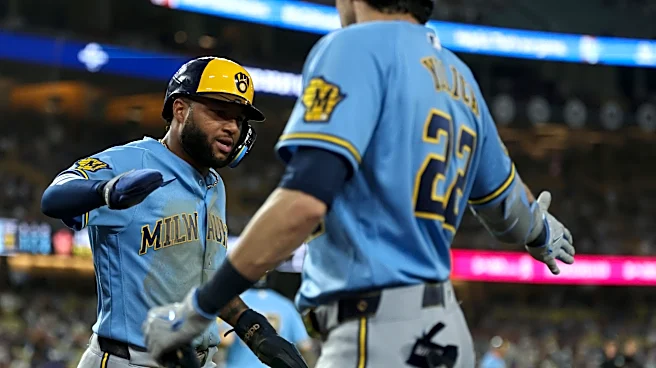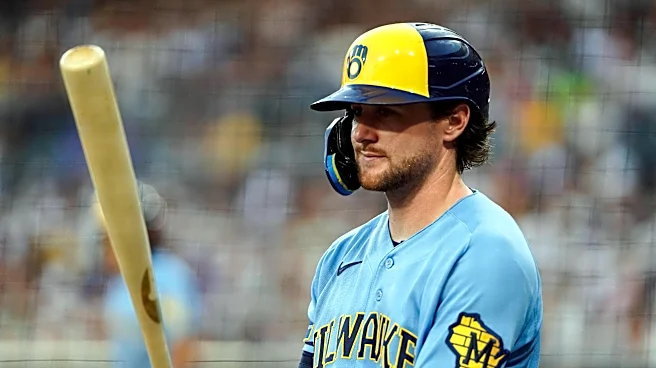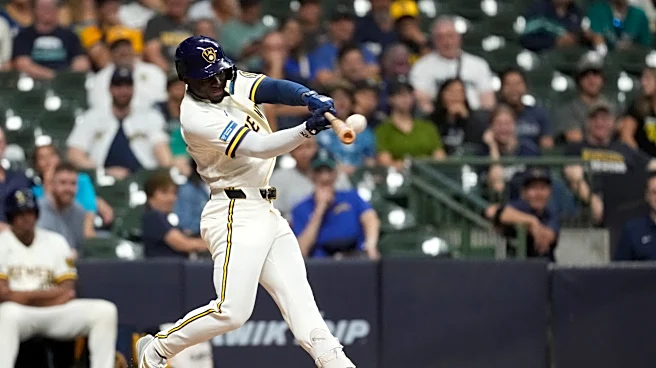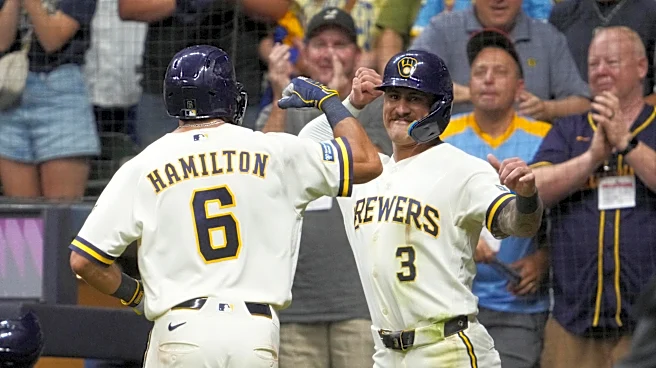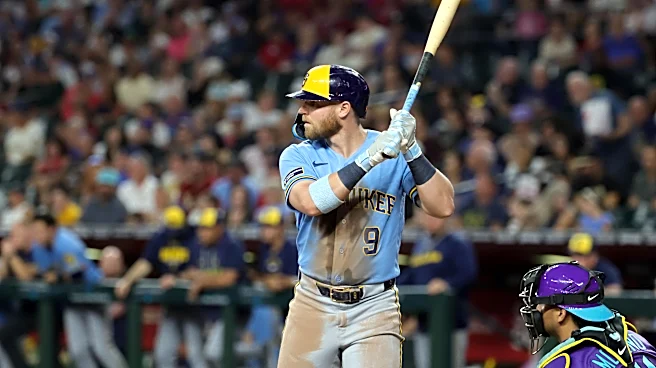


I’m writing on August 19, and Jake Bauers has a 146 OPS+ in 452 plate appearances. The last time a Milwaukee Brewer had a 146 wRC+ in a season in which they had even 350 plate appearances was in 2019, when Christian Yelich was in the second of his back-to-back MVP-caliber seasons.
Of course, there’s a good chunk of season left, so we don’t know how things will end up. But Jake Bauers, right now, is as good an offensive weapon as the Brewers have had in the past seven years — a span in which the Brewers have made
the playoffs in all but one season and in which they’ve won four, perhaps soon to be five, division titles. On top of his on-field play, Bauers has also turned into a team leader; it was he who spoke out after the Brewers’ tough series in San Diego last week, and he who sparked their turnaround in Los Angeles, where they took three of four to salvage a solid road trip at the end of a 17-games-in-17-days stretch.
How did we get here?
If you told someone in 2017 that 10 years later Bauers would be one of the league’s best hitters (Bauers is eighth in the league in OPS+ at the start of play on Wednesday), that wouldn’t have surprised anyone. Bauers was a seventh-round pick of the Padres out of high school all the way back in 2013, but he was included in a massive trade after the 2014 season (one which included such highly regarded prospects and young players as Wil Myers, Trea Turner, and Joe Ross) that sent him to Tampa Bay. In the Rays system, Bauers thrived; in 2016, when he was just 20, he hit .274/.370/.420 with 14 home runs and 28 doubles at Double-A Montgomery, and he started appearing on top 100 prospect lists heading into 2017. Another strong season in 2017 (.263/.368/.412 as a 21-year-old at Triple-A Durham) put him on the major league doorstep. He was 22, and Baseball America had him as a top 50 prospect.
After that, things got rocky. He debuted with the Rays in 2018 and slugged a bit with 11 homers and drew a bunch of walks in 388 plate appearances, but he hit just .201. After the season, he was sent to Cleveland in a big trade that ended up with Carlos Santana in Cleveland and Yandy Díaz in Tampa (the Mariners took back some cash, a pick, and the shell of Edwin Encarnación). Bauers played 117 games for Cleveland in 2019 but hit just .226/.312/.371 (a 78 OPS+). He didn’t make Cleveland’s roster in the pandemic-shortened 2020 season and thus didn’t play baseball; in 2021, he got off to a poor start and was traded yet again, to Seattle, but the names in the trades that Bauers was included in at this point were losing some shine; Seattle sent a pitcher named Damon Casetta-Stubbs who never got above High-A.
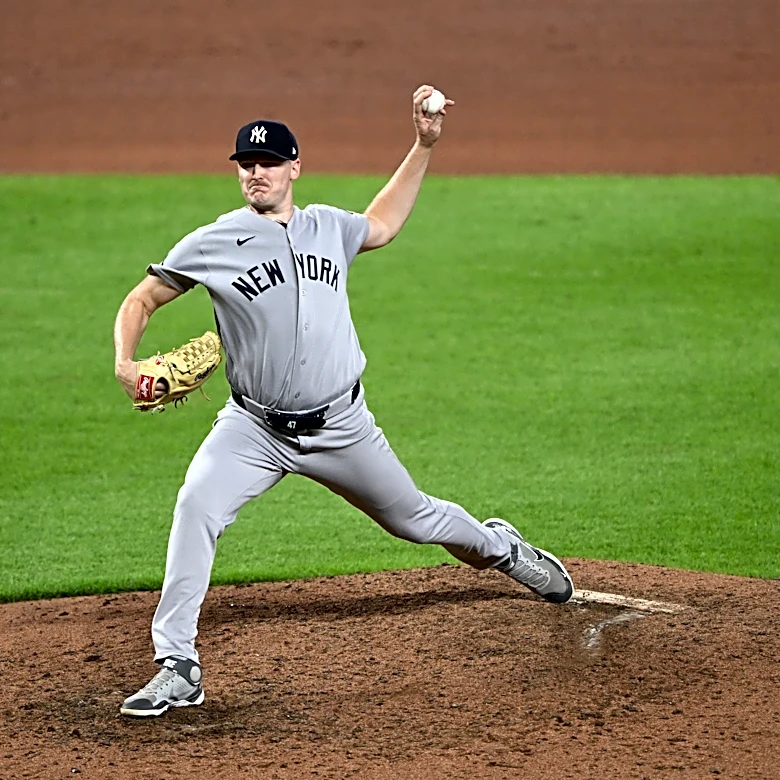
The struggles continued in Seattle, and Bauers could only manage a minor league deal as a free agent in 2022. He played 29 games in Cincinnati’s system and hit .135/.276/.271. The Yankees brought him on and he hit .226/.352/.406 for Triple-A Scranton/Wilkes-Barre. Things finally turned around a bit for the now 27-year-old Bauers in 2023; it was just a 24-game sample, but Bauers hit .359/.485/.897 (!) with 11 home runs in 97 plate appearances before he earned another chance in the big leagues with New York. The batting average was still poor, but Bauers did flash some power; 12 homers in 272 plate appearances for the Yankees in 84 games in 2023.
The Brewers traded for him after the season, sending a couple of lottery tickets, Jace Avina and Brian Sanchez, for him. As we all know here, the struggles continued for Bauers: in 117 games and 346 PA in 2024, he hit only .199. He did walk a lot, and he hit 12 homers, and Pat Murphy seemed to like him. He stuck around in 2025. Through 60 games played, Bauers was hitting .197 with five home runs in 151 plate appearances. On July 18, he went on the injured list with shoulder inflammation.
What changed?
It’s not entirely clear what happened in the four-ish weeks that Bauers spent on the injured list, but something happened. Bauers has talked about simplifying his approach, and in interviews these days you’ll hear him talk often about mental things like remaining even-keeled, not letting himself get too high or too low, valuing his family, and keeping a long view of things.
Whatever happened, Bauers was a different hitter. After a few games shaking the rust off, Bauers hit .360/.458/.560 in 22 games in September. In six postseason games, he hit .308 with a double and a homer in 14 plate appearances. This season, he has shown that whatever happened in that small sample at the end of the 2025 season has endured.
So what actually happened?
The fact is, Bauers always had some good indicators. Look at his Statcast pages going back to 2023; Bauers was always good at finding the barrel and hitting the ball hard. He didn’t chase much. He always swung the bat hard — he’s a strong guy. But the thing that really sticks out is strikeouts. Check out his strikeout percentages:
- 2023: 34.9% (unqualified on Statcast, but bottom five-percent-ish)
- 2024: 34.1%, 2nd percentile
- 2025: 27.1% (unqualified, but 15th percentile-ish)
- 2026: 24.8% (27th percentile)
Bauers still strikes out a lot, but he is vastly improved from four years ago, and the change that has made to his other indicators is enormous. While he was always getting his barrel on the ball and hitting it hard, he wasn’t putting the ball in play enough to be a major factor. But now look at the effect the increased balls in play have had on his expected batting average and slugging percentages:
- 2023: .221 xBA, .475 xSLG
- 2024: .199 xBA, .389 xSLG
- 2025: .234 xBA, .457 xSLG
- 2026: .260 xBA, .484 xSLG
Bauers has also always been an elite walk-taker; I mentioned the chase percentage as a major strength earlier, and to illustrate the point he was in the 88th percentile in walk percentage even when he was badly struggling in 2024. Bauers has sported walk percentages of 14.7 and 14.6% in the last two seasons; he’s in the top 10 in walk percentage this year and would’ve been last year if he’d qualified.
Bauers is a poor fielder. His reputation as a good defensive first baseman is merely a reputation at this point — his numbers don’t back it up. He does offer the Brewers value by being able to play in the outfield, and it has enabled them to opt for some offense-heavy lineups during times when they’ve really needed a boost. But let’s not pretend that Bauers is by any means a good, or even decent, defensive outfielder.
That does not diminish his value to the team, though. With Christian Yelich and William Contreras struggling badly for huge swaths of the 2026 season, with Jackson Chourio still in the “young and streaky” phase of his career (and absent for the first six weeks of the season), the Brewers needed someone to step up and lead the offense. Brice Turang has done his part, but Bauers is the guy who has been there all year, steadily. Bauers has five more homers than any other Brewer, he’s walked more than every Brewer except Turang (who has two more walks in 75 more plate appearances), his OPS+ is 12 points higher than the next highest (Andrew Vaughn) and 25 points higher than another player with 300 plate appearances (Turang).
Where do we go from here?
It’s certainly a question as to whether Bauers will be back to ply his trade with the Brewers beyond this season. He is a free agent, and he’s played well enough this season that he’s very possibly going to be the best free agent first baseman on the market. The Brewers very well may offer Bauers the qualifying offer (a decision that would be made before the looming lockout); would Bauers take it?
My guess is no — he’ll be 31 before the postseason is over, and according to Spotrac, Bauers’ career earnings are currently less than $10 million. I mean, I’d be happy to take that for my own career earnings, but we’re talking relatives here; this will be Bauers’ best chance to lock in generational wealth for his family. The roughly $22 million qualifying offer is a lot (and the Brewers should offer it, with Brandon Woodruff coming off the books), but at his age and with his limited track record of success beyond this season, I strongly suspect Bauers would be more likely to take a longer-term, higher-value deal even if the average annual value was lower.
Could the Brewers still be in on that deal? I’m looking at something like Christian Walker’s three-year, $60 million deal signed with the Astros before the 2025 season. Walker definitely had a longer record of success at that point — he’d averaged over three WAR per 162 games over the previous six seasons — but he was also entering his age-34 season, three years older than Bauers. Three years and $60 million would be a lot for the Brewers. Would Bauers settle for something like three years and $45 million? Or two years and $40 million? It’s hard to say, and it’s kind of difficult for me to believe that, given the offensive struggles of some of the league’s wealthiest teams this season, there wouldn’t be a team out there that would beat an offer like that. Plus, we’re all working in hypotheticals here, anyway — we do not know exactly what sort of limits on free agent contracts may or may not exist after the lockout.
(One other quick note that could apply here: if the Brewers do offer Bauers the qualifying offer and he declines it and signs elsewhere, Milwaukee does recoup a draft pick. But where that pick ends up could be a question; under current rules, if he signed for less than $50 million, it would be after the second round; if more than $50 million, it’s after the first round.)
For now, let’s worry about next year next year. Bauers has been immense for the Brewers this season, and given how long it took him to get to his place, it’s a good story, too. He’s probably going to end up with some down-ballot MVP votes this year, a nearly unthinkable outcome after the first couple years of Bauers’ Brewers tenure. Great teams often need a player like this to step up unexpectedly, and Bauers, at a bargain price, is doing that for the 2026 Brewers as they march toward the league’s best record.