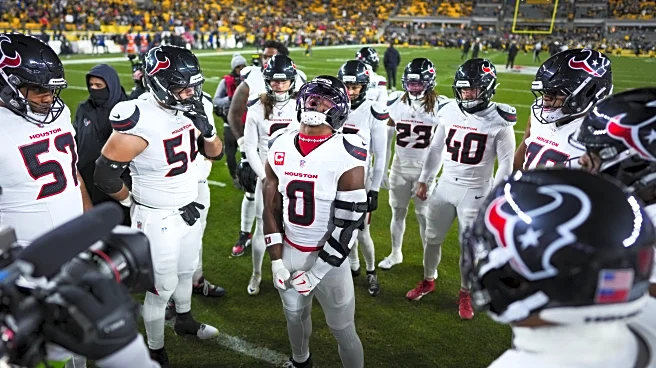

BIG PICTURE: In one respect, this season was a massive success. The team tied its record for most wins in a regular season, matched its longest regular season winning streak and counting the playoffs,
set the franchise winning streak record. It finally won a road playoff game. It got three players on the All-Pro team and had multiple Pro Bowlers. They became just the second team this century to come back from an 0-3 start to make the postseason. The team had arguably the best defense in the league, leading the league in yards allowed and almost leading the NFL in points allowed.
Yet, you could also say that this season wasn’t all that. They lost (again) in the Divisional Round. They struggled most of the year with consistency on offense, and now the narrative about the team is what is going on with CJ Stroud. Imagine ending this season with questions about the starting QB? Given that many of the traditional AFC powers weren’t in the mix (Chiefs and Ravens missed the playoffs), teams like Houston had a chance to breakthrough for at least an AFC Conference Title matchup, if not a Super Bowl appearance. Yet, Houston could not get there. That the season ended with the only double-digit loss of the year just seemed to reinforce that the Division round is more obsidian ceiling than glass.

DE-FENSE!! (Clap Clap) DE-FENSE!!! Coming into this season, this author felt that this could potentially be the best defense in franchise history. That was a gross understatement. Tied the franchise record for points per game allowed, set the record for yards allowed/game. 2nd most sacks in a season. 3 defensive All-Pros and of (now) 7 Pro Bowl selections, 6 came from the defensive side of the ball. A legit DPOY candidate (more later) and just an overall dominant year on that side of the ball. Before this year, Ryans called the defenses. However, as Houston started 0-3, Ryans turned over defensive play-calling to Matt Burke. The team went a collective 13-3 with the defense leading the way. You have to really look to find flaws with this squad, mainly the propensity to allow teams to convert on 3rd/4th and longs (especially if it was 10+ yards) and issues with QB scrambles. Ultimately, this was the type of defense that had Houston moved on, could have taken their place among the great single-season squads.
Yet, this was a fairly basic scheme. They didn’t blitz much and played straightforward coverage. Then again, think about that talent. You don’t have to scheme up much pressure when you have Anderson and Hunter as your bookends on the pass-rush. You don’t need to get too fancy on pass-coverage with Stingley and Lassiter manning up on receivers and a defensive backfield with ball-hawks like Pitre and Bullock. The DT rotation benefited from the DEs, but they could lock down the middle. The LBs were the weakest overall unit, but still pretty [KITTEN] good. While most of the key stars should return next year, it will be hard to match the performance they offered in 2025-26
Defensive MVP: Danielle Hunter. There is some logic to this move as you will see later. He led the team in sacks (15.0) and paired with Anderson to give Houston perhaps the best pair of defensive ends in the league. Arguably the best free agent signing of the Caserio era.
Unsung Hero: Kamari Lassiter. Hard to call a Pro Bowl selection with 4 INTs unsung. However, consider that he plays next to Derek Stingley Jr. By the end of the season, teams just did not throw anywhere near the 2-time All-Pro. Thus, a lot of the burden of coverage fell to Lassiter. He more than answered the bell. Yet, his impact was best measured when he was out. When he missed time against the Chargers and sat out the game against the Colts, teams had some of their best passing days against the Texans. Not a coincidence.
Defensive LVP: CJ Gardner Johnson. The big off-season trade acquisition, he was expected to add even more dynamite to an-already dangerous secondary. Yet, the only explosive element he added was the kind that could damage a locker room. His big highlight was making a tackle on Baker Mayfield after he scrambled for a massive gain on a 4th and long in a Monday Night loss. His attitude was trending toxic, and the Texans immediately released him.

OFFENSE: WELL, THEY WERE AN OFFENSE: This offense never seemed to get going. They started the year on pace to match the expansion season for worst scoring output in a season. While they did manage to end the year 13th in scoring, a lot of that came as a result of special teams and defense. The team had problems converting Red Zone trips into TDs (30th in the league), manifesting itself when the team went 1-for-4 at New England. The season-long loss of Joe Mixon hurt. We all witnessed the worst two-game stretch in QB CJ Stroud’s career in the playoffs. The offensive line, the expected weak spot on the roster, lived down to expectations, rating among the worst squads in blocking winning rates.
This is not to say that everything was horrid. Caley’s play-calling did improve as the season progressed, lending some credence for the team keeping him. Woody Marks, while not the most explosive back, proved an effective chain-moving runner, especially when the team needed to eat clock and yards. Nico Collins validated his status as as WR1. Dalton Schultz acted as a major security blanket for Houston QBs this year. The team saw its sacks allowed numbers drop from 54 to 31 and in the regular season, and aside from the playoffs, didn’t turn the ball over that much.
Offensive MVP: WR Nico Collins. The top weapon for the team. Another 1000-yard season. The concussion that kept out of New England hindered Houston’s attack at New England.
Unsung Hero: RB Woody Marks. With Joe Mixon a season-long scratch and Nick Chubb a shell of his former self, the burden of the running game fell to this 4th rounder. More than a few heads were turned when Caserio traded up to draft him, and most figured him a depth piece/3rd down back. Instead, Marks ended up the primary ball-carrier, rushing for over 700 yards.
LVP: LT Cam Robinson. The big OL free agent pickup, Houston signed him to a 1 year/$14M deal to try to man the LT position vacated after the Laremy Tunsil trade. He started at LT in the season opener, but he did not last long. By the 3rd game, he had given way to the talented, but incredibly raw rookie Ersery. He was soon traded to Cleveland for a mere pittance.

SPECIAL TEAMS: STILL GOOD. The struggles to start the season impacted the special teams as well. Adjusting to the new kickoff rules took Houston some time and even as the season went on, they still had their issues. On the season, Houston ranked 21st in kick return yards allowed. The punt units had their struggles this season, punctuated by allowing Parker Washington to return a 71-yard punt for TD. However, the special teams units offered more good than bad. Ka’imi Fairbarin set the NFL record for FGs made in a season and Tommy Townsend continued the validate the money invested in him. Jaylin Noel offered some quality returns in both the punting and kicking game, doing what he could to help the mercurial Texans offense. Throw in a couple of FG blocks by Autry and you had a special teams squad that generally did a lot to get the team to where it ended up.
Special Teams MVP: PK Ka’imi Fairbairn. An alternate for the Pro Bowl, he might have had his finest season yet. He tied the NFL season mark for FGs made and matched the franchise record for FGs in a game (6). Additionally, he improved his kicking performance in cold-weather outdoor venues (remember his struggles at Arrowhead the previous season).
Unsung Hero: PK Matthew Wright. Called up to replace Fairbairn when he missed two games. Those two games were against Jacksonville and Tennessee. Two narrow divisional matchups where his kicking was desperately needed. The walk-off against the Titans was a nice touch for his short tenure in Houston.
LVP: KR/RB Dameon Pierce. How the mighty have fallen. The one-time rookie phenom was relegated to the bottom of the running back and kick return room. Played in only 4 games, managing only a couple of returns. Was a mid-season release, later signed by the Chiefs, but ultimately did nothing.

TEAM AWARDS:
Team MVP: DE Will Anderson Jr. Hard to find a game where he didn’t have a major impact from the defensive end. He led the league in pressures, finished with 12.0 sacks and was perhaps the most relentless DE in the game. That continued in the playoffs, when he led the defense to the Divisional Round. If not for the (overrated) exploits of Myles Garrett, Anderson might just be your DPOY. Probably should be the winner (although LB Nik Bonitto from Denver also has a case). Still, Team MVP isn’t a bad consolation.
Runner Up: PK Ka’imi Fairbairn. If he didn’t have the season he did, would Houston have made the playoffs?
Team Unsung Hero: LS Austin Brinkman. For a team that lived and died on defense and special teams, getting the snaps right was critical. He did that. All while replacing the longest tenured and most consistent Texan in franchise history, Jon Weeks. One season went well. Just needs to do that for 14 more years to match his predecessor. No pressure.
Team LVP: Dameon Pierce. You could put Gardner-Johnson or Robinson here, along with others on the O-line, and Stroud’s playoff debacle will have some mention here, but Pierce’s fall impacted both offense and special teams. The full backstory of what happened to him may never be known, but an unfortunate waste.

A COUPLE OF OTHER SUPERLATIVES:
Biggest Game/Best Win: Week 10. HOU 36-JAX 29. Arguably the fulcrum of Houston’s season. At 3-5 coming into that game, this was a must win if Houston had any playoff hopes. Going with Davis Mills after a less-than-stellar relief effort in the Denver loss didn’t inspire confidence. Then Houston fell behind 29-10. Oops. Yet, somehow, someway, Houston managed to climb out of a massive hole with their record-setting 26-point 4th quarter. The beatdown in Pittsburgh for the Wild Card and the road wins at KC and LA (Chargers) also merit consideration.
Worst Loss: Week 2. TB 20-HOU 19. . The loss to Tampa Bay, the team’s only loss to a non-playoff team, really hurt. This was a game that Houston lead by 5 with under 2 minutes left. If they had stopped Mayfield on a 4th and long QB scramble, they likely win that game. At 13-4, they win the tiebreaker against Jacksonville due to a better division record, thus hosting at least one home playoff game. While they climbed out of that setback, it probably never should have come to that. Also considered was the home loss to Denver and the Divisional Round debacle against New England
Most Critical Play: TE Dalton Schultz 20-yard reception on 3rd and 10 at the HOU 7 against Jacksonville. Back to the biggest game. In the Week 10 TDATDA, this was the critical play. Given how the season played out, this was the most important play of the season. The 10-game win streak stemmed from this game, and this play was the one that allowed Houston to then drive down the field for the go-ahead TD. That win sparked all that followed it.
With that, we turn the page on the Texans’ 2025-26 season. For the NFL, there is still the Super Bowl, but after that, the long, but far from boring, offseason awaits.