
Overview
Low-scoring games such as this one create a conundrum from a data analysis perspective. Once Oregon scored after the strip-sack fumble to go up 13-0 each team’s performance indicated (according to hythloday’s
statistical models) that the Red Raiders no longer had a realistic opportunity to win the game. Tech’s offense had been so inept up to that point that a two-touchdown deficit was insurmountable within the bounds of regular play. When running the full-season numbers in future articles, all drives after that point will be excluded as garbage time.
For the purposes of this game in isolation, however, with over 26 minutes of game time left a single high-variance play could put the outcome in doubt once again. Indeed, the Ducks had been fortunate that several bad snaps and a poor mesh exchange hadn’t allowed a scoop-and-score opportunity to keep the Red Raiders within less than 7 points. As time went on and Texas Tech failed on 4th down deep in their own end of the field, down 16-0 with less than 7 minutes left, even a fluke play still wouldn’t have given them any chance to come back. For this article we’ll use that point as the garbage-time cutoff – it leaves Texas Tech with 11 meaningful possessions and Oregon with 9 (the last drive of the 2nd quarter needs to be excluded regardless as there wasn’t enough time on the clock for regular play calling).
The highest level view of this game is that neither offense was capable of full-field drives ending in touchdowns. The difference became that Oregon was in scoring position more often because they won the turnover battle 4-1 in the box score. With hindsight being 20/20, the Ducks could have put the game into garbage time sooner had they attempted field goals every time the kick would have been from less than 50 yards. Based on what was known at that point in the game, I think it is fair to question the wisdom of forgoing the field goal attempt to try to pick up 4th and 1 from the 23 at the end of Oregon’s second offensive possession (though I quibble more with the play call than the decision). I agree with the choice to go for a touchdown from Texas Tech’s 2 yard line in the second quarter (again, aside from the call), though. Failure left the Red Raiders offense with 98 yards to go after it had been established how unlikely that was, and there was enough time on the clock to get the ball back before halftime.
Offense
There are four primary factors that combined to make for what was, overall, a very poor showing from the Oregon offense. The first is simply the fact that the Texas Tech defense is the best the Ducks have faced all season. As hythloday documented the Red Raiders have elite edge rushers and athleticism at the linebacker positions. Their interior defensive line and secondary are, while not as elite as other personnel, still better than FBS average. This makes trying to succeed in obvious passing situations or attacking horizontally the equivalent of an archer targeting a knight’s shield; there is no chance of breaking through. Running up the middle or going deep on 2nd/3rd and short is equivalent to targeting the chain mail between plates; still tough but a direct hit can do the job.
The lack of success Oregon had running the ball was concerning. While explosive runs against this defense would always be hard to come by, efficient gains had been found by the Red Raiders’ past opponents by well executed interior blocking. The Ducks offensive line simply wasn’t up to the task with collective error rates of 28.28% in run blocking and 21.38% in pass blocking. While a similarly poor performance in the run game against Washington (the pass blocking was better) could be, at least in part, blamed on starters returning from injury, there were no such mitigating circumstances at the Orange Bowl.
Additionally, OC Will Stein and his staff fell into the same trap so many of Texas Tech’s previous opponents had and continued to attack the perimeter with screens and outside runs where the speed of this defense is at its strongest. Despite the early struggles, past film would indicate that Oregon should continue to test the interior while using the threat of these runs for RPOs, plays I saw used a bit but none attached slant or go routes to exploit aggressive linebackers and safeties. Even if such RPO plays only extended a few drives, inside zone and cutback runs could then have been more effective late in the game as fatigue set in.
In addition to struggling to block Texas Tech’s defenders in general, the offensive line seemed consistently befuddled when the Red Raiders lined up with a true nose tackle directly across from the center. This had been put on film before, but the line never seemed to adjust their blocking assignments to compensate throughout the game. Trying to use speed to the edge was just as bad or worse. Texas Tech’s defenders were too quick to the sidelines and consistently made tackles in the open field.
Attempts to use QB #5 Dante Moore in the running game to gain an advantage were generally ineffective. Moore has demonstrated he has the speed to be a threat with his legs, but he isn’t a naturally instinctive runner and gaining an extra blocker wasn’t enough of an advantage against this defense to justify risking the starting quarterback. It appears the surprise factor of these plays has worn off and I doubt they will be as useful again this season as they were against Penn State. I’d prefer Moore used his speed as a threat on reads and scrambles. What little success was found by the Ducks in the run game came from unbalanced formations, using the threat of Moore to occupy a defender, and occasionally pushing pile forward a few yards.
What was most impressive in the run game (and by the pass catchers as well) was none of Oregon’s ballcarriers allowed Texas Tech to punch the ball out as they had done so often this season. That alone was enough to secure a win with Tech’s own offense stuck in neutral.
Here is a representative sample of successful rushing plays:
(Reminder – you can use the button in the lower right corner to control playback speed)
- :00 – This is about as smash-mouth as it gets, running inside zone from under center. Notice Texas Tech DT #2 Hunter lined up as true nose tackle at 0-tech directly across from C #72 Laloulu. In this case the alignment actually is helpful for the offense, RG #74 Iuli has a better angle to help Laloulu turn the defenders’ shoulders perpendicular to the line of scrimmage, but he misses the linebacker when he moves up to the second level. The other “chip and up” from RT #71 Harkey never gets a clean release so both linebackers greet RB #0 Davison. The runner has to keep churning his legs to push the pile forward for 5 yards.
- :18 – On the very next play the Ducks break out an unusual package with reserve TE #83 Saleapaga in the backfield, who leads RB #6 Whittington through the hole on a draw. The Red Raiders defensive line, except Texas Tech #8 Banks, move too far up field and LG #75 Pregnon has his man handled. Laloulu and Saleapaga get free releases to the second level.
- :35 – The backside defender is being read by Moore, TE #18 Sadiq only fakes toward hitting him and heads toward the corner in case the QB had kept the ball. A crease is quickly formed between Laloulu and Iuli. The block on the linebacker isn’t enough to prevent him from making contact with Davison, but the big back is strong enough to fall forward for a good gain.
- :50 – This was one of very few successful plays to the perimeter. Lined up close to the formation, WR #11 McClellan has a good angle on the MIKE. Sadiq makes contact with the SAM but cannot get outside leverage for RB #23 Hill to get to the sideline. Only Hill’s exceptional speed and ability to run through tackles allows him to gain 6 yards.
And unsuccessful rushing plays:
- :00 – This early 4th down attempt showcases the difficulties a 0-tech nose tackle was causing with zone blocking throughout the day. This is an unbalanced formation with 6 OL (notice reserve OT #59 Crader on the left so OT #76 World can join OT #71 Harkey on the right) and the ball is snapped directly to Davison. The entire line is supposed to kick step to their right then take the defender in their area. The count is off for the entire line’s assignments. Pregnon tries to get to the nose tackle but has no hope of getting to him in time.
- :13 – The defense is lined up in a more typical alignment for a 4-3 defense so there is no assignment confusion on this inside zone play. The line and tight ends are simply playing with poor pad level across the board and can’t even get enough push to gain 2 yards.
- :29 – We see Limar in as a blocker again, this time executing a slice across the formation. As in the first clip, the Texas Tech defense is lined up more like an odd front with a true nose tackle, a 3-tech to the offense’s right, and a 5-tech end to the offense’s left. The nose tackle gets immediate penetration into the backfield, but it’s away from the play. The problem is Iuli who has a free release to the linebackers and goes for the MIKE when that is Pregnon’s job. Nobody lays a hand on the WILL so Davison has to try to go outside where the end has kept contain and the safety is coming down to help.
- :45 – The Ducks try to use a QB draw to gain a blocker on 3rd and short. The plan is for Moore to follow Whittington through the A-gap to the offense’s left, so the double team can stay on the 1-tech and leave the WILL unblocked. Pregnon loses his hand fight with the DT and the double team gets out leveraged to the play side so Moore has to try to improvise and runs right into Laloulu’s butt.
Oregon’s staff was under no illusion how much they would struggle to contain Texas Tech’s pressure off the edge. The majority of the passing game was planned around quick reads and getting the ball out on shorter routes. As he has had to do too often this season, Moore absorbed a number of hits after releasing his throws. The offense did take occasional shots to the sideline when the defensive alignment showed one-on-one coverage, which was the highest leverage strategic move of the passing game and I’ve been wanting to see more of all season. Besides this, the only explosive passing came from some run-after-catch opportunities. Combined with the difficulties running the ball, this meant the Ducks had to march the field on long drives and never reached the end zone without a turnover.
The Ducks ran 5 screen passes (about 8% of all offensive snaps), but only one succeeded and the average yards per play was a dismal 0.8. The weakest part of Oregon’s offense against the strength of Texas Tech’s defense was always a losing proposition. Calling 2-3 of these plays to set up a shot at some point would have been reasonable, but any more was wasting offensive snaps that were already hard to come by.
Below are examples of successful passing plays:
- :00 – World is struggling with Texas Tech’s excellent DE #9 Height. Fortunately Moore sees the corner bailing in Cover-3 and knows McClellan will be open on the comeback, so he releases the throw before edge pressure can get to him.
- :22 – It’s fourth down and there is pressure coming at Moore from both sides. Notice Harkey introducing former Stanford standout Texas Tech DE #31 Bailey to Big Ten style pass blocking. Moore knows he has to get the ball out, so he risks a throw to the tightly covered Sadiq. The ball is placed in the only spot it could be for a completion, just out of the defender’s reach.
- :45 – The offense had tried to find WR #4 Benson to the far side of the field earlier in the game and the ball had been slightly under thrown, resulting in an incomplete pass. Fortunately the Ducks decided to go back to it. The protection is holding up a bit better and Moore doesn’t need a lot of time. Once he sees no deep safety to the field he uncorks a back shoulder throw and Benson displays some fancy footwork to come down with the catch in bounds.
- 1:12 – More effective than screen passes were the couple of times Oregon found the running backs in the flat. Against man coverage the routes run by WR #2 Bryant and TE #9 Ja. Johnson create a natural rub. Limar has the first down and more for free then gets extra yardage when Ja. Johnson throws a downfield block for him.
And unsuccessful passing plays:
- :00 – Both the tight end and running back are looking to chip before releasing into the pattern as Texas Tech brings a blitz. Because the extra rusher is coming from the offense’s left, Harkey is left one-on-one against Bailey and he simply isn’t quick enough. Moore never has a chance. With enough time he would find Whittington open short with nothing but green grass in front of him.
- :19 – The corner with the highest grades in pass coverage from hythloday’s film study had to leave the field due to a helmet issue for this play. OC Will Stein’s response is an RPO where the throw is a quick screen into the boundary. Based on Hill’s path the play is supposed to go to the sideline, but the safety has outside leverage by alignment and the linebacker is fast enough to recover even if he misses.
- :26 – Despite having 8 blockers in pass protection, World has to resort to holding (uncalled) against Height and Bailey is plowing through three Ducks on his way to the quarterback. Moore has just enough time to get the throw off, but whether due to the pressure in his face or a simple misfire he can’t make an accurate back shoulder throw to a wide open WR #1 Dak. Moore.
- :54 – Moore does well to get a completion with Bailey (lined up to the offense’s left this time) about to bring him down. If he had a moment longer he might have seen the corner over Bryant bailing at the snap, leaving him wide open for the first down.
Defense
As much as Oregon’s offense struggled in this game, Texas Tech’s issues were that much worse. Every trend hythloday had picked up on in film study showed up in this game and Oregon’s staff had planned to exploit each one. While Red Raiders’ QB #2 Morton was as healthy as he has been all season the precarious depth situation meant Texas Tech wasn’t willing to risk him as part of the running game (as our counterpart had thought). Without the ability to occupy an extra defender, Texas Tech’s offensive line couldn’t open any holes for their excellent running backs to exploit. Morton’s lack of touch in the short game and tendency to lock on to his first read killed drives with inaccurate throws and interceptions. Combined with a fumble recovered by Oregon, the Red Raiders’ offense ended up giving their opponents the one advantage they themselves and thrived on all season: short fields and extra possessions from turnovers.
The performance metrics show Texas Tech was slightly better running the ball than the Ducks were. These numbers are skewed however by the two explosive runs they hit, both exceptional plays. The first was a missed tackle in the backfield that lost backside contain and resulted in a 50 yard gain. The second was a 13 yard gain on second and very long after consecutive false start penalties (yet another trend that hythloday’s film study had revealed) that caught the defense by surprise. None of the Red Raiders remaining 22 called rushing plays gained more than 5 yards.
Here is a sample of successfully defended rushing plays:
- :00 – The Red Raiders have used this variation of split flow inside zone with Texas Tech OT #79 pulling across the formation all season. I’m not sure why because the tackle simply isn’t fast enough to make this work most of the time. It doesn’t matter in this case as LB #28 Boettcher gets penetration on a blitz and DT #52 Washington tosses the undersized right guard aside.
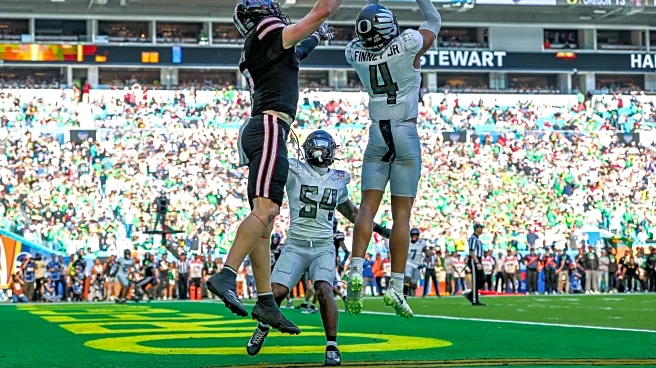
- :14 – The front has closed off all the gaps in the middle of the field where this play is designed to go. Texas Tech’s running backs are very dangerous when given a chance to improvise, and DE #55 Mat. Johnson has peaked inside and loses outside contain. Fortunately CB #4 Finney has diagnosed the play and makes the tackle before the back can break contain into the open field.
- :32 – The Red Raiders appear to adjust to the stem movement by the defensive front without much issue. Notice how even though OLB #44 Tuioti crashes on the running back the QB hands off, I don’t think any of the run reads were live in this game. The tight end is stood up by DE #10 Uiagalelei and the center is halted in his tracks by Finney coming off the edge, knocking the runner on his back as reinforcements arrive.
- :49 – This outside zone toss is the same play Oregon’s offense tried a few times in this game. The boundary corner, #5 Th. Johnson, reacts quickly enough to occupy the tackle who has pulled around the block of the tight end, leaving DB #21 Flowers free to run the alley. The runner is stopped just short of the line to gain because LB #26 Jackson fights through the block of the receiver to hold him just short of the line to gain
And unsuccessfully defended rushing plays:
- :00 – Lined up as a 5-tech, DT #1 Alexander is moved just enough by a double team to open a crease for the back. Jackson is right there to meet the runner, but is pushed back just far enough that the offense is awarded 4 yards on 1st and 10.
- :18 – This is the play right after the fourth clip in the previous collection. There might be only a foot to go, so even with DE #29 Porter holding the edge and DB #22 Canady quickly reacting to the play the back can stumble forward for a couple yards. Only immediate backfield penetration can stop a run in this situation.
- :26 – Texas Tech goes hurry up, snaps the ball directly to the running back, then fakes a pitch to the quarterback who… is not sure what his motivation in this scene is. Notice DB #31 Thieneman spinning down into a linebacker position with LB #54 Mixon on the line of scrimmage. Thieneman gets blocked by the tight end and Boettcher is frozen when the back takes his little counter step after taking the snap. The result is one of the Red Raiders’ better runs.
- :42 – On the very next play Texas Tech again adds some window dressing to an otherwise standard play. The quarterback looks like he is checking with the sideline and will change the play, but it’s actually a quick snap right on the clap. The whole production doesn’t fool the defense, but the double teams stalemate the defensive line and the left guard gets a solid block on Mixon so the back can pick up a first down.
Knowing that Texas Tech’s most effective passing plays were deep shots down the sideline, Oregon spent the majority of the game in a two high shell to take these throws away. Morton didn’t have enough time in the pocket behind a leaky offensive line to try any other deep throws, and his inaccuracy meant the passing game would never be efficient enough for the short game to drive the field.
The Ducks were less aggressive blitzing to keep more resources deep in coverage, but the pass rush was disruptive none the less. Indeed, blitzing was often counter productive as it opened up the quick throws Texas Tech needed against the pressure. They also played more zone as opposed to man compared to earlier in the season, which caused problems given Morton’s tendency to “lock in” to his first read. Aside from a few quick hitters, Texas Tech’s only successes through the air came from extraordinary efforts by Morton and his receivers. Thankfully, in a low scoring game we did not see any of the busted overages on deep throws that plagued the secondary during the regular season.
Below are examples of successfully defended passing plays:
- :00 – Morton has the running back wide open in the flat for the first down, but that is the last read in his progression. By the time he begins to look that way Tuioti has nearly pushed the right tackle into the QB’s lap. Morton can’t make the throw running backwards, then he hesitates and doesn’t throw it away as Tuioti catches up to him so he loses field position in addition failing to convert on 3rd down.
- :19 – This is an example of how Oregon used more zone coverage in this game, and how effective it could be against Morton. There is pressure coming from Uiagalelei, but the quarterback thinks his first read will be open on an out toward the boundary. He has mis-read the coverage though. The safety has deep responsibility so Finney can squat on the intermediate route and undercut the pass.
- :49 – Big XII defenses routinely fell into the trap of playing only a single high safety and leaving sideline go routes open in man coverage, which is also Morton’s best throw. Oregon usually played with split field safeties, as on this play. The corner DB #7 Obidegwu can play trail technique and work the receiver toward the sideline because Canady has downfield position. There is no window to fit this throw into.
- 1:06 – Mixon comes on a blitz leaving no defenders in the middle of the field, so the tight end is wide open running a slant. The QB sees it but Washington has come underneath on a twist and, showing remarkable situational awareness, gets his hands up to bat down the ball.
And unsuccessfully defended passing plays:
- :00 – The Ducks send a linebacker blitz, but this time the protection holds up well. This is partly because Boettcher picks the wrong gap, when he goes inside he collides with Washington looping around on a twist. Because five defenders are rushing the passer, the defense is in man coverage with a single safety deep. This leave the in breaking route to the tight end open.
- :16 – Another blitz and Texas Tech must have been anticipating it as they have called a tunnel screen. Uiagalelei diagnoses the play immediately and forces the QB to double clutch the throw. This buys time for Mixon and Flowers to limit the damage. Finney was being pushed back by the tight end, and if the receiver had improvised and run down the sideline he might even score.
- :38 – Morton was supposed to be as mobile as he had been all season, though we didn’t see it often as Texas Tech didn’t want to expose him to unnecessary hits. He does show off his scrambling ability here though. After breaking the pocket he also showcases his arm strength by putting the pass over the top of Th. Johnson, and his receiver makes an incredible acrobatic catch. There is no defense against a play like this. Sometimes you have to tip your hat to the offense.
- :57 – The blitz pick up by the running back buys just enough time for Morton to get this pass away. The throw is on time and extremely accurate; if the ball didn’t lead the tight end to the sideline Finney might have a chance to break up the pass.