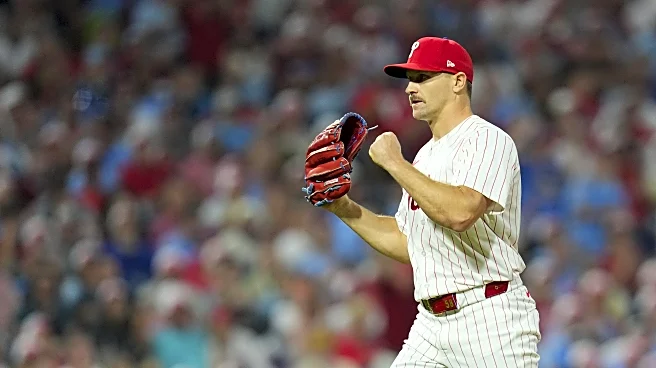




You would be forgiven if you often overlook Tanner Banks’ spot on the Phillies roster. Being a reliever who doesn’t throw hard and who occupies the third left-hander role in a bullpen isn’t exactly a formula for becoming a household name. It’s not a glamorous role, but it is one that Banks filled tremendously last year, especially when he was called upon in big spots in the wake of José Alvarado’s suspension.
2025 stats
69 games, 67.1 IP, 3.07 ERA, 1.01 WHIP, 22.8 K%, 4.5 BB%, 1.7 WAR
What went right
Banks turned in the best
season of his career and was a steadying presence for a Phillies bullpen that was in flux for much of the season prior to the acquisition of Jhoan Duran. In 34 appearances made during Alvarado’s suspension, Banks pitched to a 2.16 ERA and 0.90 WHIP while striking out 29 and walking just three. That lack of walks was a key part of Banks’ season, as he cut his walk rate almost fully in half, going from 8.0% in 2024 to his career-best 4.5% in 2025. That number also put him sixth best among all qualified MLB relievers in walk rate. An adjustment to increase his sweeper usage and decrease his fastball usage, therefore utilizing a slider-sweeper combination, seems to have helped achieve this success.
Banks also found himself with more leverage appearances thanks to Alvarado’s absence, and the 33-year-old lefty thrived. In 17 such appearances deemed “high leverage” by FanGraphs’ leverage index, Banks was charged with one earned run in 8.1 IP with 7 strikeouts to three walks. He allowed only 12 of 32 inherited runners to score despite entering with runners on base in 20 of his 69 appearances.
What went wrong
Despite all of his success, Banks still didn’t miss many bats despite having a strikeout rate right around league average. He was very good at inducing weak contact with an average exit velocity in the 84th percentile, but Banks’ whiff rate (21.9%) and chase rate (26.7%) were both way below average. Opponents hit only .224 against Banks, but a .255 xBA and .260 BABIP both suggest that some regression may be coming.
The biggest concern however from an otherwise stellar season was Banks’ penchant for giving up the home run. He was good at limiting hard contact, but when he did surrender some, it usually left the yard. Banks allowed 9 homers in 69 appearances, giving him a career-worst 3.4% home run rate. Those nine home runs were second only to Jordan Romano’s ten longballs for the most surrendered in the Phillies bullpen.
The Future with the Phillies
Banks, now 34, is under team control through the 2028 season. Spotrac estimates his salary for 2026 to be around $1.2M, a very low number for a pitcher who was as useful as Banks was in 2025. However, there have been rumors that the Phillies could deal from their surplus of left-handed relievers with Banks, Alvarado, and Matt Strahm all under contract for 2026. Banks, despite his age and non-explosive stuff, would possibly fetch a somewhat decent return considering he’s cheap, controllable, and still has an option year remaining. But whatever return the Phillies could get would probably not be worth subtracting Banks from their MLB roster.
Recently though, those trade rumors have centered in on Strahm possibly being the one moved. If that were to happen, Banks would once again find himself bumped up the bullpen depth chart as the second lefty after Alvarado. He would suddenly become more important, especially considering Alvarado’s inconsistency over the last two seasons. It’s not hard to envision a scenario where Banks finds himself going from a middle reliver/depth piece into a regular leverage arm against lefties if Alvarado falters. But that depends on Banks proving that his 2025 wasn’t a fluke and repeating his results. If he does, the Phillies have some Alvarado insurance. If he doesn’t, the Phillies could go from having too many left-handed relievers to not enough.