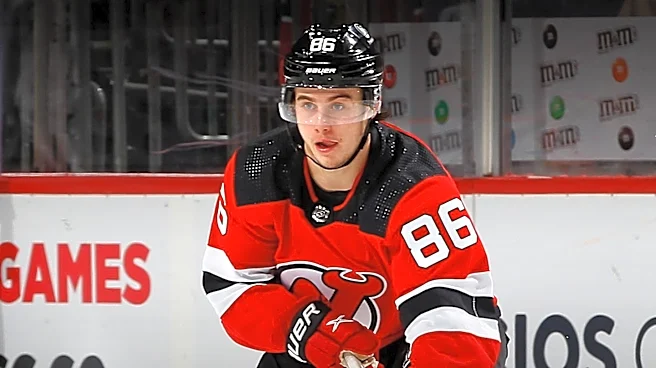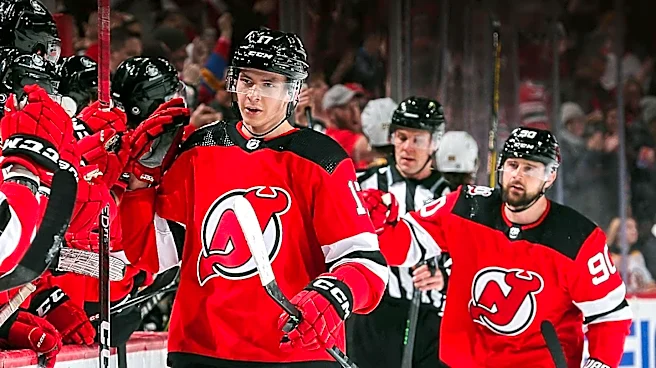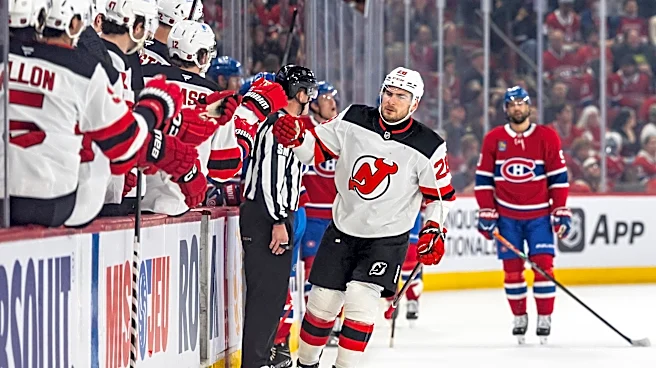




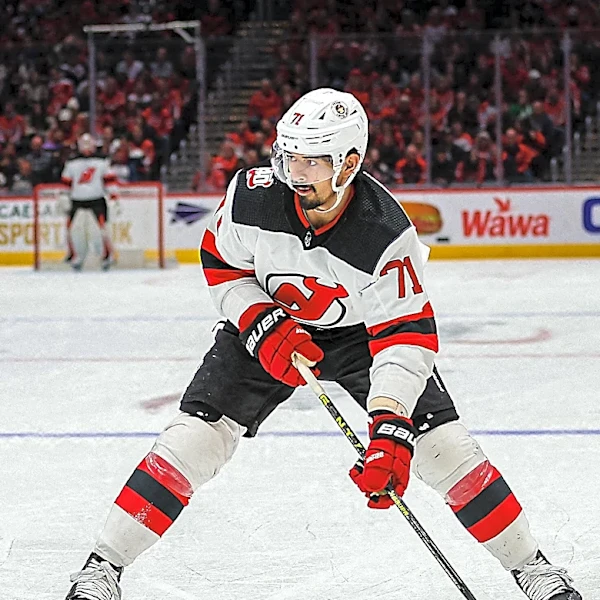



Ever since the New Jersey Devils traded for Timo Meier at the 2023 trade deadline, former general manager Tom Fitzgerald, the entire Devils organization, and Devils fans alike have envisioned a perennial 30- to 40-goal scorer sitting atop their lineup. After three-and-a-half seasons in the Garden State, things haven’t gone quite as planned for Meier and the Devils. It’s not that he’s been bad, as he’s produced 87 goals and 163 points in 247 games. That’s good for an 82-game pace of roughly 29 goals and 54
points. That’s genuinely good production. The problem is, despite that strong goal-pace, Meier has posted, 28, 26, and 24 goals in his three full seasons in New Jersey, which is a concerning trend. That, coupled with his reputation for being an elite goal-scorer with the San Jose Sharks and his $8.8M AAV price tag, have left Devils fans feeling disappointed. For a player of his stature who makes that much, more production is expected.
But for whatever reason, it just hasn’t clicked for Meier here. He has yet to come close to his career highs in San Jose. His peak in total points was 76 in 2021-22, while his peak in goals was 35 in that same season. He did hit 40 goals in 2022-23 split between the Sharks and Devils, but as far as full seasons with one team go, that 2021-22 campaign was his magnum opus. He did also hit 30 goals and 66 points in 2018-19, which again is significantly more points than he’s posted in any full slate with the Devils.
So as far as filling the scoresheet, Meier hasn’t lived up to what most Devils fans have wanted. The good news is, I do think there’s a way to squeeze more production out of Meier, and it’s a fairly simple remedy. We’ve had this discussion about Nico Hischier before, and since Meier has been stapled to Hischier’s side for a few seasons now, the same would apply to him: Free Meier from brutal shutdown minutes and grant him more opportunities to shine offensively.
Meier, Hischier, and Glass: The Three Pieces To The Puzzle
As mentioned, we’ve discussed lifting Hischier’s defensive burden on this site before. Last summer, I wondered whether using Cody Glass more in a top shutdown role could unlock Hischier’s line to do serious damage on the scoresheet. Chris explored this to a degree as well in a couple of articles this past spring. Hischier is matched up against the opposing team’s best players night in and night out. He takes all the toughest shifts, takes all the toughest faceoffs, handles the hardest penalty killing assignments, and starts in his defensive zone way more than the Devils’ other top line. Whereas Jack Hughes and Jesper Bratt start a shift in their defensive zone less than 30% of the time, Hischier starts there close to 50% of the time. The fact that he is able to produce the amount of points he does and drive play to an excellent degree despite such hellacious conditions shows what an immense talent he is.
But at the same time, I also can’t help but feel like Hischier could provide even more if he didn’t have to take on all this responsibility. I’m not even advocating for him to be stripped of ALL elite matchup minutes. But if they could be lessened, and he could take just a few more shifts against lesser competition, Hischier could become a true monster in this league. If there was nobody on the Devils roster who could take that burden from Hischier, I wouldn’t be pushing for it either, but I do believe Glass has that potential. His defensive metrics took a bit of a step back this past season, but it was a step back from truly elite to merely very good. According to Natural Stat Trick, among forwards who played at least 500 5-on-5 minutes, Glass’ Expected Goals Against of 2.55 was tied for 131st-best among 384 forwards. That puts Glass in roughly the top third of the league in that metric. Again, not amazing, but still very good. And that’s just a single analytics model too. In Chris’ article from April, he cites HockeyViz, which has Glass tabbed as one of the best defensive forwards in hockey, hands down.
In my eyes, it really does feel like Glass is the key to unlocking Hischier as a truly elite point producer. And now that Evan Rodrigues, a strong defensive winger in his own right, is in town, perhaps Glass and Rodrigues could form a potent shutdown combo on the third line. If Sheldon Keefe can hand some of those tougher assignments to Glass this upcoming season, that would free up Hischier to rack up a ton of points.
But this is supposed to be an article about Timo Meier, so why am I talking so much about Nico Hischier? Well, because if Glass can free up Hischier, that would mean he’s freeing up Meier as well.
I don’t think it gets talked about enough that Meier has the same brutal deployment that Hischier does. When we talk about Hischier’s point production, I think most Devils fans are understanding about how heavy the defensive burden on him is and cite that as an excuse for Hischier never reaching the true heights of the league in raw point production. However, that same grace is not extended to Meier most of the time. I get it to a certain extent. Hischier is the center, which comes with more responsibility than a winger. Plus Hischier kills penalties, which Meier does not. Still, I think we should find it in our hearts to excuse Meier’s lack of point production to a degree. To me, two things can be true at once: Meier should still be producing more, but he also isn’t being set up to succeed.
And in case you don’t believe me about Meier absorbing the same tough minutes as Hischier, here is the amount of ice time those two have shared at 5-on-5 over the last three seasons:
2023-24: 307:57
2024-25: 738:46
2025-26: 748:43
Over the last two seasons, Hischier was by far Meier’s most common linemate. That means eating the same brutal deployment as the Devils’ captain at 5-on-5. Remember how Hischier gets way less offensive zone usage than Hughes and Bratt? Meier has that same usage as well.
And I’m really not exaggerating about Meier getting hard-matched against elite competition on a nightly basis. According to Hockey Stat Cards, Meier’s quality of competition metrics are close to the 100th percentile, meaning he takes on some of the toughest minutes in the league.
And yet, despite all that, Meier continues to produce. Sure, we’re all disappointed at the level at which he’s producing, but consistently scoring in the mid- to high-20’s every year with around 50 points per season is still solid. And while he’s doing that, he’s still driving play. Whether you look at Hockey Stat Cards or Natural Stat Trick, Meier put together a strong analytical profile in 2025-26. Hockey Stat Cards had Meier at 60.96 xGF to 52.30 xGA (which comes out to an xG% of roughly 54%). This is almost bang on with the Natural Stat Trick numbers too, as they have Meier at an xG% of 54.08. Doing this against top competition alongside Hischier is impressive work.
And Meier’s ability to drive play is another reason why I think he can get to where we all want him to be if Keefe allows him to feast on lesser competition and more offensive zone time. If Meier can post the point totals and the play-driving metrics he does while taking on a heavy burden, then logic would dictate that he could do even more against more second and third line competition. Perhaps he can reach those lofty 40-goal/70-point heights we all fantasized about when he first came over to New Jersey.
The Power Play Factor
While I do think that Meier’s 5-on-5 deployment is a big part of this, I would be remiss if I did not mention his power play usage as well. In his three full seasons in New Jersey, Meier has averaged 2:25, 1:55, and 2:05 on the man advantage. That’s a good amount of PP time per game, but it mostly comes on the second unit. There have been stretches over the years where Meier got bumped up to PP1, but for the most part he leads the charge on the second wave.
It’s funny, Meier didn’t actually get boatloads of power play ice time in San Jose either. If we’re not counting his 2022-23 that he split between the Sharks and Devils, then Meier only got two seasons in San Jose where he averaged more than two minutes on the advantage: 2019-20 (2:08) and 2021-22 (2:46). That 2021-22 number really sticks out. It’s no wonder he posted his best season of his career during that campaign. In fact, prior to that season, Meier’s high in power play goals in a single campaign was six. He doubled that in 2021-22, posting 12 PPGs. He’s only surpassed that total once since: That split 2022-23, in which he averaged a ridiculous 3:04 with San Jose and 2:54 with New Jersey, and rewarded his teams with 17 power play goals.
Still, it’s only logical to think that getting more power play time and spending more of that time with the top guns will lead to more scoring. I don’t know if I’d advocate for Meier to start the year on the first unit, I’d have to delve deeper into that to come to a strong conclusion myself. But I just wanted to be fair and point out that while I believe better 5-on-5 usage can really help Meier, limited power play time definitely caps his ceiling.
No Need To Pick A Side
One more thing before we wrap up.
A big part of the discussion around Meier’s production (or lack thereof) has been playing him on the right side for a change. He played on the right for much of his time in San Jose and he racked up big goal totals there. But since he’s put on a Devils sweater, he’s lined up almost exclusively on the left side, leading some to believe that him playing on the left is a big part of the reason why he has struggled to produce points.
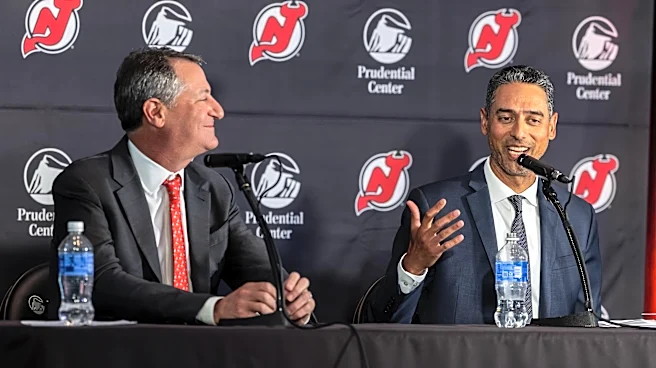
In a recent interview with NJ.com, Sunny Mehta was asked about this specifically when it comes to Meier. And while Mehta is not the be-all, end-all, he basically poured cold water on the notion that wingers perform better on one side or another. You can hear the entire question and answer around the 17:25 mark of the linked video, but the gist is that Mehta said he did a deep dive in recent times on whether there’s anything to wingers playing on their strong sides versus weak sides, and his research concluded that, at least when it comes to offensive zone play, it really doesn’t matter at all.
Again, Mehta is not an unquestionable hockey deity. But at this moment in time, I trust him a LOT more than I trust myself or anyone reading this article right now (no offense!). So it appears that Meier shifting over to the right wing is not something that the Devils are giving much thought to.
Final Thoughts And Your Take
As I said before, two things can be true at the same time. On the one hand, Meier is paid like an elite goal-scorer, and he has yet to reach that level consistently in New Jersey. His goal totals have gone down with each full season, and when taking his salary and pedigree into account, it’s no wonder why a lot of Devils fans are disappointed with what they’ve gotten out of Meier in New Jersey. But on the other hand, his extreme shutdown usage must be taken into consideration. When a player has to spend as much of his time and energy shutting down elite competition as Meier does, it’s very difficult to find time to produce at a high level. The fact that Meier continues to draw those assignments and still post strong underlying numbers is worthy of praise.
But at the end of the day, while it’s impressive that Meier can keep his head above water under such harsh conditions, I do think the Devils would be better off deploying him in more offense-first roles. And since he’s been a fixture on Hischier’s line for a few seasons now and I don’t see that ending anytime soon, that necessarily means that Hischier has to be freed from his defensive burdens as well. That would make Glass the next in line to take those minutes, and with a potential reinforcement in the form of Rodrigues, perhaps the Devils have the makings of a third line that can truly shut down the opposing team’s best players on a nightly basis.
What do you think of all this? Do you think the Devils should make an effort to give Meier cushier deployment in 2026-27? Do you think Glass and his potential linemates would be up to the task of taking those matchup minutes from the Hischier line? As always, thanks for reading!