
The clock had struck midnight. It was officially over. The decision had been made to go in a different direction and just as quickly as he had taken the job, he was gone. The suddenness was jarring, and the hope
of a brighter future was shadowed by the clouds of uncertainty.
Changing head coaches at the University of Michigan is a reluctant process, but an inevitable one. And following Juwan Howard’s eight-win season and multiple hollow apologies, enough was enough.
After nearly five years as the leader of the basketball team, Howard was out. What started as a plucky upstart team before the pandemic in year one and peaked as an Elite Eight team in year two had quickly spun out of control. The year after the magical NCAA Tournament run, which cruelly culminated in a Franz Wagner air-ball and a two-point loss to UCLA, the Wolverines’ head man began to lose his grip on himself and the program.
In Feb. 2022 in the midst of an inconsistent season, Howard snapped. Following a 77-63 loss to Wisconsin, he physically struck Wisconsin assistant coach Joe Krabbenhoft in the handshake line after a verbal altercation escalated with opposing head coach Greg Gard. Punishments and fines were quickly dished out by the Big Ten, and Howard was subsequently suspended for the final five games of the regular season.
Already known for being a fiery personality, the slap pushed his public perception from passionate competitor to temperamental child. Naturally, fans rallied with echoed Pistons cries of “Ann Arbor Bad Boys” and referenced the street gospel of “talk shit, get hit.” Coping with the veneer of toughness (“I’d like to know where Lou Holtz is right now!”) is always fun as it relates to competition, but internally, everyone knew the clock was ticking.
With a contrite Howard back on the bench a few weeks later, the Wolverines collapsed against Indiana in the conference tournament and limped into the NCAA Tournament with a 17-14 record. With his back against the wall and eager to prove himself a changed man, like a single dad following a divorce, Howard was able to muster a stunning two-game performance. The 11-seeded Wolverines toppled Colorado State in the opening round and advanced to the Sweet Sixteen following the “Brooks hook” in an upset win over Tennessee. Michigan fell to Villanova the second weekend of the tourney, but hope, to a degree, had been restored.
Entering his version of A Season on the Brink, fans were excited for this team to build off last season’s surprise upswing finish and return to true contender form. Unfortunately, the Sweet Sixteen run was quickly proven to be a death rattle instead of a revival. The 2022-23 season is now widely forgotten and only remembered as being the first time since 2015 that Michigan missed the NCAA Tournament. Howard’s season on the brink quickly became a season-long slide into the second round of the NIT. But his magnum opus of ineptitude came during the 2023-24 season, his last in Ann Arbor.
Michigan won eight games under Howard that season. EIGHT. The Wolverines lost 19 of their final 21 games, including nine straight to finish the year, and the team’s 24 total losses were the most in program history. Two days later, Howard was fired. Warde Manuel had only acted this quickly in previous years when he saw some credit not being taken. But things had bottomed out that even the most notorious hand-sitter had to act.
Michigan’s coaching search was immediately underway with the non-negotiable caveat the next head coach not only needed to be a leader of men but also a person of substance. A program builder who could win consistent, high-level games and also live up to the ethos of a Michigan Man. The next coach needed to be an incarnation of John Beilein.
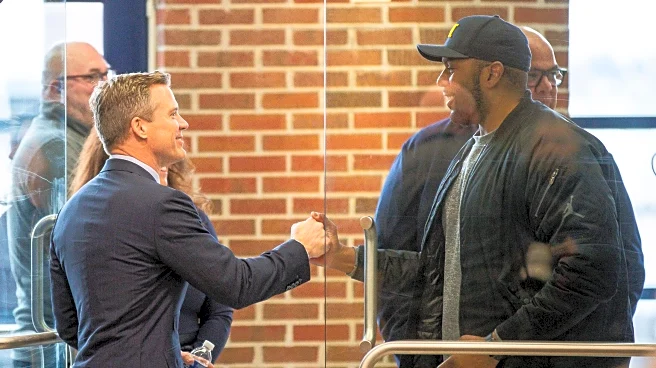
Nine days later, Dusty May was named the 18th coach in Michigan basketball history. The decision was met with generally positive reactions. Detractors, as they always do, certainly voiced their apprehension. But Michigan achieved what it sought to do in the hiring process — looking beyond the record and weighing character as much as winning percentage.
May’s day was here as he accepted his first Power 4 coaching job, and 19 months later, it looks like one of the shrewdest head coaching hires in any sport this decade. Michigan is currently 11-0 and the betting favorite to win it all. The team is ferocious and disciplined defensively — the No. 1 ranked team in KenPom and statistically the best in program history — and an explosive avalanche on offense, having scored 100 points or more in five of the last six games. In 19 months, this program has transformed from a national embarrassment whose coach was best known for postgame slaps than celebrations, to one of the most dominant and respected programs in the country under May.
The right hire changed everything, and the football program is now at a similar crossroads.
Across nearly 40 years, from Richard Nixon’s first year in office to the waning years of the George W. Bush administration, Michigan had been led by three coaches — Bo Schembechler, Gary Moeller and Lloyd Carr. That’s it. Entering 2026, Michigan is preparing to hire its third head coach in four years.
When Sherrone Moore was hired in early 2024, it was viewed as a home run. Not because he was some fabled coordinator like Lincoln Riley or Kirby Smart finally getting his shot, but because he was adamant he was going to keep a good thing going. Two years ago, drunk on a national championship, no one gave it a second thought. This was exactly what everyone wearing maize and blue wanted to hear.
Players advocated for Moore to get the job; pundits gave rave reviews. It was replacing Bon Scott with Brian Johnson. Michigan had its guy and key players — Will Johnson, Colston Loveland, Mason Graham, Kenneth Grant, Kalel Mullings, Donovan Edwards — were ready to run it back. But unbeknownst to (presumably) everyone involved was Moore had already lost his grip on his personal life and it was only a matter of time until the program slipped away, too.
The 2024 season was a sobering realization. Even if a team had the talent of a Harbaugh team and played like a Harbaugh team, it doesn’t make it a Harbaugh team without Jim present. Entering the final week of the season, the team stood 6-5. A low mark, a Harbaugh team had never sunk to entering the final week of the regular season.
With his back against the wall and eager to prove himself more than a substitute teacher doing a Harbaugh impersonation, Moore was able to orchestrate a shocking two-game performance to finish the season. In The Game, the Wolverines pulled one of the biggest upsets in rivalry history, beating Ohio State, 13-10, in Columbus. And for an encore, despite missing several key NFL pieces, the Wolverines beat Alabama for the second time in the calendar year, 19-13, in the ReliaQuest Bowl.
Both wins felt like Moore had put it together. He understood his personnel and beat the eventual national champions, and the first team left out of the College Football Playoff, with an excellent game plan that relied on physicality and defense. It felt like the ‘69 team after halftime of the Minnesota game. Finally, this team had an identity and momentum.
With the arrival of the nation’s No. 1 quarterback and a new offensive coordinator, fans were expecting this bowl win to be a launching pad. A Mario Kart super mushroom to shoot them straight to first. The team was supposed to build off of this success and catapult back to the top of the Big Ten.
But much like the basketball team after beating Tennessee, it was more of the middling same. Minus the climactic finish.
Michigan felt eerily similar this season to last. The Wolverines handled opponents they should have handled, and lost to opponents they should have lost to. James Franklin would be proud. It was a team with conflicting identities and an insipid personality. Despite a better record thanks to a more favorable schedule, the lessons learned from the previous season were not applied. What happened to the team that marched into Columbus and stole Ryan Day’s soul? Where was the physicality in the trenches? Where had the magic gone?
Preparing to enter his season on the brink, Moore never had a chance to rise to the occasion or bottom out, at least on the field. Less than two weeks ago, a not-so-funny thing happened on the way to the office. With new insurmountable evidence, Moore was fired and arrested in a day so wild that all that was missing was a white Ford Bronco. The dust hadn’t even settled from the Moore fiasco, but with an unforgiving 24/7 college football calendar, the question was already asked before Moore was arraigned — where does Michigan go from here?
For the football team, the hire of the next head coach is less theoretical and more literal — the Dusty May of college football. The balanced embodiment of a leader and winner. Someone who can put an end to the endless drama and scandals that have marred the last five years. But unlike the hiring of May, Michigan entered the coaching-search cycle last in line.
Currently, the Wolverines are preparing for a bowl game so inconsequential it could be called the NIT. An interchange of players is on the horizon. The coaching staff is already looking for new jobs and homes. Manuel is marching to the gallows. And in the midst of one of the most chaotic months in Michigan history, the pressure to make sure the chaos does not extend into next season seems to be incapacitating those in charge of making the hire.
Michigan has already missed out on Kalen DeBoer following Alabama’s victory over Oklahoma. And after being courted as a fall-back plan and never officially offered, Arizona State’s Kenny Dillingham has re-upped to stay in the desert. The right hire could still exist, but Michigan is facing an 0-2 count, still searching for a home run.
Two years from now, Michigan could be awaiting to play in the opening weekend of the College Football Playoff. Quarterback Bryce Underwood could have just finished as a finalist for the Heisman Trophy. This team’s defense could be faster and more physical than any team in the country. In two years, everything could be in front of this team as the previous two fade into an obscure memory. But it all hinges on making the right hire.
The future of Michigan’s program is on the brink. And the clock is ticking.