
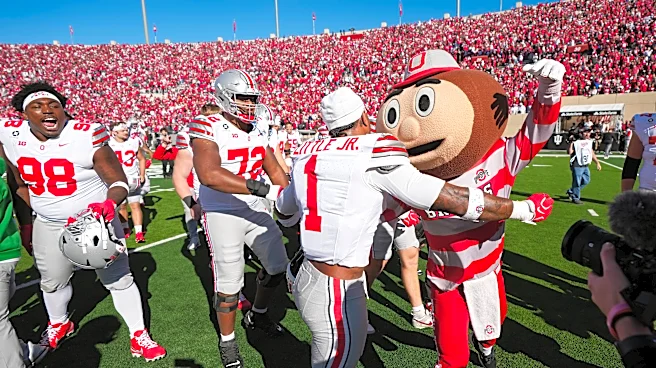

I don’t know about you, but I have spent a considerable amount of time over the past two weeks trying to convince myself that Ohio State’s national championship aspirations didn’t disappear the moment Julian Sayin suffered an injury to his throwing arm against Indiana. Although, having broken down enough film Zapruder-style, I’m increasingly convinced that he was initially injured against Maryland.
And while I certainly recognize that losing a Heisman-finalist quarterback is never a good thing — especially
in the middle of a season as absurdly wide open as this one — I have talked myself into optimism heading into Saturday’s game at the Coliseum. The more I think about it, the more I am convinced that the Buckeyes might not need their next signal-caller to be nearly as spectacular as the guy he’s replacing; in fact, I don’t think he needs to be spectacular at all. I think he needs to be Craig Krenzel.
While I don’t believe that either Luke Fahey or Tavien St. Clair is a molecular genetics major, and college football has changed an incredible amount in the 24 years since the Krenzel-led Buckeyes won a national title in my (first) senior year at Ohio State, I have to imagine that two guys who were recruited by Ryan Day — regardless of how inexperienced — can operate the offense enough to keep the team’s collective heads above water.
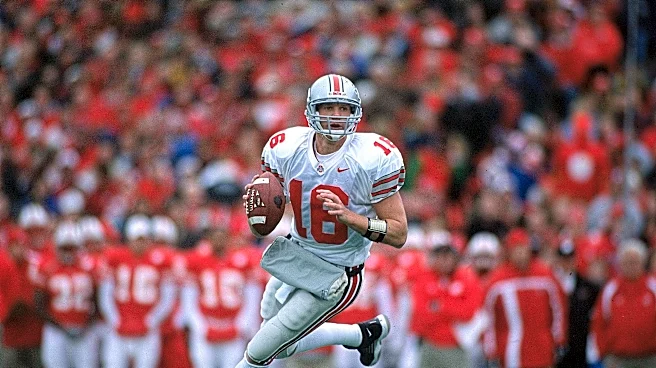
As magical as that season was — and I was at every home game, the Holy Buckeye Game at Purdue, and the BCS Championship Game in Tempe — Krenzel was not exactly setting the world on fire, but he wasn’t being asked to either.
During that undefeated campaign, Krenzel completed 148 of 249 passes (59.4%) for 2,110 yards (150.7 yards per game), 12 touchdowns, and seven interceptions. Those aren’t numbers that would typically inspire confidence from Ohio State fans accustomed to modern quarterback production, but what made Krenzel so valuable was that he understood precisely what his team needed him to be.
He threw an interception on just 2.8% of his attempts, averaged an impressive 8.5 yards per pass, and found ways to make plays with his legs when necessary; nowhere was that more apparent than against Miami in the national championship game, when he rushed for 81 yards and two touchdowns on 19 carries, leading both teams in rushing.
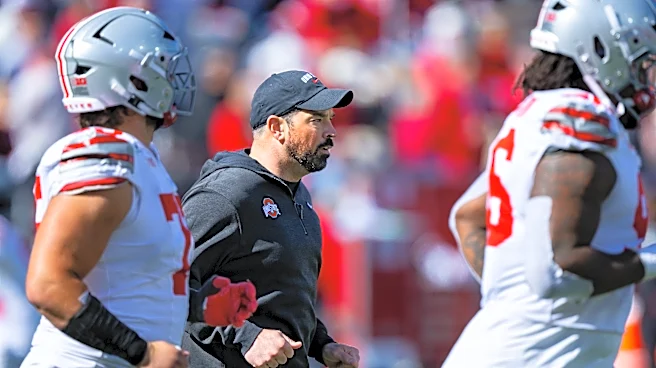
Krenzel finished 2002 with a 140.9 passer rating. He wasn’t necessarily the most prolific or statistically accurate quarterback, but he was efficient, generally careful with the football, and remarkably dependable when the pressure was greatest. He possessed a grit and toughness that seemed to set the tone for the entire team. And, considering that Day harped on the need for the next QB to be tough — physically, mentally, and emotionally — during his Tuesday press conference, I can’t think of a better example in Ohio State history than Krenzel.
But what might be the most useful for this season is that he didn’t need to be the center of the offense for Ohio State to win a game. Obviously, on offense, Krenzel could hand it to Maurice Clarett and throw it to Michael Jenkins and Chris Gamble, but the strength of Jim Tressel’s title team was his defense. And while the offensive weapons on this year’s squad are obviously more dynamic than the ones Krenzel worked with, if the new QB can just keep the offense relatively efficient, I think Matt Patricia’s defense just might be able to handle the rest.
Through seven games, the Silver Bullets are allowing just 13.4 points per contest, fifth nationally and second in the Big Ten. For a little historical perspective, the defense that helped Krenzel lead the Buckeyes to the 2002 national championship surrendered 13.1 points per game. The Buckeyes are surrendering only 264.3 yards per game, good for sixth in the country and second in the conference, while opponents are completing a measly 52.6% of their passes (less than Krenzel did in 2002) and averaging just 3.1 yards per rushing attempt.
While those numbers might not be as eye-popping as what we’ve seen from the OSU D over the last two years, they are absolutely good enough to keep a team in championship contention even when its offense isn’t operating at maximum effectiveness. And what makes those stats even more encouraging is that the defense seems to be improving at precisely the right time.
After some early-season growing pains, which were to be expected given all of the roster turnover, the Buckeyes have increasingly begun to look like a cohesive, confident unit, with their individual talent finally translating into the kind of collective performance we had hoped to see all offseason. Better yet, the defense is also getting healthier, with Kenyatta Jackson Jr., John Walker and Khari Wilder all absent from Wednesday night’s official injury report.
Obviously, Jay Timmons’ status remains a significant concern after Day said he would be a game-time decision. The true freshman’s emergence has been one of the most important developments of the season, and the defense, especially in coverage, is markedly better with him on the field. But even with that uncertainty, there is reason to believe this defense’s best football might still be ahead of it.
Which brings me back to Krenzel, Fahey, and St. Clair.
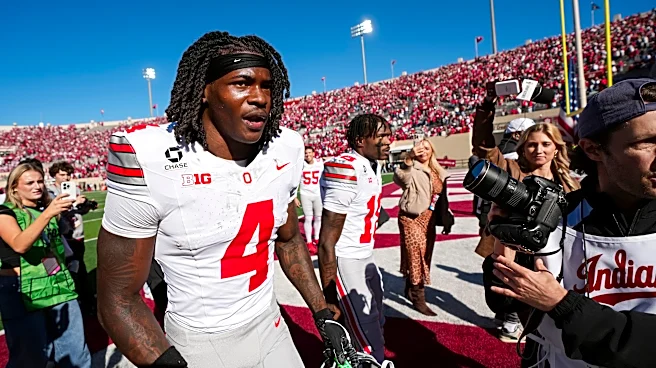
I’m not suggesting that whichever youngster gets the start should be relegated to handing the ball off 40 times and hoping the defense does the rest. For one thing, that would be an unconscionable waste of Jeremiah Smith, who remains the most dangerous player in college football.
Rather, I want the next Ohio State quarterback to embrace the fundamental principles that made Krenzel so successful: Protect the football, make intelligent decisions, take the opportunities the defense gives you, and trust the extraordinary talent surrounding you.
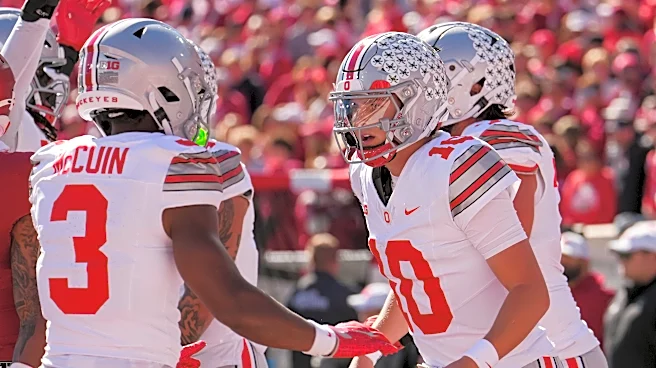
Get the ball to Smith. Find Devin McCuin and Chris Henry Jr. when defenses inevitably devote additional attention to No. 4. Let Bo Jackson, Isaiah West, and maybe even Legend Bey provide some balance, and understand that an incompletion or punt is infinitely preferable to a reckless interception. And when the situation demands something more, don’t be afraid to make a play.
Of course, it might be too much to ask that either Fahey or St. Clair possess Krenzel’s composure, decision-making, or knack for delivering in critical moments, given Krenzel was in his fourth year in the program by the time he took the Buckeyes to a national championship. But I also don’t believe the Buckeyes need their next quarterback to become C.J. Stroud, Justin Fields, Troy Smith, or even Julian Sayin overnight.
And perhaps that’s the most important lesson to take from Krenzel’s championship season. Krenzel wasn’t perfect, nor was he asked to be. He made mistakes, had stretches when the offense couldn’t do much of anything, and occasionally needed his defense to bail him out. But he also understood that his job wasn’t to win the game single-handedly; it was to do his part to make sure that the team had a chance to win it at the end. Given all of the talent on this year’s team, I think that’s a pretty fair standard to set for whichever young signal-caller takes the field on Saturday.
If Ohio State’s defense continues its ascent, if its returning contributors provide the anticipated boost, and if Day can put his young quarterback in positions to succeed rather than demanding he carry the entire offense, I genuinely believe this team can still accomplish something special.
After all, 24 years ago, Ohio State proved that you don’t necessarily need a superstar quarterback to win a national championship. Sometimes, you just need a guy who knows how to help his team win. And if Fahey or St. Clair can deliver even a little bit of Krenzelian magic, I wouldn’t be surprised if this season ends up being considerably brighter than any of us dared to imagine when Sayin walked off the field in Bloomington with his arm in a sling.