

The average football fan might think that picking a starting XI is one of the more straightforward parts of a manager’s job. Scour over the list of available players, pick the best ones, put them as close to their best position as possible, and done. Maybe you’ll make a change or two depending on the opponent but for the most part, pretty simple.
In reality, this decision is anything but simple. A manager has so many different things he has to weigh up when picking a team. Who are we playing, and
what is our game plan? Those are basic things but who are we playing next might be equally important? Player X has trouble playing two games in four days, and maybe the next game is the more important one so I’m gonna leave him on the bench today. Sometimes it’s as simple as this player needs a rest, sometimes you need to sit someone because they will need a rest soon, but the next three games are important and if I don’t rest him now then it will be too late. Sometimes there’s just classic man management at play, this player needs a game to stay sharp and thus, someone needs to drop to the bench.
Once all those decisions are weighed up they are generally trying to get their best players on the pitch at the same time. But there’s another piece to this crazy jigsaw puzzle – compatibility. Throwing the best individual players onto the pitch together doesn’t always create the best team. You need to ensure those players skill sets are compatible with each other in order to get the best out of everyone and to make the team greater than the sum of its parts.
That’s not always straightforward. Sometimes a poor decision by a previous manager – or a club’s recruitment department – will leave a coach with a situation where some of his best players don’t compliment each other. Putting all of them on the pitch at the same time tends to those players – and fans – happy, but unless one of those players is capable of sacrificing themselves and adapting their game to help the others, it doesn’t usually lead to good performances.
That adds another level of complication to things. In order to get the best team, one must start with who they feel is the best player – the one they’re going to build around – and fill in the remaining spots with the most complementary players. Now one injury, or just one change, can completely change the dynamic of the team. That single change could cause a chain reaction down the team. One player with a slightly different skill set can impact another player’s ability to perform at their best.
For a manager to get their starting XI right, each decision has to be taken within the context of other decisions. Sometimes, when one change is made you might need to make two other changes to maintain the proper balance. Sometimes injuries and suspensions mean you don’t have much of a choice, but when you start making decisions in isolation that’s when wonkiness is going to start happening.
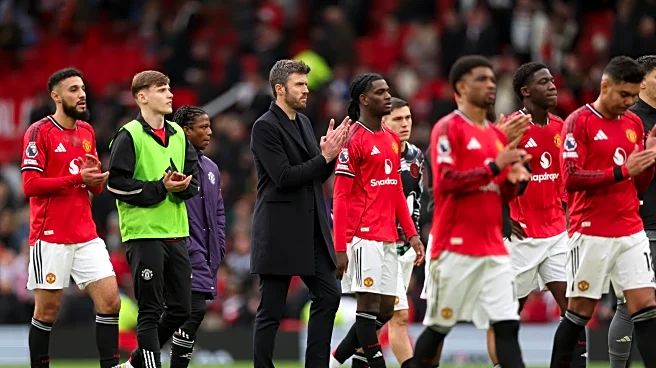
Enter Manchester United against Newcastle last week.
When it came to the starting XI Michael Carrick made a bunch of decisions on who would be in the team. Individually, these decisions all made sense – or at least could be explained. Collectively, though, they didn’t really go together and this was quickly exposed on the pitch.
We can start with striker Benjamin Sesko. The Slovenian had been tearing it up off the bench – scoring three (crucial) goals in five substitute appearances under Carrick. That form earned him a start against Crystal Palace, especially as in their last two games, United had not played well in the first half. Having their in-form striker in there was supposed to help.
There are two ways to look at Sesko’s performance against Palace. You can say his presence on the pitch did not make an impact from the start. United were still poor in the first half and Sesko struggled to get involved, taking just seven touches in the first half. Palace’s center backs were able to easily mark him out of the game and he didn’t strike until Maxence Lacroix was sent off. It wasn’t a performance that screamed I need to be in the XI and maybe, at this point in time, Sesko is just more effective as a sub? You can also say, who cares how many touches the striker had? He’s not out there to do buildup; he’s there to score goals, and he did just that. He should be in the team for that reason alone.
Carrick opted to keep Sesko in the XI for the trip to Newcastle. So now you move out to the wingers. Carrick opted to flank Sesko with Matheus Cunha and Bryan Mbeumo, keeping Amad on the bench for a second straight game. I’ve been skeptical of the Cunha-Sesko-Mbeumo front three all season for this exact reason. On paper they’re not very compatible. Sesko is someone who needs service from his wingers while Cunha and Mbeumo are not those types of players. They like to cut inside on their strong foot and shoot. Maybe Amad is a better fit in this spot but – individually – it’s not like Amad’s recent performances have made him undroppable either. In isolation that decision makes sense.
When United Mbeumo and Cunha last summer, much analysis was centered around the pair’s relationships with their center forwards, Yoanne Wissa and Jørgen Strand Larsen, respectively. Both were at their best when they were able to play closer to the middle and play “off” their center forward. This season, their best games have come when they’ve been able to play closer to the middle – whether it was the two of them together, or one of them being closer to Sesko.
However, both players trying to be closer to the striker presents a problem for United in that they become far too narrow. Someone has to hold the width on the outside. Down the left, Luke Shaw can overlap to provide width but Diogo Dalot doesn’t offer the same ability on the right so the job is taken up by Amad. With the Ivorian on the bench, the job now fell to Mbeumo, moving him further away from the goal and the striker he likes to play off of.
Here you can see Mbeumo out wide, with Cunha taking up a position in the left half space and Shaw out wide.

Against Newcastle, for whatever reason, Carrick decided to start Noussair Mazraoui at right back rather than Dalot. Maybe Dalot picked up a knock last game? Maybe he needed a rest? With Luke Shaw and Harry Maguire carrying an illness, maybe Dalot picked that up as well? Or maybe, Carrick just felt that Mazraoui needed a game.
In isolation, all those reasons make sense. But when looking at the rest of the puzzle, we can see how this combination of decisions creates problems for United.
Mazraoui does not get forward to support his wingers. He does not make overlapping runs. When Mbeumo gets the ball out wide, two Newcastle defenders come on him.

This is par for the course with Mazraoui, it’s who he is as a player. If you go back through the games from the past two seasons you’ll notice a pattern of the winger/no 10 struggling on the side where Mazraoui is playing fullback or wingback. If Mazraoui makes an overlapping run (in the above situation) he’d pull one of these defenders away from Mbeumo. Even if he doesn’t get the ball, even if he’s not a threat, the defenders have to honor the run and follow him, which would create more space for Mbeumo.
Just look at how much space Rashford gets when Aaron Wan-Bissaka makes an overlapping run for him even though Rashford hardly even gives him a look.

Instead, when the ball came wide to Mbeumo, Mazraoui kept his more narrow position. No overlap was made and Mbeumo didn’t have many options other than trying to take on two defenders at once, which he wisely opted not to do.

This was the story of the match. Mbeumo isolated out on the right wing, far away from goal, dealing with double teams that effectively marked him out of the match. Chances were few and far between, and when he finally did get one, he did what typically happens when players aren’t involved in the flow of the match. He pressed a bit and fluffed the chance.

With United’s midfield struggling to progress the ball, Bruno Fernandes would have to drop deep to get on the ball and push it forward. With Mbeumo isolated out wide, the front four essentially became a front two trying to generate attacks. But Sesko isn’t a creator, he’s a finisher, leaving the creative burden on Cunha until Bruno could push up the pitch after dropping deep. In other words, United struggled as they were short players up in attack.
Just after the hour mark, Carrick made his first change of the match, taking off Casemiro and Shaw for Manuel Ugarte and Diogo Dalot. Both players are pivotal to United’s ability to get forward and score goals. Both were a bit off of it on the day, they were both carrying yellow cards, and in Shaw’s case he was coming off an illness that rendered him unable to even complete a half hour on the pitch three days before. Again, in isolation, the decisions make sense.
The substitution triggered a re-jiggering of the back line with Dalot coming in at right back and Mazraoui going over to left back. Mazraoui is pretty capable of doing job at either fullback position but he’s a different player on the right compared to the left.
On the right Mazraoui takes up narrow positions but doesn’t get forward. When playing on the left, Mazraoui will get forward but he does not hold width at all. He stays narrow and typically gets into the more dangerous positions.

Towards the end of the first half and the start of the second half, Cunha had started to come alive as he played close to, and off of, Sesko. He was looking like United’s most dangerous player and was the driving force behind creating that missed Mbeumo chance.
When Shaw came off and Mazraoui moved to the left, Cunha was pushed out to the touchline to hold the width from United.


It was a complete change of role for Cunha and took him away from all the positive things he had been doing. A look at Cunha’s touch map from before and after the Shaw sub shows a clear difference in where he was touching the ball.

Moving Cunha out wide cut him off from the striker and limited his opportunity to make an impact on the game. With Amad replacing Mbeumo shortly after – and naturally playing wider on the right – United had essentially pushed their best attackers further away from the goal, isolating their striker who needs an attacking player close to him. For the last 30 minutes of the game, they essentially turned Cunha into a passenger while the dangerous situations were handled by a (defensive) fullback.

On an individual basis, none of the decisions Carrick made regarding personnel were outright bad. They all made sense – or at the very least could be explained. But when you’re managing a football team there is no decision that happens in a vacuum. Each decision affects other players in other areas of the pitch. With each decision Carrick made, the impact was felt more and more by players as their jobs became all the more difficult, leaving United with what was ultimately a mess on the pitch.
Carrick’s early success with Manchester United has been down to simplicity. At the end of the day he’s done a very good job of putting players in their best positions and giving each individual player their best chance to succeed. Last Wednesday night was the first time he didn’t do that.