
A theme across most of our position previews thus far has been a need for groups to improve after being somewhere between bad and awful in 2025. As we shift to defense, that changes a little bit. While last year’s offense was putrid no matter how you look at it, Bill and Steve Belichick’s defense fared a little better by box-score standards: the Tar Heels ranked 38th in the country in yards allowed per game, 66th in points conceded, and 20th in sacks, which make it easy for some to think that the story
of the team was an awful offense letting down a genuinely good defense. Jordan Shipp said as much to media after last year’s loss to Wake Forest that started that end-of-season slide. But when you look under the hood, the story of the 2025 UNC defense isn’t quite as rosy as all that. The Heels ranked 102nd in opponent 3rd down conversion rate and almost dead last on 4th downs and ranked 96th in defensive FEI, which are all similar levels of badness to the offense. Those other numbers don’t mean nothing, and I should also mention that the Heels were a top-20 red zone defense, so I’m not suggesting that the defense needs as much work as the offense. Just that it, too, contributed to last year’s team not being good, rather than simply being let down.
All of that said, probably the best position group on the team last year was the defensive line, and it’s also perhaps the group on the team that has undergone the least attrition and turnover. So it’s fair, I think, to expect good things again from this group — and as we’ve seen so far and will continue to see, that’s a rare thing for these previews. As mentioned, this defensive line spearheaded the effort that got this team to rank 20th in the country in sacks, as well as 23rd in opponent rush yards per attempt. And nearly every major contributor to those efforts has returned, though there are of course a couple of changes. Let’s take a detailed look at how UNC stacks up on the defensive side of the trenches:
Key Departures
We’ll get to last year’s sacks leader in a second, but the player across from him had a pretty respectable season too: that’s edge rusher Tyler Thompson, who put up 7 sacks and 2 forced fumbles as a redshirt sophomore. Thompson played steady rotation snaps but was really a pass-rush specialist; he didn’t have much production as a run defender and got pushed around a fair bit when runs went his way. He’s now transferred to Louisville, where the group might be deep enough to hide his weaknesses a little more.
On the interior, the Heels got decent production from C.J. Mims and D’Antre Robinson, both of whom also transferred out. Mims is now at Texas A&M, while Robinson will be playing for Oregon. Both were reliable run defenders who didn’t offer much rushing the passer, though Mims did have a sack against Clemson.
Key Returnees
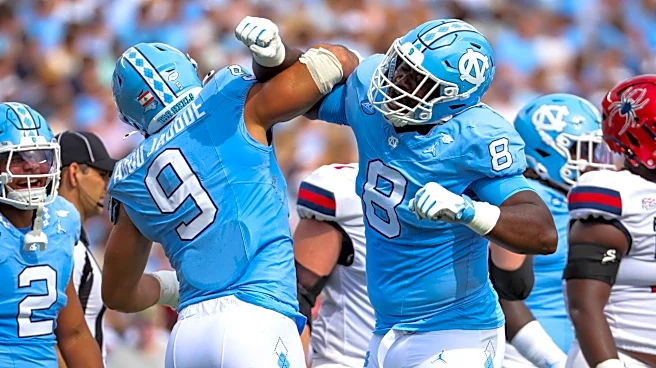
Bill Belichick, Mike Lombardi, and their staff had two major retention wins this past offseason. The first was wide receiver Jordan Shipp, whom David profiled in that position’s preview. The second was Melkart Abou-Jaoude, the breakout edge rusher who led not just his team but the ACC with 10.5 sacks after transferring from Delaware, where he’d initially walked on. It’s a fantastic story, and Abou-Jaoude is going to be asked to be the centerpiece of this unit once again, this time while being at the top of every offensive coordinator’s and OL coach’s scouting report. He’s an absolute grinder on the field, has really powerful hands, and is relentless in his attack against offensive tackles with the strength and length to absolutely feast on quarterbacks who hold the ball too long. As I said in my 2027 draft preview, he doesn’t have exceptional craft, bend, or speed, and against a stronger schedule, he feels like somebody whose pass rush production could regress pretty hard. On the other hand, he recorded 42 pressures, and a 4:1 pressure-to-sack ratio is usually indicative of a player whose sack production is for real — and it’s especially good to see in this case, because 10 of those sacks came in 4 games. It’s an open question on whether the vibes/eye test or the numbers will end up being right here. Abou-Jaoude does play the run well, setting a hard edge and being a sure tackler. Those traits set a high floor for him regardless of the other stuff.
Filling the interior are two returners, Leroy Jackson and Isaiah Johnson. Jackson was named a Freshman All-American by The Athletic last year because his play as a redshirt first-year way outpaced his stats. He didn’t record a single tackle for loss, let alone a sack, last year, but he was stout against the run even when double-teamed and created a fair amount of havoc in the backfield. He wasn’t able to finish a lot of plays, but that’s something that can change with experience, as a player knows better what to expect out of an offense. I think he could have a really big year. Johnson was the more disruptive pass rusher, with 2 sacks, and he’s steady against the run as well, but he flagged heavily towards the end of the year as the snaps seemed to catch up to him.
Key Newcomers
The biggest question mark for this group is who’s going to start on the edge opposite Abou-Jaoude. The staff brought in two transfers who appear to be fighting for that spot: Jaylen Harvey from Penn State, and Donovan Hoilette from the University of Richmond. Harvey played around 10 snaps a game for the Nittany Lions last year as a sophomore and wasn’t anything special, recording one sack and 5 solo tackles. The tools are obvious, though — he’s got long arms, is lightning-fast off the line, and shows very good bend. He’s fairly slight, which meant that even in winning positions, offensive linemen were often able to push him around and get him out of the play, but with some time in the weight room, it’s easy to see him being an explosive and disruptive pass rusher. Hoilette, on the other hand, had a ton of production last year, with 9 sacks and 13 tackles for loss en route to first-team All-Patriot League honors. He recorded 3 pressures against UNC when the Heels played the Spiders in 2025, so there’s some track record of success against Power 4 competition. He, too, is a primarily speed rusher with a similar build to Harvey, just a couple of inches taller, so the same bulk and edge-setting concerns remain — I don’t think this is a case where the more experienced player has a higher floor. And as a younger player, it’s more likely Harvey can grow with S&C work whereas a senior like Hoilette is likely closer to being an anthropomorphically finished product.
It’s hard for freshmen to come into college and play on either line right away; the types of bodies they’re going up against in the trenches in the NCAA are just so far removed from what they’ve seen in high school that it takes nearly everybody a year, at least, to truly adjust and be ready to regularly contribute. And it’s probably even harder on defense than on offense. So I don’t really expect any of this year’s 40-man freshman class to offer serious contribution to this position group. But still, it’s worth keeping an eye on Vodney Cleveland and Trashawn Ruffin, two defensive tackles with big-time pedigrees who certainly had college-ready bodies coming in.
Outlook
I think the Heels have a stout front 4. Jackson, Johnson, and Abou-Jaoude are strong players who can at worst go one-on-one with opposing linemen and gain ground into the opposing backfield, disrupting runs and condensing pockets. There’s some reason to worry that whomever wins the fourth spot between Hoilette and Harvey will be more of a finesse guy and thus not really fit with the group’s MO, but at the very least they’ll have traits that can help the team in passing situations and be able to funnel runs to a place where the guys behind them can easily clean up. And if Abou-Jaoude can continue that pressure rate and Jackson can improve on his play-finishing from a year ago, there’s upside to this group to go with that floor and they could be genuinely game-changing for this team and a unit that ranks among the better defensive fronts in college football.
My worry, though, is depth. I’ve only really talked about the candidates to start in this breakdown, and that’s not really by choice. Not only do the names listed on the roster after the guys I’ve mentioned not have track records, they’ve also been virtually absent from any and all preseason reporting I’ve gotten my eyes on. A defensive line rotates more than about any other on the field; it’s a uniquely tiring position. Most starters, except for the elites among elites, play about half the defensive snaps in a game. Abou-Jaoude played 646 out of 854 defensive snaps last year and has talked in the offseason about how he played a lot of them really tired. It was in the context of wanting to improve his conditioning, but I fear that’s just the nature of the position. I’m not sure the Heels have the bodies to be able to avoid repeating that not just for him but for Jackson and Johnson, too, and that means they’re risking fatigue at the end of games and as the season wears on — it’s both a loss risk and an injury risk.
It’s much easier to see success for this group than for most that Bill Belichick has had in Chapel Hill, both last year and this one. But it’s also hanging on a knife’s edge, and it’s also got maybe the highest expectations, which means any aberration could snowball and have a correspondingly bigger effect on the rest of the team. I know I’m being a Debbie Downer, so I’ll end it by saying this: There are definitely going to be a lot of moments when this unit is really good, and those moments are definitely going to be fun to watch.