



There’s a certain kind of silence that lives on the oval 400 meter track. Not the empty kind; more like a held breath. The hush right before a gun cracks. The moment a finely tuned body and mind knows something is about to happen, even if the rest of the world is too busy to notice.
San Jose State has always understood that silence.
Long before “content” became the currency and highlights became a substitute for history, SJSU track & field built a reputation that didn’t need an algorithm to validate
it.
They called it Speed City — not as a slogan, but as a reality. A place where sprinters didn’t just run fast; they ran like they were carrying something. A legacy. A message. Sometimes a burden.
And that burden is crashing heavy with everyone all at once today; regardless of who, what and where you are.
You can’t talk about San Jose State and track without the 1960s entering the room. It arrives with names that still feel like a flare in the dark: Tommie Smith. John Carlos. Lee Evans. Bud Winter and the science of speed. The program wasn’t just winning races; it was becoming a national stage where athletic excellence and social reality collided in full view.
And then, of course, 1968.
Mexico City. The podium.
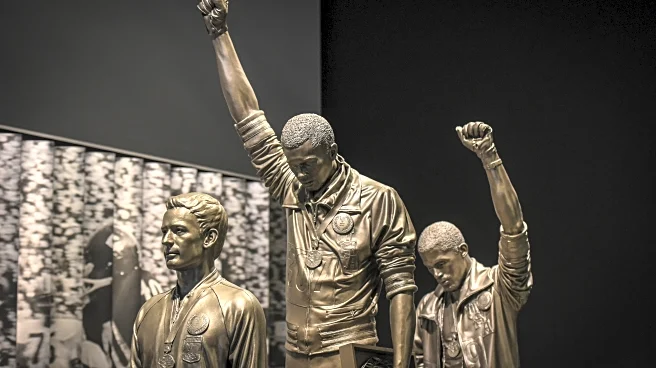
Two Black American sprinters from San Jose State raising gloved fists, heads bowed, the world either shaking in admiration or scrambling to condemn what it couldn’t control. It upset people then and still upsets some people now.
It’s one of the most enduring images in sports history, yet it’s also treated like a museum piece; an icon we reference without always sitting with what it cost them, and what it revealed about the country watching.
…and what it’s still revealing even moreso today.
Track, at its best, is an honest sport. There’s no hiding in it. No clock to argue with. No eye test.
Either you ran the time or you didn’t. That honesty is exactly why the moment mattered: it wasn’t performance. This was presence. It was a reminder that even at the highest level of American celebration, there were Americans who weren’t free to simply exist without consequence.
That’s the part that feels lost now; not because the story disappeared, but because the modern news-and-entertainment machine doesn’t leave much room for stillness. Our attention is chopped into fragments and fed back to us as noise. We get the anniversary post, the quick montage, the required mention.
The deeper thread is how a university program helped shape the vocabulary of athlete activism. It gets blurred, filed away, treated as a chapter instead of a living lineage.
And here’s the thing: San Jose State’s track & field isn’t just history.
In the last couple of years, the Spartans have been quietly doing what Spartans do — showing up, stacking results, sending athletes into bigger and bigger meets, building relay chemistry, finding podium moments that don’t always make the national sports cycle. You’ll see it in the Mountain West lanes, in NCAA regional appearances, in the way SJSU athletes keep punching upward in events that demand both grit and precision.
The program’s recent successes don’t need to be framed as a return as much as a continuation, because at San Jose State, the track has never stopped being a place where people become more than what they were when they arrived.
That’s the sociological significance that matters now.
Speed City wasn’t only about speed. It was about identity. About visibility. About the idea that a campus, a team, a coach, a community can produce excellence and also produce a challenge to the status quo, which we need now more than ever.
In a world where our perspectives get blurred by a constant stream of distraction, SJSU track stands as proof that some stories don’t belong to the feed. They belong to the foundation.
Because every time a Spartan steps into blocks, there’s that held breath again. That silence before the gun. If you listen closely, you can hear it: history isn’t over. It’s just waiting to be run.