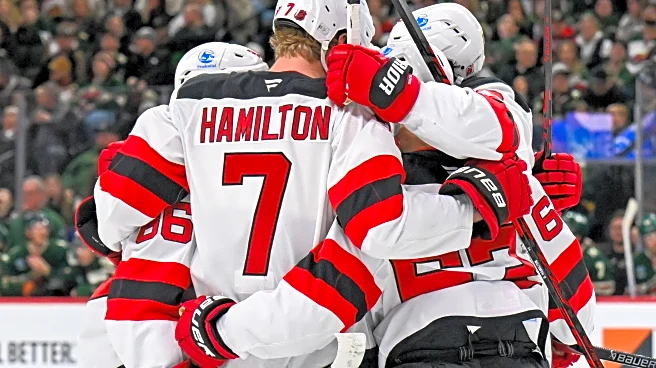

On Sunday afternoon, the New Jersey Devils scratched Dougie Hamilton from their lineup against the Winnipeg Jets after Johnny Kovacevic was returned from injured reserve. At the time, national hockey reporters began to report that Hamilton had blocked a trade over the summer, and that the Devils were still looking for a trade. This led to a spirited back-and-forth between Hamilton’s agent and General Manager Tom Fitzgerald through Pierre LeBrun. Hamilton’s agent, J.P. Barry, argued the benching was not
due to his on-ice play, but it was a “business decision” to twist Hamilton’s arm into expanding his acceptable trade list so the Devils could shed his salary.
In a perfect world, the Devils would be able to move Dougie Hamilton while trusting Simon Nemec and Seamus Casey to step up into his role as the key right-handed offensive driver on the blueline.
The Devils do not live in a perfect world.
While Seamus Casey has been named an AHL All-Star for the second time, Simon Nemec has been improving in the NHL. Unfortunately, he has not improved enough to consistently take advantage of his easier deployment. Of qualified Devils defensemen, Simon Nemec has the worst expected goals percentage at 43.70%. The next-lowest number is Luke Hughes at 47.04%. On the other hand, Nemec has benefitted on offense from the highest on-ice shooting percentage on the team at 10.69%, with the next-highest coming with Brenden Dillon on the ice at 8.05%.
So, the more Nemec plays, the more his results reflect his underlying numbers. Currently sitting at 32 on-ice goals against at five-on-five, Nemec has the worst on-ice goals against per 60 minutes among right-handed Devils defensemen:
- Nemec: 3.22 GA/60
- Pesce: 2.73 GA/60
- Hamilton: 2.04 GA/60
By goals for percentage, Nemec fares a bit better, but is still behind Hamilton despite having easier deployment:
- Pesce: 35.71 GF%
- Nemec: 46.67 GF%
- Hamilton: 46.81 GF%
So, what’s the argument for trading Hamilton? How would trading him make the team better right now?
Hamilton’s Impacts Are Not Declining
An understandable justification for trading Dougie Hamilton would be that he is getting too old for his cap hit. He might even invite comparisons to former Devil P.K. Subban, who was traded to the Devils by the time he had fallen off from a true top-pair option to someone who could only hold down third-pair minutes. But by the same models that showed P.K. Subban had gone into steep decline by the time he was a Devil, Dougie Hamilton has bounced back from his pectoral injury to being an off-the-charts top right-handed defenseman. From HockeyViz:

By comparison, Nemec is only marked as a low-end third pairing defenseman on the same model because of his defensive deficiencies. But HockeyViz is not the only analytic model that argues Hamilton is still a true top-pair defenseman. Rono of RonoHockey posted Hamilton’s card a couple days ago, which showed a very interesting trend. With Sheldon Keefe needing a shutdown defenseman in the absence of Johnny Kovacevic (and then when Brett Pesce was injured), Dougie Hamilton actually performed very well in such a role.
As stated earlier, Dougie has the best defensive numbers by goals against among Devils right-handed blueliners. And while Dougie brought almost all of his value on the offensive side in Rono’s model over the years, this has flipped to a defense-first impact this season. See it below:
The key here is that role difficulty. With the injuries the Devils have had, even a hobbled Hamilton has had to take on tougher minutes against tougher competition than he has in previous years. But who can say that 2.04 goals against per 60 minutes is bad for those minutes? It should be nobody, but Hamilton has droves of blind detractors that just see a guy that hasn’t been known for his defense throughout his career.
On the offensive side, the issues are all production-based. Both Rono’s model and HockeyViz show that the Devils create their best scoring chances with Dougie Hamilton on the ice, which is more impressive because of the quality of competition he has faced this season. But the Devils have not finished their chances with Hamilton on the ice, now sitting at a 5.60 on-ice shot percentage with him on the ice (only Pesce is lower at 5.38%). Over these last two games, this has flipped. The Devils are starting to finish. Jesper Bratt finished one of Dougie’s passes and tipped one of his shots into the net. Cody Glass tracked his shot for a perfect rebound (and Dougie is the best on our blueline at creating those rebounds). By getting more bodies to the net and getting away from the three-high offense that the Devils regressed to from October to the beginning of this month, the Devils will start finishing more of these chances that Dougie creates because they’re not letting goalies track the puck as easily.
Just like Nemec’s defensive results have begun to more accurately reflect his underlying numbers as the season has gone on, Dougie’s numbers won’t be forever dragged down by some of the worst finishing trends in modern league history. This team is too skilled for that. As it stands, the Devils have scored about 14 goals below expected with Hamilton on the ice at five-on-five. And that’s after he got three assists over the last two games.
The Devils Never Got to Face Carolina in the Playoffs With a Healthy Defense
Let’s run down the injuries that plagued the Devils in the 2025 playoffs:
- Jack Hughes: out, shoulder surgery
- Dougie Hamilton: returned early from a knee injury to play all five games
- Jonas Siegenthaler: returned early from a lower-body injury in Game Three
- Brenden Dillon: departed Game One with a neck injury
- Luke Hughes: departed Game One with a shoulder injury
- Johnny Kovacevic: departed Game Three with a knee injury
Needless to say, the Devils had their work cut out for them in the playoffs against Carolina. If the Devils had just three of these players at full health, could they have won a playoff series last year? As it was, the Devils did okay for only having one scoring line. But if they had Jack Hughes and a healthy defense, it easily could have been a different ballgame in that series. If the Devils won one game and had the chance to miss more, they should have taken that series to six or seven games with a full squad.
We saw how perfectly that lineup works against Minnesota. Kovacevic and Siegenthaler handled tough defensive minutes. Dillon and Hamilton ran roughshod on the Wild in offensive deployment. And Hughes and Pesce did well with their all-situation deployment.
As it stands today, the Devils have enough cap flexibility from Stefan Noesen’s injury to make adds to their forward group. In my opinion, they already have enough forwards to run a good top six. The greatest improvement they could make to their roster is to replace Luke Glendening with a better fourth line center, allowing Hischier and Hughes more shifts off at five-on-five. Does Hamilton really need to be traded to get a fourth-line center? Otherwise, they can look for players on low-dollar deals and fit them under the cap with some salary retention.
It’d be one thing if Hamilton was tied to big top six scoring forward targets, and it’d be another thing if Nemec had shown more growth over the last two seasons. But if the Devils trade Hamilton to get some lumbering, heavy non-scoring forward and push Nemec into more minutes, they are not going far in the playoffs. If the playoffs are the goal, they need Hamilton at the helm.
Forward Targets the Devils Can Seek Out Without Trading Hamilton
I have marked two obvious choices for trade targets that would massively improve the Devils: Morgan Barron from the Winnipeg Jets and Luke Evangelista from the Nashville Predators. Barron, a fourth-liner who has played a decent amount of center this year, would provide size to the team at 6’4” and 220 pounds while being a more reliable five-on-five player than Glendening. Adding his contract would mean the Devils would simply have to carry two extras instead of three.
Evangelista is a higher-end option. Making $3 million, the Devils would need the Predators to retain salary for the final year and a half of his deal to fit him under the Devils’ cap. But Evangelista is a true top six winger. If the Devils put up a package of picks and prospects for Evangelista, he would provide tons of playmaking value to the team for years to come at a low enough salary to keep the books open for more adds in the coming offseason.
The point is: just because Tom Fitzgerald had a spat with J.P. Barry does not mean that Dougie Hamilton should no longer be a Devil. The locker room loves him. He’s one of the faces of the team in the community. He’s their most talented right-handed defenseman. I would certainly understand trading him in the offseason in the context of larger moves, but the Devils should not take a low return on a still-great player who has done pretty well in a miscast role this season. Now that he’s in the right spot, expect those points to pile up. It’s not like we’re getting Quinn Hughes to replace him in the case of a trade.
If Tom Fitzgerald is that hellbent on moving Dougie because he already decided it’s what needs to happen, he’s blinded. This team will fall off the moment he pulls that rug out. There’s nothing wrong with admitting a mistake, and professionals should be able to patch up a little disagreement.
The benching still serves a purpose. It gave him a kick in the you-know-what, and Dougie responded in such a way that should be an example to the rest of the team that has been looking for that kind of “response” all season. Without Dougie in these last two games, fueled by that benching, the Devils would still be on a losing streak, and we would likely be down a head coach in that case. So what kind of a message would it send to bench Dougie again, or to trade him after he seemed to play a part in saving the season?
Keep Dougie a Devil.