



In the mid-’50s, Major League Baseball introduced a couple of new awards to honor exemplary performance. The Cy Young Award recognized the best pitcher in baseball (later expanded as separate awards for each league). The World Series MVP recognized the player who had the biggest impact on each year’s Fall Classic. Since that time, six players have taken home both in the same season, demonstrating a historic level of dominance as they carried their team to a title. Among them are Hall of Famers like
Whitey Ford, Randy Johnson, and Sandy Koufax as well as franchise icons Orel Hershiser and Bret Saberhagen. The sixth? Bob Turley.
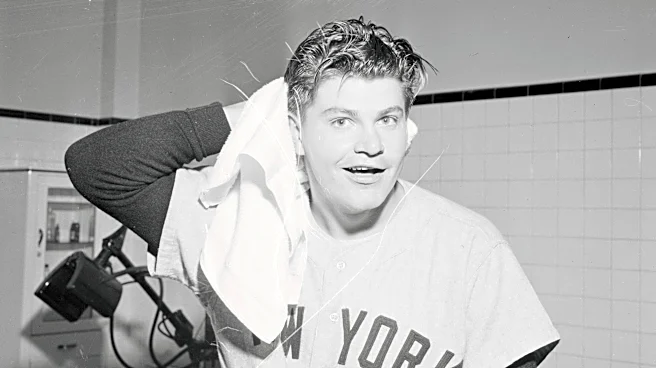
Robert Lee Turley
Born: September 19, 1930 (Troy, IL)
Died: March 30, 2013 (Atlanta, GA)
Yankees Tenure: 1955-62
Turley grew up in Illinois. A baseball prodigy from an early age, he was banned from pitching in his youth league at the age of 12. Young Bob drew the attention of the Yankees after attending a tryout camp with his uncle, Ralph. The club was reportedly impressed enough to sign “R. Turley” but offered a contract to the wrong one. While Ralph briefly joined the Yankees organization, his nephew signed with the St. Louis Browns on the night of his high school graduation.
Turley immediately displayed the double-edged sword of his dominant stuff, allowing 71 free passes in 97 innings as a 17-year-old but going 9-3 nonetheless. Over four minor-league seasons, he’d post a strikeout-to-walk ratio of 411:481 in 817 innings, a harbinger of what would come in his big-league career.
Turley got the call in 1951, 10 days after his 21st birthday, starting just one game before season’s end. After that brief cup of coffee, he’d spend nearly two years serving in the Army. Returning in August of ‘53, he made 10 strong appearances for a Browns team on its last legs. When the team moved to Baltimore the following year, Turley was squarely entrenched in their rotation, pitching the home opener for the first MLB game in Baltimore since 1902.

The ‘54 season would prove to be a breakout campaign for Turley. He earned an All-Star berth while leading all of baseball in strikeouts and walks, a feat also accomplished by Hall of Fame fireballers like Bob Feller and Nolan Ryan. His 14 wins were tops on a Baltimore team that lost 100 games (Don Larsen went 3-21 for them that year).
While Turley was going places, it was clear the Orioles were not. And so, before the ‘55 season, they made a historic, 17-player swap with the Yankees, sending Turley alongside Larsen and a cadre of others to the Bronx. “I’d have crawled to New York,” Turley said later of his feelings after the trade, which flipped him from the 100-loss O’s to a Yankees team that had won 103 games the year prior.
The 24-year-old didn’t skip a beat after swapping laundry, earning another All-Star berth while winning 17 games and punching out a career-high 210. Come October, though, he stumbled. In his only World Series start, Turley recorded only four outs, allowing a Roy Campanella home run in the first and walking in a run in the second before getting the hook. It would not be Turley’s last chance to contribute in a Fall Classic.
The ‘56 season was a setback for Turley, who saw his ERA balloon over 5.00. “You had to baby him a little bit,” Yogi Berra said of Turley’s struggles. “You know, he’d get a little wild. You had to go out there and say, ‘C’mon, Bob, you’re better than that.’” The two-time All-Star was bounced from the rotation in September and worked out of the bullpen to start the World Series. But in Game 6, the day after Larsen’s perfecto, manager Casey Stengel handed the ball to his embattled star.
Turley would later call it the best game he ever pitched. Like his former Orioles teammate the day prior, he held a Dodgers lineup stacked with five Hall of Famers off the board through nine innings, recording 11 strikeouts including three at Campanella’s expense. “Man!” said the Dodgers catcher. “When you see me take three swings at three fastballs and not even foul tip one, the fellow throwing ‘em must have something. Maybe he was using a little gun to fire that ball up there.” Unfortunately for the Yankees, Brooklyn’s Clem Labine was just as tough, blanking the Yankees through 10 frames. In the bottom of the 10th, the Dodgers walked off Turley to force a Game 7. Still, after a lost season, the 26-year-old had proven he could perform under the brightest of lights.
Turley regained his mojo in ‘57, posting a 2.71 ERA in 176.1 innings and earning a complete-game victory in Game 6 of the World Series. But it was the following year that would be his pièce de résistance. Turley once again led the AL in walks but, more importantly, he led in wins (21) and complete games (19) too, edging out Milwaukee’s dual aces Warren Spahn and Lew Burdette for the Cy Young Award. He nearly took home MVP honors as well, ending up narrowly bested by Boston’s Jackie Jensen.

Facing Burdette in Game 2 of the World Series, the magical season seemed to implode on Turley. He’d face just five batters, four of whom reached base, before Stengel got the hook. Turley took the loss and wouldn’t pitch again until Game 5, by which point the Braves were up three games to one. On the brink of elimination, the Cy Young Award winner returned to form with a complete-game shutout. Most impressively, he held Hank Aaron out of the hit column, striking him out twice.
The next day, he entered in the 10th with two outs and the tying run on third, retiring Frank Torre to force a Game 7. Larsen drew the start that day but, after he put on two runners in the third, Stengel pulled out his trump card, turning to Turley. He’d allow just one run in 6.2 innings of relief as the Yankees clinched an unlikely World Series comeback. Turley was feted with the fourth-ever World Series MVP, coming just a few votes shy in the regular-season MVP race of being one of two players (alongside Sandy Koufax) to win the Cy Young, MVP, and World Series MVP in one season.
At the age of 28, Bob Turley had just put the finishing touches on one of the greatest pitching seasons in MLB history. He’d never reach those heights again, making no additional All-Star teams and receiving no more Cy Young or MVP votes. He’d have one more hurrah in the Fall Classic in ‘60. After taking home the victory in Game 2, he drew the start in the decisive Game 7 but got only three outs while allowing three runs in what would forever go down as the Bill Mazeroski Game.
Turley spent two more uneven seasons in pinstripes before splitting the ‘63 campaign between the Angels and Red Sox. He then worked as a pitching coach before entering the business world, where he made a fortune in insurance and real estate and staked a second legacy as one of the most financially successful former players in baseball history. He remained a fixture around the Yankees, regularly appearing at Old-Timers’ Day celebrations.

Bob Turley did not sustain his career long enough to end up in the Hall of Fame. At his peak, though, he was that caliber of talent, a fireballing force of nature who played a critical role on five pennant-winning squads and posted a season in 1958 that ranks among the greatest of all-time.
See more of the “Yankees Birthday of the Day” series here.