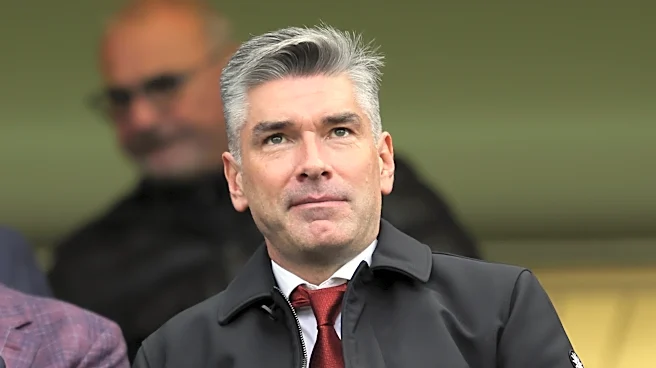




In his first summer in charge at Liverpool Football Club, following his appointment along with the returning Michael Edwards as the loftily-named Chief Executive of Football and the hiring of Arne Slot as head coach, Richard Hughes failed to deliver in his role as Sporting Director.
With Hughes, Edwards, and Slot gifted a side that the season before had been in the title race until winter began to thaw and the legs on a thin squad began to fade in Jürgen Klopp’s final year in charge, it didn’t much
matter. The idea at the time was that with a little maturity gained by the players in the prior season and perhaps with a slightly less demanding training regimen, this was a side capable of competing at the highest levels.
The only real glaring weakness, not just for the upcoming season but looking longer-term, appeared to be defensive midfielder. And there, Hughes made a play for Athletic Bilbao’s Martín Zubimendi. In the end, he was embarrassed by the player and his camp pulling out of the deal at the last moment.
He did manage to get two deals for senior players across the line, though. One, Federico Chielsa, is a fan favourite, but struggles with fitness and an inability to ever fully find favour with Slot have limited minutes. The other, Giorgi Mamardashvili, saw the club invest £30M and agree to loan the Georgian international back to Valencia for a season such was Hughes’ certainty he was the answer to the Alisson succession question.
Two years later, and with Mamardashvili having been called on for long stretches to fill in for an increasingly injury-prone Alisson—a situation that highlights that a succession plan was probably a good idea—there remain massive doubts about the younger goalkeeper, who both struggles notably on the ball and has yet to show he is in Alisson’s class as a shot stopper.
Meanwhile, last summer Liverpool sold Caoimhin Kelleher to Brighton. He had been Alisson’s former backup, was notably strong on the ball, and has been more convincing as a first choice for his new club this season than Mamardashvili has been for the Reds.
Liverpool, it now appears, already had a better succession plan on the books and have now spent two seasons and £30M setting up a worse one for the club. This isn’t entirely a surprising outcome, either, given questions were asked at the time about whether Mamardashvili’s struggles on the ball might not just rule him out as a first choice for Liverpool but for most top sides.
That first transfer window, though, was never meant to be decisive. There was always a suggestion that the incoming sporting director and head coach as well as the returning Edwards knew how good a situation they were coming into. That Jürgen Klopp and those he had worked with in previous summers—Jörg Schmadtke, Julian Ward, and up until 2022 Edwards himself—had left strong foundations.
Especially after the Reds won the title last season, the consensus was that this was a side that needed only minor tweaks and additions. That this was a side set up for long-term success. That with a little depth, and a few smart purchases to set themselves up for life after aging superstars like Alisson, Mohamed Salah, and Virgil van Dijk, Liverpool were set up to keep winning for the foreseeable future.
With that as a consensus, and having had a year for Hughes, Slot, and Edwards to run the rule over the squad in person, if Hughes’ first summer in charge was a disappointing one, what came next can’t be cast as anything other than disaster and an utter failure by Hughes.
Having identified the need for a defensive midfielder but failing to sign Zubimendi the summer before, at the second time of asking Hughes determined Ryan Gravenberch was the viable long-term answer. To make matters worse, promising club trained youngster Tyler Morton was sold to Lyon for £10M. He has gone on to be the French club’s player of the season while defensive midfield has been a significant problem for the Reds.
In defence, another talented club trained player was sold in Jarell Quansah after Slot froze the local talent out after a bad half in the first game of the 2024-25 season. The 23-year-old was sold to Bayer Leverkusen where he has thrived in 2025-26, and he will be heading to the World Cup with England this summer.
Liverpool signed a promising youngster to replace him, but gutting the club of its local talent and academy products and replacing them with imports that don’t offer a clear upgrade became a theme last summer, and in addition to shipping out Morton and Quansah and making the side worse in the process, there was also a quite disastrous loan deal to offload Harvey Elliott.
Elliott was sent to Aston Villa for the season on loan with a £35M purchase obligation should he play ten games in the Premier League for his presumed new club. Villa, though, soon decided they didn’t want to trigger that clause and relegated Elliott to the bench rather than pay Liverpool a termination fee.
Liverpool for their part were unwilling to waive the fee, meaning the 23-year-old Elliott has now wasted a year and will return to the Reds with just a season left on his contract. Having been named Player of the Tournament at last summer’s U21 Euros, Elliott’s value was at a high point last summer. This summer, it’s at a low point. If Liverpool couldn’t find someone willing to pay £35M up front for him last year, they won’t find it now.
In the meantime, Eliott has wasted a season and Liverpool have gone without a player who at a minimum could have provided a valuable depth option for a side left far too thin by Hughes as he sold everything not nailed down in order to bankroll his Alexander Isak obsession.
That, in turn, brings us to last summer’s incomings. Liverpool and Hughes spent a quite eye-watering £450M on new toys in 2025, though all the sales brought the net number down by roughly half, or about £225M. During Jürgen Klopp’s nine years at the club, Liverpool’s total net spend was around £350M.
It is impossible to make the case that Liverpool today has a stronger squad today than the one Klopp left to Hughes, Edwards, and Slot. Meanwhile, the side everyone agreed just a year ago was set up for long-term success is said to be in need of a complete rebuild. Rather than asking how many titles this group could win, people are now asking how many years it might take to get Liverpool back to competing for titles.
The most egregious mis-step of last summer was the push to sign Isak even after bringing in striker Hugo Ekitike. Depth was clearly needed with the sales of Darwin Nuñez and Luis Diaz and the tragic passing of Diogo Jota, yet Ekitike arrived looking like a potential first choice and with Liverpool had needs at defensive midfield, at centre half, and on the wing in addition to striker.
Selling everything not nailed down to bring in Isak for more than £100M while leaving the club dangerously thin at other positions raised eyebrows at the time—surely, many said, a cheaper striker option and a focus on other positions with the remaining budget would be wiser.
Isak, though, was the target. Signing him would be an even bigger statement of intent than brining in Florian Wirtz for £100M+ in a deal that while not a disaster has yet to live up to its billing and would see people questioning the German’s impact if he’d cost even a third of what he did.
So Hughes and Liverpool sold and scraped and gathered together sufficient funds to buy Isak. Isak has spent the better part of the season injured, not an unexpected outcome for a player who arrived with a reputation for being injury prone. And in addition to that meaning the club haven’t had sufficient striker depth, defensive midfield and centre half and wing depth has also been a problem.
Richard Hughes was given title-calibre squad. Two years later, Liverpool no longer have that. His clearest transfer win is the signing of Ekitike—who he followed up by staying fixated on Isak to Liverpool’s detriment. His second biggest transfer win is signing left back Milos Kerkez. After that, it’s hard to point to something Hughes has done that has clearly made the team better.
Then, on the other side of the ledger, are the things he’s done that have made the team worse. The sales of everything not nailed down, of club trained homegrown talent and of senior stars who understood the mentality needed to be successful.
For all that a player like Nuñez could be frustrating, his graft and hard work—not to mention being able to stay fit—would have helped Liverpool far more this past season than Isak. And that’s without even touching on Hughes’ decision to sell the combative Diaz to Bayern Munich, fail to replace him, and invest the wage that would have kept Diaz happy in a lucrative new contract for Cody Gakpo, who has since failed to justify that investment.
Gakpo’s contract and the lack of a suitable renewal offer for Diaz aren’t the only eyebrow raising contract situations. Under Hughes, negotiations have regularly dragged and stalled, and we head towards the final game of the current season still bizarrely not knowing what the future holds for Ibrahima Konaté while Curtis Jones is down to his final year and appears to have one foot out the door.
Richard Hughes was given a title-calibre squad well set up for long-term success, and a squad that then won the title with no help from him. Two years later, Liverpool no longer appear to have a title-calibre squad and they certainly do not appear to have one set up for long-term success.
Some of the blame for that will rightly be placed at the feet of head coach Slot. Much of that, though, must be answered for by Hughes, who has been an unmitigated disaster for Liverpool Football Club. Liverpool today are a worse side than when he arrived. Allowing him to oversee another transfer window as sporting director or to potentially have a hand in selecting Slot’s successor would be a disaster.